
The Carrington Event was the most intense geomagnetic storm ever recorded. In September 1859, auroras were visible as close to the equator as Columbia and some telegraph stations were severely damaged by current induced in the lines. If a similar event occurred today, with a lot more more wiring to pick up current than just an embryonic telegraph network, the results would almost certainly be cataclysmic.
Various modifications to the grid have been proposed to avoid another storm of that magnitude bringing on a new dark age, but a recent paper in the journal Space Weather proposes a more radical solution: using the sun’s energy to create a massive barricade in space.
While the authors of the paper refer to this concept by the compelling name StormWall, it’s not a physical wall. It’s actually just gas, likely of alkali metal atoms, to be deployed by solar-powered satellites.
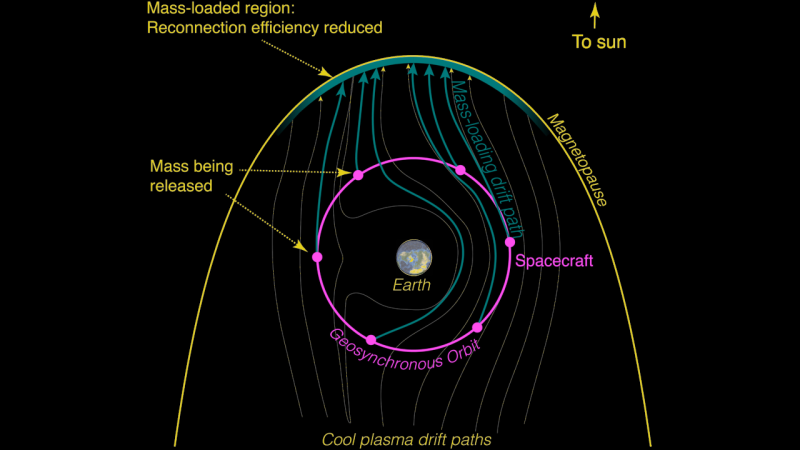
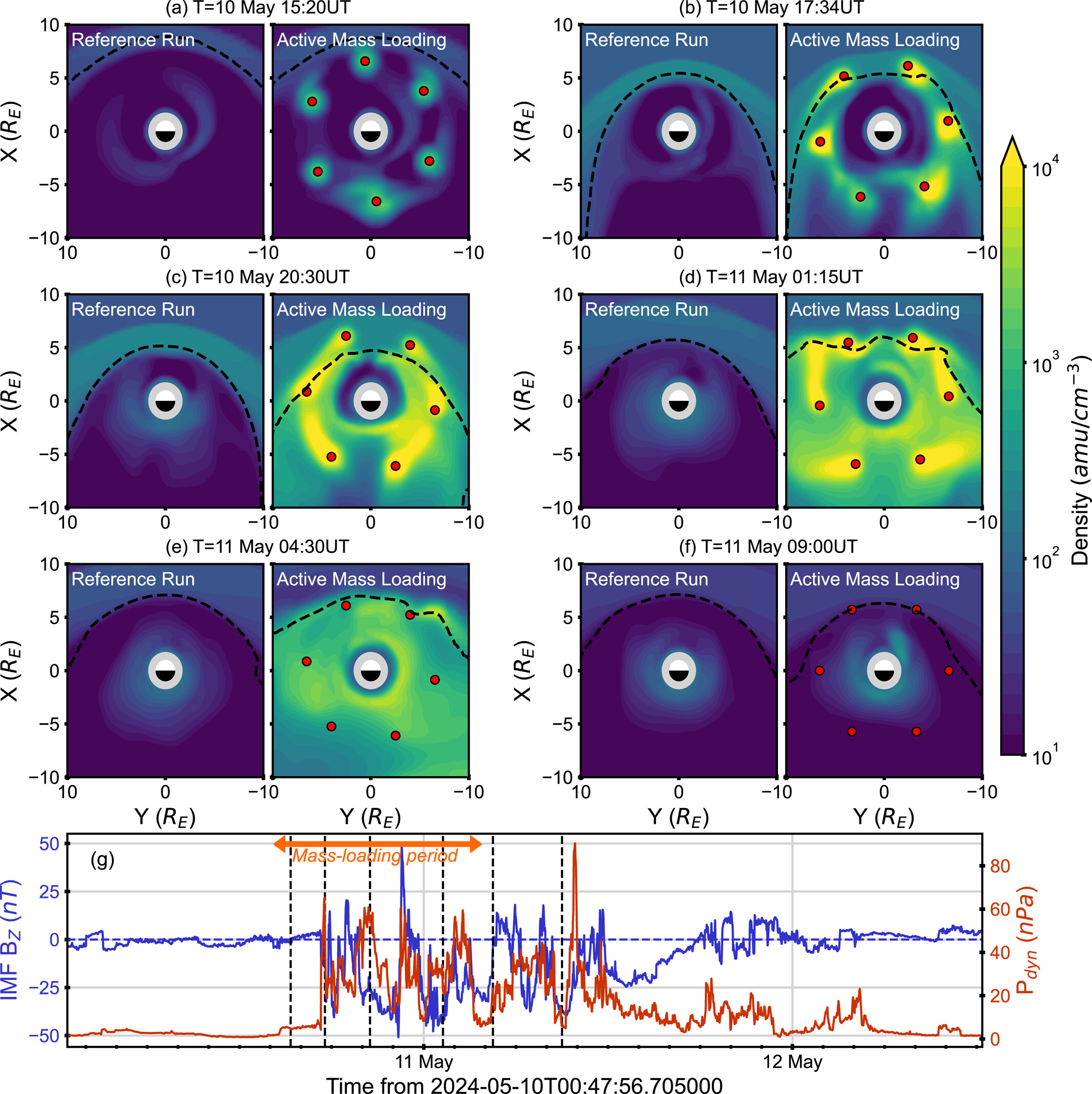
To oversimplify, the proposal is to release lots and lots of neutral gas in Geosynchronous Earth Orbit (GEO), in what the researchers call “artificial mass loading” — the neutral gas would of course be ionized by the storm, but in so doing could absorb up to 50% of the incoming energy of the geomagnetic storm, frustrating its coupling to Earth’s magnetosphere. As a bonus, it would protect not just terrestrial assets like the power grid, but everything in a lower orbit than the mass load: everything from communication satellites in GEO to the International Space Station. Assuming its hasn’t been reduced to debris laying at the bottom of Point Nemo by then, anyway.
In simulations, the StormWall required 384,048 kg of gas, which is not exactly trivial. But even accounting for tanking, the researchers estimate that would only take about six launches of SpaceX’s Starship. Though that does assume its GEO capabilities end up being roughly equivalent to the massive vehicle’s projected 100-tons-to-Mars payload capacity.
It’s certainly an interesting hack to solve a problem that has caused a lot of worry these past decades. If you’re interested in learning more about the record-setting geomagnetic storm, we have a piece about the 1859 Carrington Event that should give you plenty of anxiety about the frailty of our modern infrastructure.












“You’re meddling with powers you can’t possibly comprehend.”
~Marcus Brody
Personally, I instantly thought of Fantastic Four. But I like the way your mind went as well.
Would this mean that it will cancel most of the northern lights?
It is hoped it will cancel the equatorial lights in the case of a big storm. And only for the few hours the gas will hang around.
If it’s only going to absorb half the storm energy there’s still going to be a nice northern (and southern) light show.
So…….
How do you plan on stopping that CME, that hot plasma that arrives a day and a half behind the big radiation burst?
These forces of nature are tens of orders of magnitude beyond anything we can deal with.
/See Space Elevators and wireless power transfer for more bad ideas.
Skepticism is healthy.
Preconceptions are normal.
Blurting objections while obviously having not read the paper, well, that just marks you.
Uh…. the solar storms observed at Earth are the CME arriving. That’s literally what they’re simulating. The Carrington event was a CME so energetic it took less than a day to arrive.
The reason the geomagnetic field is so affected is because it’s being heavily loaded with charged particles, causing the magnetic field to reconnect all over the place. Loading it with neutral particles suppresses that.
Sigh, loading it with heavier, not neutral.
Try again…..
This idea won’t work.
Sorry to burst your bubble…
Space Elevators all over again.
How about we build a walking path to the Moon?
“This idea won’t work”
Won’t work technically? As in if we get the metal there it won’t provide any protection from a solar event?
Won’t work politically? We’re unable to fund it?
Won’t work for some other reason?
You are going to keep this gas cloud in position against the force of X-45 flare?
How?
Is this an idea or a fever dream.
You’re not keeping it in place. It’s a one time shield. You release it, it gets ionized rapidly, and temporarily creates a heavier plasma (it’s a barium gas) on the Earth-side of the magnetosheath and prevents effective magnetic reconnection.
It’s not hard theory, it’s just the practicality of a few hundred metric tons of barium gas in orbit.
It feels like a plasma wave front particle accelerator to me, potential backfire spectacularly.
Maybe a superconducting distributed artificial magnetosphere spread across a mesh of satellites night be an interesting way to go, maybe poised between a Sun and Mars, perhaps we could thicken to the atmosphere a little.
Frankly the way things are going, humanity could do with another Carrington event.
You’d think rather find a way to use that energy to store in a capacitor or battery
If all it takes is wire and solar panels, how more efficient do they get during a solar storm
The way things go, we’d prepare for a Carrington event and end up getting a Miyake event.
TIL about Miyake. Thanks. Little nuggets like this are what makes all the chaff here worth going through.
Colombia 🇨🇴?
I’m reminded of this, https://hackaday.com/2016/02/09/vhs-tape-plasma-mirror-drives-tiny-particle-accelerator/
Makes me wonder about propogation…might as well just take it easy that day.
If one of the launches fails and lands in the water I expect the fire resulting from dumping that several ton chunk of sodium into the water would be entertaining to say the least.
The backup plan is to call the resulting sodium hydroxide rain an acid rain mitigation project. :-)
So is this a permanent structure which has to be produced (and routinely topped up with extra ions), or is this something which can be arranged (with sufficient launch capacity) as a one-off at a few days notice when a CME is seen leaving the sun?
I get the impression we’re looking at prepositioning the satellites that hold the alkali metal gas, and releasing it only when needed. As ambitious as SpaceX often is, I think even they’d balk if we asked them if they could do six Starship launches to GEO in one day with such short notice.
That’s what the paper figures, but it actually wouldn’t really have to be there constantly. You could launch a set for each solar cycle, for instance. You’re not going to have a major flare during solar min.
Which solution would be more economically viable?
1) Deploy and maintain a fleet of satellites beyond GEO to spray a cloud of metal on demand.
2) Build more robust terrestrial infrastructure that is immune to disruption from external EMF.
3) Let the sun free us from this grim prison of our own making
Hare Rama. Lot of inspiration between the chaff;)
My gut says 1 is likely more viable. However I need to do more reading on exactly how the solar storm affects things to be more sure.
Either way the power grid is likely far far larger of an endeavor compared to a few satellites.
Yeah, if people think a few hundred metric tons is a lot, the power grid makes that look like peanuts.
This document from FERC does a good job: https://www.ferc.gov/sites/default/files/2020-05/ferc_meta-r-319.pdf
How many cans of beans to send in space?
Wouldn’t the chance that solar particles hot an atom be mucht too small if only this small amount of matter would be spread in such a huge ‘globe/ball’? Who can do the calculations, I am interested?
‘hit an atom’