
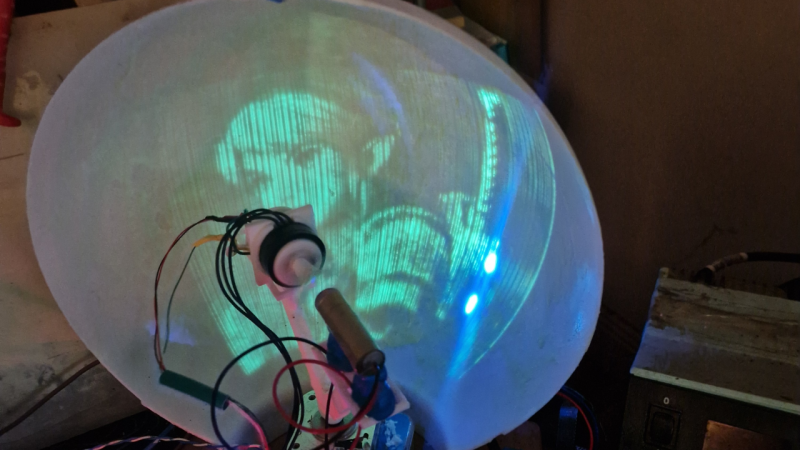
Slow-scan CRTs were never exactly common compared to their faster cousins, but given the popularity of Slow Scan TV (SSTV) amongst hams and NASA broadcasts, many of you are probably familiar with them. The slow scan rate of SSTV meant it required much less bandwidth, but in the early days you needed a CRT with a long-persistence phosphor to hold onto the image. [AJRussell]’s Glow Engine works much the same, with one key difference — instead of cathode rays, he’s using a frikkin laser beam.
In this case, the phosphor is Strontium Aluminate, the same stuff that gives most glow-in-the-dark toys and filament its kick. Energized by a 405 nm laser of questionable wattage, the phosphor will glow for several seconds, allowing the creation of an image. So while this is a laser projector, it works more like a CRT than most galvo projectors, which rely on Persistence of Vision to create an image. Here it’s persistence of fluorescence.
Because the phosphor is so slow, you don’t need the rapid scan rate you would with a laser projector, so [AJRussel] can skip the mirror drum and just mount the mirror on a gimbal motor. Field Oriented Control makes the precise sweeping of the gimbal possible, via a hall-effect sensor and the SimpleFOC library that we featured last year. The other axis just moves the laser and gimbal assembly on a big stepper. The whole thing is driven via an ESP32. The biggest downside is that the short focus range of the repurposed engraving laser means it’s smack dab in front of the screen.
This is a work in progress and still changing, so it’s not clear which — if any — of the various SSTV modes the Glow Engine can handle. Given the number of scanlines in the photos it looks like a good use case, and without trying it the timing might work, too: [AJ] reports scanning left-to-right to generate a frame takes about eight seconds, depending on the resolution, and depending on the PWM power setting on the laser the image can last up to a minute.
Given the one-minute decay time with this particular phosphor, perhaps he can make a clock. If you have a longer-lasting glow powder, we’ve seen uses for such a persistent display as well.













Frosted Glass and put the rig behind the glass?
Curved bubbles of frosted glass?
Think about it. Back lit images.
Hi Alan,
The rig behind glass or completely inside a plastic globe is the eventual plan.
If you examine the above image you will notice that is a half plastic globe from a big outdoor light.
I still have work to do, but have had good results so far getting an image showing through the coating.
Ill update the project with more details soon.
Regards
I can’t remember which glow in the dark material it was, but red lasers on a glowing surface stops the glowing. My guess is it enough energy to get the phosphor over the photon releasing threshold but not enough to charge it.
Big surprise to me because I was expecting the opposite effect. I never got around to showing it to an actual physicist.
So-called ‘quenching’. I’ve tried replicating that with glow-in-the-dark paint and a red laser, but no luck. Wrong material, wrong red wavelength, not enough power, I don’t know.
But there are also materials that behave the opposite: photostimulable phosphors
Charge ’em up all you want with bright light, but they don’t glow. Then you hit them with a red or near infra-red photons and they release that stored energy as blue photons, confounding anybody who has been taught that fluorescence can only produce light with longer wavelengths.
The jig is up, of course, when you’e used up all that stored energy and the trick doesn’t work again until you charge up the phosphor.
You could buy this stuff at Radio Shack: Charge it up a little plastic card under a fluorescent lamp, and you could use it to see the beam from a remote control.
Also used in so-called “computed radiography” in the place of film: Make an x-ray exposure on it, storing that exposure energy, then read it out by scanning a HeNe laser raster over it and measuring the blue photons with a photomultiplier tube. The phosphor stuff used for this application was europium-doped barium fluorohalides. The high-Z barium gave it the x-ray stopping power to make it a sensitive x-ray detector.
Cool
For what it’s worth, the laser was a keychain laser from the dollar store, and the glow in the dark tape was stuff the photo supply store sold to mark cabinet corners and the floor in the darkroom so you didn’t bash your face on the cabinet or get lost.
Might have been this?
https://www.bhphotovideo.com/c/product/271590-REG/Delta_30110_Photoluminescent_Glow_in_the.html
FWIW… I recently picked up some vinyl glow-in-the-dark tape (chemistry unknown.) Quenching has always been facsinating to me, and in this case I could readily observe that playing a red laser dot on the tape (after having first”charged” it with a UV Led) resulted in a dark dot where tge laser dot had been.
The brightest glowing and fastest charging plastic sheet I managed to find was one from a toy called “glow art studio” produced by Crayola. The other good source was the sheet of Glow iron on film for vinyl cutters, it seems to stay charged quite a long time. A camera flash is probably the fastest way to charge the sheets, although I like to use those UV torches that are sold for finding pet urine strains, they are usually pretty bright and don’t have the warm up time of a money scanner. Pretty good for finding charity shop uranium glass too.
Ok, Perhaps… Inflate a large balloon around the rig…. Choose a good coloured one….
Might work real trick for a sort of HOLOGRAPH imagery idea..
Next to use a red laser to erase the image or part of the image and introduce animation.
“many of you” — Sir, we’re on Back day, it’s “MOST of you”.