
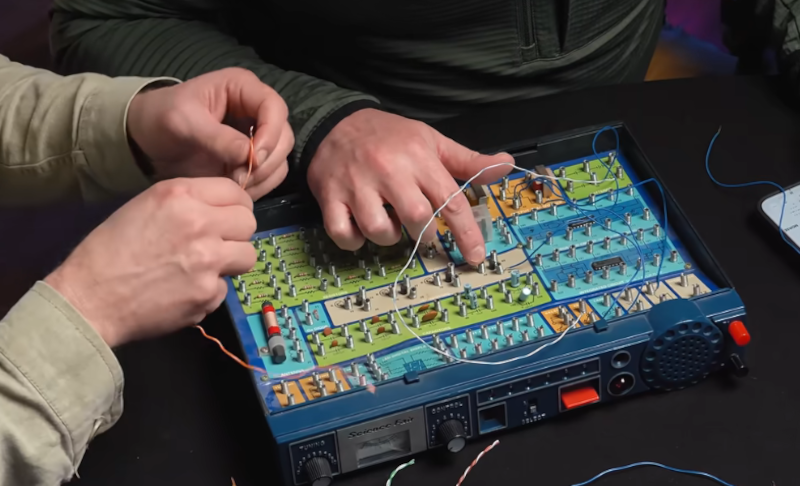
[The Modern Rogue] found an old childhood friend in a closet: a Radio Shack 200-in-1 electronic kit. Along with [Josh Nass], he put it through its paces and made a few repairs along the way. As you might expect, the batteries had long ago leaked out their magic juice.
If you missed these, they were a host of real electronic components with springs connected to the leads. To make a circuit, you bend the spring over, insert a wire, and let go of the spring. By changing the wiring, you could make radios, alarms, computer circuits, and more
There were dozens of these kits, some more capable than others. This was a particularly nice one with a loaded front panel and several exotic components. In the end, they made a code practice oscillator, and it worked.
While you can’t find kits exactly like these anymore, you can make your own. Or try Snap Circuits and print your own modules. You take solderless breadboards for granted today, but they haven’t always been around or affordable.









I wore mine out! Loved those things.
One of these got me started! Had so much fun. I still have it though not this delux model but a simpler set but gave me endless hours of fun. Then I moved on to descreet components and etched PCBs. Alas, today little time to tinker. Would always get stuck by a couple of components I couldn’t buy locally. No internet thise days!
Had a nice big red manual if memory serves.
We had a similar thing in GDR. Man I wish the 80s were back 🤤 It was the perfect time.
Yep, I had the exact kit as well. Very red. Huge book, large enough that it had to curl around the kit in the box.
I loved this, lot of fun :)
Manuals and part lists of many kits can be found here: https://www.zpag.net/Electroniques/Kit/Electronic_Kit.htm
Oh, how I miss my 70’s-era 10-in-1 and ultimately 100-in-1! Dear nostalgia, dear.
I remember you could make a transmitter of some sort? As an 8-year-old I figured out how to wire my turntable up to it and had my very own radio station, which only me and my sister could hear. We played the second side of Deep Purple’s Machine Head a lot 😜
I’m not sure if they’re still being produced new but at least the Elenco 100-1 kits are still widely available online for 20-30 USD.
Now you got me remembering, built an FM transmitter with a microphone that I used to disturb a sunbathing girl listening to the radio by the condo pool. Was a young kid, never had so much fun as watching her fiddle with the radio for me only to tune in again at a new frequency and continue irritating her with all kinds of unpleasantries!
Also built a UHF audio transmitter that would interfere with the neighbor’s TV set. Being an old lady and nearly deaf she would fall asleep at the TV at full volume . Here in Italy apartment walls have no sound insulation so you could even hear the ticking clock on the wall next door. So I would turn on my transmitter and tune it to her channel and broadcast silence until the following morning!
I had one of these, and burnt out the LEDs not understanding that I needed to put a resistor in line with them, not just hook them straight up to the batteries. Built most of the circuits in the book before that though. Loved that thing.
Snap Circuits has destroyed the market. It’s total rubbish compared to the vintage X-in-1 thing and the manual doesn’t really explain anything about electronics.
Rich kids got the Radio Shack 200-in-1 or even the 150-in-1.
I got the 100-in-1 and it was so much fun. Still have it. Changed my life towards electronics. I was way too young for it. Imagine one transistor as an wireless burglar alarm, AM transmitter. Smart circuits.
100-in-1 released 1972 $22 or $175 in today’s dollars. It has an “IC” a thick-film made in Japan with a transistor and resistors on it.
150-in-1 1978 $29.95 or $153 in today’s dollars.
75-in-1 1978 $22.95 or $113 in today’s dollars.
So these were expensive in the day.
source: https://www.radioshackcatalogs.com
I still have mine from the 80s and early 90s. Those were fun to try and invent new design.
I got a 50-in-1 kit for Christmas, one year. Built all 50 projects.
Lovely toys those. swap in a different component value and watch how things behave. shifting wires grade hardware hacking all easily accessible.
those kits inspired spring terminals on the big multi-tap transformer i kept on my teenage years scrap bench, and on several other components that got used a lot. crossovers and rectifiers and the serial terminal breakout board etc.
actual connectors cost money and it wasnt like i was building anything that was supposed to last. Tho the truck horn alarm clock stayed in service for at least 2 years.
Tried to get these kits (plus the Mims project books) when my own kids got to a reasonable age. Took awhile and some $$$ to find good examples of each.
I had the 200-in-1 kit when I was 9, and it was my introduction to lifetime electronic design. The only component I damaged was the LEDs (accidently ran 3.0v through them).
When my son was only a few years old I saw the same kit on being sold online for about $100, and immediately bought it. When it arrived I put it on a shelf to keep it safe. When he was old enough to read the manual I got it down and let him start using it. A few days later he burned out the LEDs.
I had the RADIONICS kit in the UK (they were based in Bristol before they got taken over by Philips Electronics). It consisted of a PCB as the base board and all the components were on carriers that could be bolted to the circuit board. You can still find them on eb*y and are a full intro to electronics and radio.
I had one of the Philips EE kits, didnt know it was originally radionics but I found this https://ee.old.no/radionic/ mine was newer it didnt have the radionics reference on the box and it was orange as I remember.
The main Phillips kit was the X40 and there was an add on audio amplifier called the X40A. I had both.
I similar one as a kid, and eventually run out of ideas to try – in addition to what the booklet offered.
I also remember adding other components on my own if/when I needed them, and some of these circuits even worked, though, the choice of add-ons was limited, so at some point the kit was donated to someone else’s kid.
Something like decade ago I chanced to get a nice, and barely used Matronix/Maxitronics 300-in-1 kit with the breadboard in the middle – Radio Shack had exact same competing board. Breadboard means expandability, and that’s what was missing in my original kit, a breadboard.
Like many 70’s and 80’s kids, this was how I got my start. It lead to a career in engineering and a life more amazing than I could have ever imagined.
I still have my 150-in-One kit. I should pull it out and see what still works. Fun memories.
I would love to see a new version of this. I think with some modern technology like a companion application and QR codes to link to descriptions of functions and devices, it’d be really cool to go through to build and share projects as a starter educational system.
Hell, something like this that’s more adult that can be useful for testing different kinds of microcontroller boards that teach you how arduino-like systems work and teaches you troubleshooting would be sick.
Retail. Retail is important. And I know there are kits with sensors built in for demos of arduino-likes but they’re all kit systems, not low-level erector sets like these are.
I had one from Lafayette Radio Electronics, in the mid-late sixties. It was a lot of fun for this kid.
I am probably a bit older than you. My kit was only a 50 in 1, but I spent many hours building the projects.
I had a Heathkit same printable, built most inc am transmitter used to broadcast around my school…