
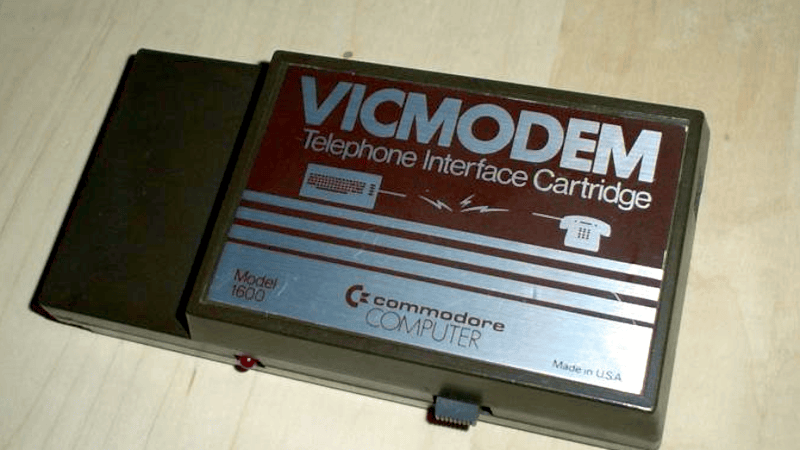
[Dave Farquhar] takes a walk down memory lane about the Commodore 1600 VICModem, perhaps the first phone modem to sell for less than $100. Commodore, of course, was famous for making cheaper computers like the VIC20, the Commodore 64, and lower-cost peripherals like disk drives. But how did they hit the $100 price point with the modem when competing 300 baud modems sold for at least twice that, and a 1200 baud unit would set you back at least $600?
First, Commodore didn’t handle the design themselves. Instead, they outsourced to Anchor Automation, a well-known modem manufacturer. It used a Motorola MC14412 modem on a chip, along with six other chips. The chip could, in theory, do 600 baud, but the modem was rated for 300. But it did make some interesting design choices.
Old-school modems were not allowed to connect to the phone lines directly, so you dialed the phone number and then shoved the handset into some padded cups known as an acoustic coupler that placed a microphone next to the phone speaker and a speaker next to the phone microphone. Modern modems didn’t have this problem (thanks, in part, to Tom Carter), and the VICModem also connected directly. But to save money, it couldn’t dial the phone for you. The idea was you’d dial the phone like you would with an old acoustic modem and then pull the handset cord and plug it into the modem yourself.
There was a problem. In those days, old phones didn’t always have a plug on the handset. Ironically, according to [Dave], the company bought phones to bundle with the modem in Canada only to find out the phones they bought had hard-wired handsets and were not usable. Not only that, if the phones had been the right kind, they would have been illegal in Canada at that time since the phone rules prohibited modular jacks for the handset.
To fix the problem, they also bundled the VIC-1605, which was essentially a Y cable for the phone. You plugged it into the wall, and then plugged the phone into an RJ-11 and the modem into an RJ-9.
There were other cost savings, too. There was a switch that determined if you were originating a call or receiving one, for example. A great example of how to design something as cheaply as possible, other than the faux pas with the phone connectors.
These days, it is hard to find a modem, but even if you do remember them fondly, it is surprising how old they really are and how little you needed to make a low-rate acoustic modem.












My first modem was a 300 baud acoustic coupler type. And yes, I had to dial the rotary phone by hand to make a connection. Coincidentally, I just bought a Commodore 1200 baud modem for my C64 at a swap meet. No land line in the house, just wanted it for nostalgia.
Hi, you can buy an old PBX from second hand create a small in-house landline.
Or use an old internet router with VOIP feature and two or more RJ11 ports..
It would allow you to play modem games easily or call a phone in another room.
Using the DreamPi project you can even have an internet access (your own ISP) for your private landline.
It’s not a requirement to have this, of course. But “nice to have”. For old game consoles, for examples. :)
Another idea for using a modem is to call computer mailboxes (BBSes).
Some are still available via telephone line (VOIP) and some use PETSCII characters.
By using a C64/128, a terminal program and a modem they can still be visited.
Yes, I know, there are also internet solutions.. But it’s still cool to be able to call them the oldschool way.
I picked up a Commodore 1670 modem at VCF Midwest and turned it into a Zimodem, without disabling the analog phone capabilities or making any external changes.
There were very few modifications required – mostly just lifting the 5V connector terminal and wiring it into a jumper to switch between analog and Zimodem modes, wiring the ESP8266 GPIOs into the connector, repurposing the answer/dial switch into a reset for the ESP, and shining some LEDs out the RJ12 connectors for status.
It was a very quick and fun modification!
I remember in the UK you weren’t allow to plug your own phone in. If you bought a new phone, you had to call up British Telecom to come over (some time the next few months) to plug in your new phone.
300 Baud was a bit before my time (poor pun intended).
I was more familiar with 1200 Baud and up and data/fax modems..
From what I’ve read, 300 Baud was the techological level of 1964 and common until up to the late 80s.
Why did it last for 25 years?
I mean, even Packet Radio on VHF started out with 1200 Baud.
On PR, 300 Baud was only used at.. shortwave.
Was phone line quality that bad that 300 Baud was the limit for so long?
It wasn’t a telephone line quality issue. 1200 bits/s modems were available in 1973, but retail customers stuck to 300-baud modems until the late 80’s for the usual reasons: demand, availability, and cost.
Oh, I see. What about the mailbox scene, did it adopt 1200 or 2400 Baud early on ?
I’m wondering because I’m more familiar with how it was in the 1990s on PC,
when there was ANSI art and some experimental things.
Back then, they had multiple logon ports to call, each with a slightly different number.
Some had an ISDN port, even, I vaguely remember.
The slowest speed I knew/encountered was 1200/75 Baud (V.23) needed to call BTX, our former national online service (part of Videotex family).
It’s official modem, DBT-03, was made in 1983 or something and was hard-coded to that connection speed.
The Commodore BBS scene is something that I had missed out on.
Must have been fun with, I imagine. With PETSCII art, pre-ANSI.
There also was that online service, Quantum Link.
It’s been revived by enthusiasts, I vaguely remember.
Like others, I had a 300 baud Omnitec 701B acoustic coupler in the early 70s, paired with a Teletype (so, 110 baud). I used it through grad school, when I upgraded to a DEC VT-05 and was finally able to use the 300 baud capability. 1200 baud didn’t happen for me until the mid-80s, when prices on full-duplex 212 modems dropped to a reasonable (for me) level. The one I bought was big and grey, about the size of a couple of large laptops, stacked. You’d dial the number yourself, and when the far end answered, you had to push a button on the back of the modem and hang up.
Greetings from Germany! :D
Just today I’ve installed an PCMCIA Xircom ethernet/modem combo card
in a venerable Windows 98 laptop from then 90s and installed the drivers and a fax software.
In order to send a fax to an agency who had a poor (modern) fax system that wasn’t compatible with a classic fax machine.
The problem was, I think, that my fax machine wasn’t using class 3 fax standard yet.
I did my first BBS’ing on a vicmodem. Fortunately or me, someone in my house owned a Kermit the Frog phone that had come out the previous year. It featured the host of the Muppet Show reclining jauntily in a chair, and the headset hung from his foot and outstretched hand. That headset was, thank god, modular.
I spent many evenings trying to dial into various single-line BBS’s in Houston by hand. It boggles me a bit how many different phone numbers I just memorized. The modem was slower than my school-age reading speed, but it was still an amazing alternate world to be a part of.
Getting the Vicmodem for my VIC-20 was a glorious day for a kid in a small town in Kansas…. right up until I got the long distance phone bill for calling Compuserve for a couple of hours. :)
^This^ My dad hit the roof when our phone bill was $80 higher than usual (about $260 in today’s $). Took me quite a while to work that off as a 13 year old.
Yep. I was in meteorology school trying to download weather data at a time where I lived in a “rural” trailer court where just about everything useful was a long-distance call. Thankfully there was 1 local BBS with a decent relay to a university Gopher service.
Got this modem for my VIC20, read the manual and it said to notify your local telecom. So called the operator to let them know I was operating a modem on the line and they had no clue what I as doing. Supposedly the reasoning was the noise on the line might be perceived as trouble on the line and cause a dispatch? Worked fine but I had to get an Atari acoustic couple modem so I could be more like War Games.
Early 300, 600, 1200 baud modems in 1982 were not THAT expensive, not even close. I bought a Hayes Smartmodem when they first came out in 1981 and it was $99.
My first modem however was a 50 baud acoustic coupler on the one side of my teletype, opposite of the paper tape reader/punch on the other side.
We did a small hack to the VICModem, as mentioned it was artificially locked to 300 baud, but could be nodded to go to 450 baud — a 50% speed boost!
I had a VolksModem VM1 (300 baud). Bought it around ’83 for $40. I barely remember something weird about the serial pin-out, but, got it to work OK with my Apple ][e.