Weaponized Quadrotor Upgrades

Today we’re looking at a few fun hacks, although they are perhaps a bit ill-advised. What’s the craziest thing you could strap to a quadrotor? Rockets? Lasers? Turns out… they’ve both been done already.

First up is [Ramicaza’s] firework launching quadrotor. The drone is stabilized using the ArduPilot Mega 2.6, and it carries a pair of “rockets” which are ignited by a pair of steel elements. An ATtiny analyzes the auxiliary radio channel’s PWM signal which controls the relays that power the elements. He’s tested it high up in the sky, so he’s actually being pretty safe about it.

Next is [JLaservideo’s] laser quadrotor. He’s taken a RC controller of a cheap toy to add wireless capabilities to his Arduino Uno. He’s re-routed the original RC toy’s motor wires to an input on the Arduino which in turn activates a 5V relay that powers the 1W laser. It looks awesome thanks to the bright beam — we just really hope he’s wearing proper eye protection, as a laser of that power can do some serious damage to your retinas!

Stick around after the break to see both quadrotors in action!

Continue reading “Weaponized Quadrotor Upgrades”

Musician On A Budget MIDI Bass Pedals

bass_pedal1

Organ pedal boards have been around forever — they’re an easy way to multitask while playing the piano, organ, or even the guitar. [Ville] plays the electric guitar and wanted to give bass pedals a shot — the only problem is, the commercial versions are pretty pricey. So he decided to make his own temporary solution using an old MIDI keyboard he had lying around.

The beauty of this hack is it’s completely non-destructive — although you might find you like it so much you won’t want to take it apart! [Ville] started by marking out spacer keys using green cardboard. He then grouped together other sets of keys using tape and polystyrene sheets, which he recycled from a plastic waste bin. He then marked off each set of keys with the range of notes to program into the MIDI receiver — on a 49 key keyboard you get just a bit more than an octave of bass pedal keys! It’ll certainly do until you get your hands on a proper organ pedal unit.

From there it was just a matter of re-mapping the keys on the software end of things, and disabling the other unused keys. He offers a few different methods of doing this, including using VST plugins, and Pure Data — to which he’s provided a patch he made to simplify the process.

To see it in action, stick around after the break and hear [Ville] play One Hour Backwards on electric guitar.

Continue reading “Musician On A Budget MIDI Bass Pedals”

Decascrap: A Three Servo Decapod

IMG_2718

[Drewtoby] loves making robots. His latest project is a 10-legged bot called the Decascrap, which makes use of only 3 servos!

What we like most about this project is the leg mechanism [Drew] has cooked up. The legs are made of guitar picks hinged to what look like popsicle sticks. Each guitar pick has a hole punched in it which allows the servo rod to go through the legs. Strategically placed globs of hot glue on either side of each leg on the servo rod allows for the parallel motion during the actuation of the legs. A third servo tilts the bot back and forth as the legs are moved, allowing the bot to scuttle about.

Stick around after the break to see it tackle some rough terrain — well, actually it’s just a piece of uneven foam, but hey!

Continue reading “Decascrap: A Three Servo Decapod”

Soldering In The Dark — Add Some Light To Your Iron!

iron_01

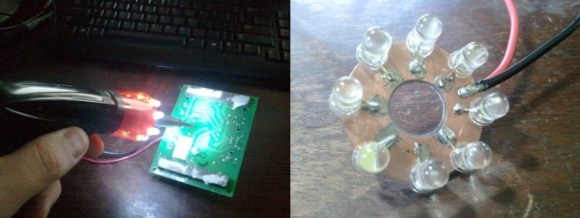
While [William] may not know what he’s doing (his words, not ours!), at least he can SEE what he’s doing now with this awesome soldering iron light modification. And judging by the build quality, we’d reckon he really does know what he’s doing!

He’s taken a piece of copper-clad PCB, and formed it to create a nice circular copper donut. This allows him to make a ring of LEDs in parallel that will slide nicely over the soldering iron and integrate into the plastic case.

To power it, he’s made a small diode bridge to rectify the AC, and a 24 ohm high-wattage resistor run in series with the heating element. The voltage drop across the resistor is 7.5V max, which equates to about 5.3V RMS minus the diode voltage drops. This means the LEDs see about 4.5V at a total of 135mA, which works out to about 17mA each — just under the approved rating. All of this fits nicely into the original casing of the soldering iron.

Finally to finish it off, he’s MacGyver’d an old pill bottle into a protective casing around the LED ring — it looks surprisingly stock on the soldering iron!

Do you have a tool hack that adds handy features? Let us know through the Tips Line!

From A Truck Trailer To A Mobile Workshop

If you’re a seasoned hacker, you might find you need a portable workshop, because every moment away from home you feel a bit naked without access to all your tools and machines. It’s a bit of an older project that we’re quite surprised we never covered, but without further ado let us introduce you to [Steven Roberts’] Polaris Project trailer!

[Steven] is quite the seasoned hacker. In 1983, he took a 17,000 mile journey across America on a technology equipped bicycle — a very impressive feat at the time — seriously you won’t regret watching his video about it.

Anyway, fast forward to 2010, and [Steven] was invited to explain his new project on Make — with detailed build instructions! The 24′ mobile workshop utility trailer features thousands of electronic parts, cabinets filled with both hand and power tools, welders, a CNC router, a 2kW generator, a solar array, AGM battery backups, a ham radio, dedicated computer, soldering equipment, microscopes and more. It is quite literally packed to the gills with an amazing variety of tools.

The picture here doesn’t do it justice, so we recommend you check it out for yourself!

Is anyone planning on making their own mobile workshop? We don’t know about you, but we are now!

[via Toolmonger]

Clever Mini-Matchstick Gun

Looking for a quick fun little project you can do for next to nothing? Why not make your own matchstick/toothpick launcher!

[Grant Thompson] the [King of Random] is at it again with another fun project that anyone can do — we just hope you’re responsible with it! All you need is some clothespins, a utility knife, and some form of munition — we like the flaming matches!

By cutting a few grooves into the clothespin, gluing it back together and re-configuring the spring layout, you can make a formidable mini-gun that can shoot upwards of 20 feet. Using a pointy toothpick it will skewer innocent fruits quite effectively too!

To see it in action and to learn how to make one yourself, stick around after the break.

Continue reading “Clever Mini-Matchstick Gun”

PVC Cryptex Keeps Your Stuff Safe

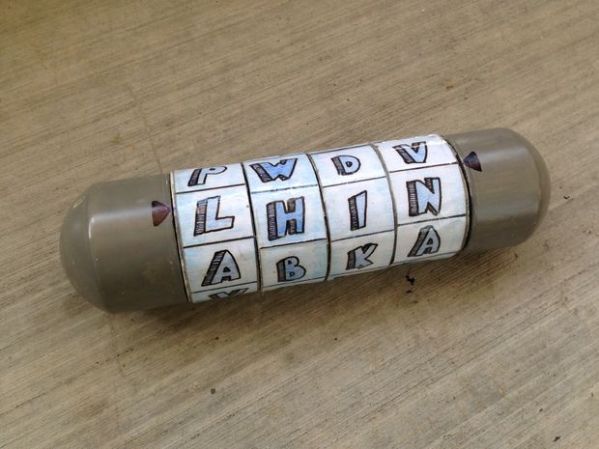
Apparently we’ve never shared a Cryptex before! Made popular (and coined) by the Da Vinci Code, a Cryptex is a combination style lock originally used to store secret messages. You can make your very own using a few pieces of PVC pipe, some epoxy, and nuts and bolts!

Cryptexes have a clever design that cannot really be lock picked, without simply breaking it. In [Dan Brown’s] novel, it was said that some Cryptexes stored a fragile vial of vinegar with the message written on papyrus — that way, if it was forcibly opened the vile would break, dissolving the thin papyrus note.

They work similar to a bicycle’s combination lock, where if the correct password is guessed, the tumblers inside align, allowing the two halves of the cylinder to come apart. It’s actually a very simple design on the inside, and the whole mechanism can easily be made by yourself with minimal tools.

Continue reading “PVC Cryptex Keeps Your Stuff Safe”