Creative Compulsive Disorder: Zina Nicole Lahr

[Zina Nicole Lahr] was an extremely talented artist, designer, puppeteer and maker, with a self-diagnosed condition that she liked to call Creative Compulsive Disorder which she describes as follows:

I suppose you could say I have a self-diagnosed condition called CCD, it’s Creative Compulsive Disorder where I have to make stuff all the time, and with whatever I have around me, so if it’s trash, or junk, or things that people would normally throw away, I try to find new ways to re-fabricate them into something useful and beautiful.

A true hacker at heart. She’s worked on tons of different projects in many different fields, even doing special effects and prop work for a TV show.

Unfortunately it is with great sadness that we share her story, as she recently passed away in a hiking accident.

What we are specifically sharing is a short 5 minute documentary about [Zina] which was made by her close friend [Stormy Pyeatte] a few months earlier for a school project. In this past week [Pyeatte] has re-cut the footage in an attempt to capture her personality, creativity and to celebrate her memory. She succeeded tremendously, our heartstrings cannot lie.

It’s a beautiful video about a beautiful soul. We wish we could have met you [Zina].

Continue reading “Creative Compulsive Disorder: Zina Nicole Lahr”
Ion Wind Propelled Star Trek Enterprise

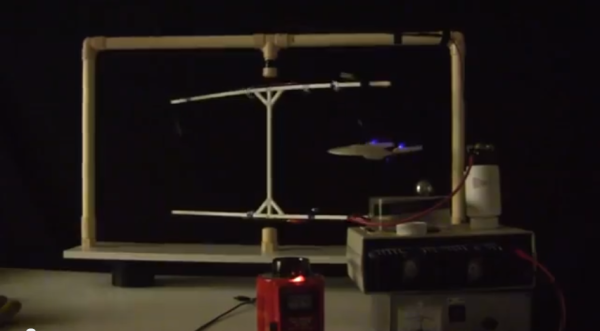
[Steven Dufresne] recently demonstrated ion propulsion using high voltage, and someone pointed out it kind of looked like the warp drives on the Star Trek Enterprise… so he went out and bought a model Enterprise and rebuilt his demonstration!

His original video on Ion Winds gives a good summary of the beginning of his experiments. In fact, it’s actually a recreation of a design he saw at the International Symposium on New Energy back in 1996 of the Electrokinetic Apparatus which was patented in 1960.

By creating a high voltage arc of electricity, it appears that the resulting “ion wind” propels the Enterprise with respect to the fixed testing apparatus. Did we mention he made the high voltage power supply himself?

[Steven] also points out that the propulsion might be occurring due to dielectrophoresis, but hasn’t discovered any conclusive evidence to prove that. Even the patent is rather vague on how this works:

The invention utilizes a heretofore unknown electrokinetic phenomenon which I have discovered; namely, that when a pair of electrodes of appropriate form are held in a certain fixed spaced relation to each other and immersed in a dielectric medium and then oppositely charged to an appropriate degree, a force is produced tending to move the pair of electrodes through the medium.

Regardless of how or why it works, it’s a fun video to watch, so make sure you stick around after the break to see it!

Continue reading “Ion Wind Propelled Star Trek Enterprise”

$50 Backyard Rollercoaster

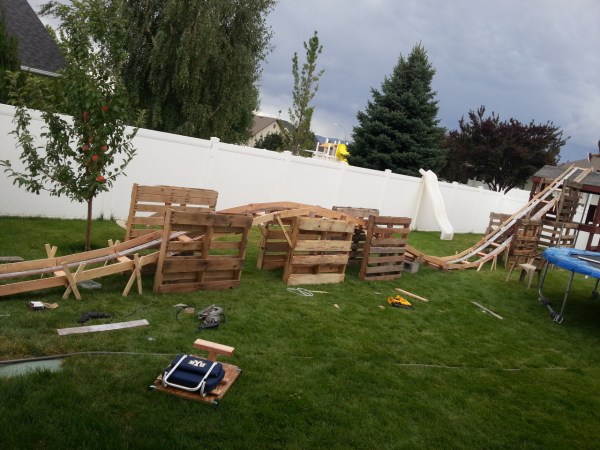
This is great. What happens when you bet a group of friends they can’t build a roller coaster in their backyard for under $50? They build one.

They built it almost entirely out of old forklift pallets, some wood from Home Depot, assorted nails and screws, some caster wheels and a folding seat from an old arena. It was built in just over 9 hours by three people. Once assembled they tested it with a 15lb cinder block — safety first right? The cinder block survived the ride, and by that logic, a 160lb+ person should be fine as well!

Well… they were right! To finish it up and get into the holiday spirit they also decked it out in Christmas lights and let the neighborhood kids use it all night. The total came to $49.27 from Home Depot for the wood and wheels.

Stick around after the break to see a .GIF of it in action!

Continue reading “$50 Backyard Rollercoaster”

Arduino RFID Car Starter

[Pierre] recently bought his first car and decided to make his own RFID electric starter for it!

An Arduino Nano controls two relays which in turn can turn the car on, start it, and turn it off. Instead of adding a button for “push to start” he opted for a 13.56MHz RFID module. Now when he passes his RFID badge across the dash, the car turns on — if it’s held there for over a second, the car starts. Another pass and it will turn off.

His eventual goal is to relocate this circuit closer to the wheel and use an NFC ring to start it! He’s done an amazing job hiding all the components under the trim in his car so far, you can’t tell anything is amiss!  Check out the demonstration in the video after the break.

Continue reading “Arduino RFID Car Starter”

LED Concert Dress

[Geri] has an awesome brother. He made this amazing LED dress for her to wear at the [Taylor Swift] concert last weekend!

As you may or may not know, she encourages her fans to bring “glowy”  things to wave around at her concerts. A quick check of the exhibition arena’s conditions of entry, and it seemed like LEDs would be allowed, so [Patrick] got to work.

He’s using a set of waterproof red LED strips and a cheap controller ordered from China. They needed a rather beefy battery pack so [Patrick] threw together a switchmode buck converter to drop a 19.8V 4.5A/h battery pack to a constant 12V for the LED controller. Not wanting to mess up the red cocktail dress, their mom sewed the strips into place. The dress is super bright and looks great — it draws about 25W, so the battery pack should last for the entire duration of the concert.

Unfortunately about a week before the concert they discovered Vector Arena is not allowing LED lights into the concert, which as you can imagine, was quite heartbreaking.

Thankfully, someone reached out to the organizers and they made an exception for them! [Geri] even ended up on the front page of their local newspaper! Stick around after the break to see a video of the dress in action!

Continue reading “LED Concert Dress”

Super Simple FM Transmitter

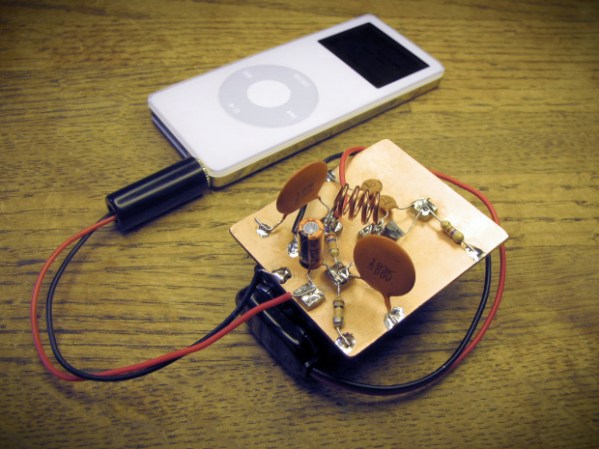
Making your own FM radio is practically a rite of passage for hackers. How about making a small FM transmitter?

Originally designed by the Japanese multimedia artist [Tetsuo Kogawa], this simple FM transmitter can be built with only 10 components and about an hour of your time. The method shown here is one of the easiest to build, and it’s called the Manhattan Style — the same method used when [Bill Meara] built his BITX radio. It’s unique in that instead of using traces it uses one copper PCB which is used for all ground connections, and then small islands of the same PCB glued on top to form nodes for the circuit to connect to. Besides being an extremely easy way to make a PCB without any fancy tools, it also makes you think about circuits in a different light. In fact, it gives “floating ground” a whole new meaning!

While its 10 component count is impressive, it can’t beat this 3 component FM transmitter we shared a year ago! Stick around after the break to see how to make your very own.

Continue reading “Super Simple FM Transmitter”

A Rostock Welding 3D Printer?

Tired of printing in boring old plastic? Why not try metal? Researchers at Michigan Tech have come up with an open source reprap style design of a 3D printer that can print metal for only $1200.

The paper was published in IEEE Access a few weeks ago that it outlines the design and testing of this printer, which is basically an upside down Rostock with a MIG welder used as the extruder. As you can imagine, the quality and resolution of the parts isn’t that amazing (hang around after the break to see an example), but this is an exciting step forward for 3D printing. Equipped with this and a mill and the possibilities are quite endless!

Did we mention how cheap welding wire is? A cost that could add up is the shielding gas though, but as a user on Reddit points out, an upgrade for this machine could be an enclosed build chamber which could then just be flooded with the gas. Alternatively, would flux-core welding wire work?

Continue reading “A Rostock Welding 3D Printer?”