Z80 Gets New OS

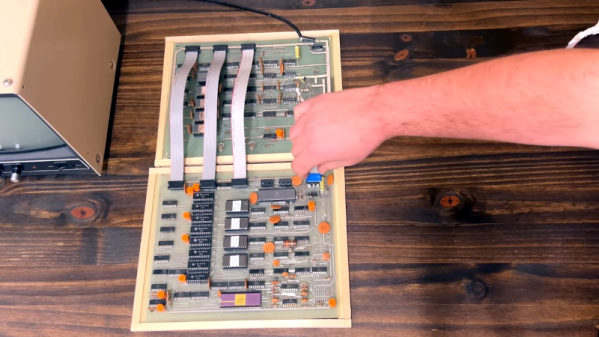
If you have a soft spot for a Z80 computer but want a new operating system experience, try Zeal. You can watch a demo of the open-source OS in the video below.

As you might expect, the whole system is written in Z80 assembly language. The features you expect are there: files, directories, device drivers, a clock, and even memory banking to support up to 16M of memory. The work isn’t totally done, nor is the initial target computer — Zeal — but it looks like a great piece of work so far and will be of interest to anyone who has a Z80.

Continue reading “Z80 Gets New OS”

Cheap Scope Troubleshoots Commodore

[Adrian] had a Commodore computer to fix and decided to see how his latest tiny portable scope would work. He paid $57 for the tiny little test instrument although the current price seems higher. It claims to have 120MHz bandwidth along with 500 megasamples per second. There are several versions with different claimed specs, but we did find a similar device for under $60. You can see the unboxing and how it worked in the video below.

Of course, these kinds of instruments often overstate their specs, and [Adrian] was also suspicious. One odd feature of the device is it can echo its output to an NTSC video output so you can send the screen to an external monitor.

Continue reading “Cheap Scope Troubleshoots Commodore”

Smelting Solar Style

If you attended the 2022 Supercon, you might have heard the story about the SMD soldering challenge table nearly catching on fire. A magnifying lamp caught the sun just right and burned a neat trench into another lamp’s plastic base. While disaster was averted, [Jelle Seegers] does this on purpose using a huge 5-meter lens to smelt metal.

The Design Academy Eindhoven student is participating in Dutch Design Week and built the machine which is able to manually track the sun to maximize the amount of solar energy applied to the metal.

Continue reading “Smelting Solar Style”

Overengineered Fume Extractor, Version 2

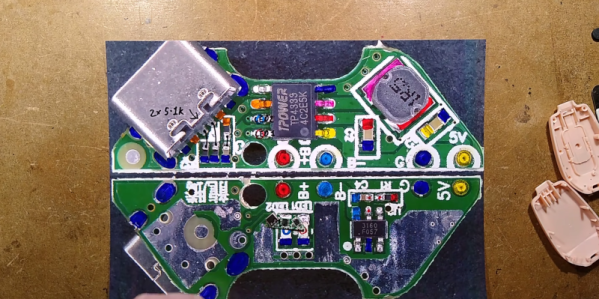
We all know the temptation of adding one more feature to your latest project. [Arnov Sharma] didn’t resist the urge. Building on his 3D-printed fume extractor, he developed a new version made of PCB material.

The device has a 18650 battery and corrects several flaws in the original design we covered earlier. In particular, the new version uses a quiet fan and consumes less power. There is also a 3D-printed filter housing that uses cotton as a filter media. Continue reading “Overengineered Fume Extractor, Version 2”

Conducting Plastic Can Replace Metal

The University of Chicago has announced they have created a material that behaves like plastic but conducts like metal. They also say they don’t fully understand why it works yet. Usually, good conductors like metals have very orderly atomic structures, something that plastics tend not to have.

The material is based on nickel, carbon, and sulfur. The resulting material was conductive and stable. However, the atomic structure isn’t orderly like a traditional conductor.

Continue reading “Conducting Plastic Can Replace Metal”

Nanoassembly With Water

Water is sometimes known as the universal solvent. But researchers at Harvard want to use water to put things together instead of taking them apart. Really small things. In the video below, you can see a simple 3D-printed machine that braids microscopic fibers.

The key appears to be surface tension and capillary action. A capillary machine uses channels that repel floating objects. By moving the channel, materials move to avoid the channel, and by shaping the channel, various manipulations can occur, including braiding. This is one of those things that is easier to understand when you see it, so if it doesn’t make sense, watch the video below. The example uses tiny Kevlar fibers.

Continue reading “Nanoassembly With Water”

3D Printer Tuning: An Engineering Approach

[MirageC] is a bit of a contrarian. Instead of taking pictures of 3D printed objects that show them in their best light, he takes pictures that show them at their worst. The reason? He wanted to figure out why he was seeing a strange artifact in his printer when using a direct extruder. Just at a quick glance, you might think the problem was Z wobble, but, in this case, it was something else. You can see the fine detective work in the video below.

There were a few odd things about the problem. First, it scaled with the part size. Secondly, the problem got better when he switched to a Bowden tube setup. We don’t want to give away the ending, but you can guess from that clue that the problem had something to do with the extrusion system.

The resulting analysis led [MirageC] to work with BMG to create a special gear which — surprisingly, didn’t help as much as he thought it would. However, it did help point the way to the correct solution.

Along the way, you can learn a lot from following along, and maybe you’ll even improve the quality of your prints. We always enjoy these detailed analyses of printer issues, like the ones from [Stefan], for example. If you want to go hardcore engineering on your 3D prints, you can always do finite element analysis on your infill.

Continue reading “3D Printer Tuning: An Engineering Approach”