Zinc Sulfide Glow Power At Home

Further solidifying her mad-scientist persona, [Jeri Ellsworth] is making glow powder with household chemicals. When we saw the title of the video we though it would be fun to try it ourselves, but the first few minutes scared that out of us.

To gather the raw materials she puts some pennies in a bench motor and files them into powder. From there it’s trial and error with different cleaners and tools to create just the right dangerous reaction to get the chemical properties she’s looking for.

Check out her experiments after the break. And if you find you’re wanting more, go back and take a look at her EL wire fabrication process.

Continue reading “Zinc Sulfide Glow Power At Home”

Hackaday Links: August 22, 2010

EL back-lit keyboard

A couple bucks worth of EL wire gives a nice green glow to [Mark Shasha’s] T400 Elite. Hopefully [Jeri Ellsworth] has some time to pull those how-to videos together so that we can make our own EL wire to replicate this hack.

Mini kaboom

This tiny cannon is right out of Night at the Museum. It works just like its much bigger brothers would; fill with powder, insert cannon ball, and light with a fuse. Both the introduction and the follow-up videos document the destruction of various objects using the diminutive weapon. [Thanks Thorsten]

Don’t close that browser
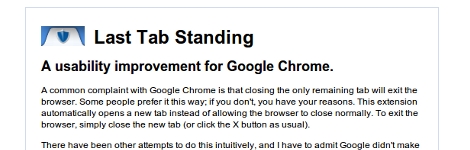
We use Google Chrome quite a bit because it tends to be more responsive when opening massive numbers of tabs while researching featured hacks. But there’s some things we don’t like about it. Lack of built-in PDF support under Ubuntu comes to mind, but a smaller thorn in our side is that closing the last tab will also close the browser window. [Ted Schaefer] got tired of the same thing so he wrote an extension called Last Tab Standing to trap that last browser tab, opening the default window instead of closing the browser.

Amiga demo winner

This 4K demo for the Amiga AGA is the top ranked submission from Breakpoint 2010. [Osgeld] tipped us off about this and made the point that although it’s four times the size of those 1K JavaScript demos, the Amiga code doesn’t get to take advantage a pre-existing framework like Java does enjoy the benefits of running inside of a browser . Is this doing more with less?

Transformers balloon sculptures

If you’re having trouble finding that art piece to fill up your dining room you should consider building transformers out of balloons. The sculpture above is a free-standing Optimus Prime but the artist has also turned out Megatron, Grimlock, and others. [Thanks W01F]

Making EL Wire

[youtube=http://www.youtube.com/watch?v=3RKBGxJJmwg]

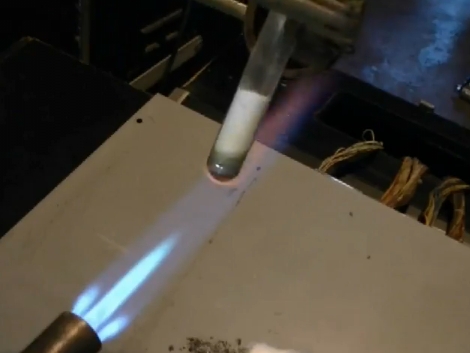
[Jeri Ellsworth] adds electroluminescent wire to the list of things she makes. The materials list is incredibly low. The common components are epoxy coated magnet wire for the center conductor and bare wire for the second conductor. The part you don’t have on hand is phosphors, although she does link to a source.

The bad news: she doesn’t show us the build process or share the details about the inductor that fires this thing up. The good news: in-depth videos are on the way. In the mean time you can marvel in her glowing success at the end of the video, or check out some of her other electroluminescent fun.

Making Nixie Tubes At Home

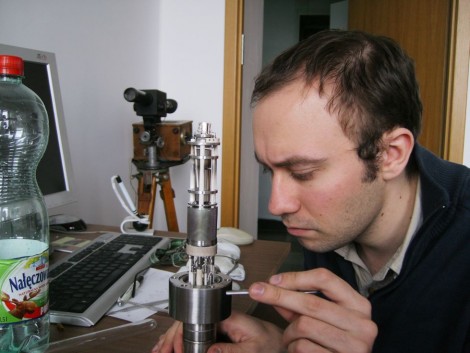
[Aleksander Zawada] makes vacuum tubes in his home. One of the most challenging builds he has taken on is to produce a working Nixie tube. He describes the process in a PDF (Internet Archive, updated 2024), covering his success and failure. It seems the hardest part is to get the tube filled with the proper gas, at the proper pressure, and firmly seal it. In the end he managed to make a tube with three digits (0, 1, and 2) that worked for about 700 hours before burning out.

[Aleksander] joins [Jeri Ellsworth] on the short list of hackers who can pull off extreme industrial manufacturing at home. Kudos.

[Thanks Duncan]

Home DNA Lab Tools

[youtube=http://www.youtube.com/watch?v=zrejvnVfZJE]

[Jeri Ellsworth] stopped by Pearl Biotech’s booth at Maker Faire and took a look at their open source DNA sequencing work. It is by no means a grab-and-go solution for anyone, but from what we’ve seen in the video they’re breaking down those laboratory walls and letting us in to dabble at this work (assuming you’ve got a few hundred bucks to burn). There is a community for info and help that you can check out at BioCurious, and Pearl Biotech has gel box kits available (or the details if you care to source parts yourself), traditionally an extremely expensive part of the process. You’ll still need a centrifuge and a heating/cooling device to separate the strands but as you can see in the video, these can be hacked together rather easily.

We’re glad that [Jeri] shot and posted this clip. She does a great job of explaining projects, whether it’s someone else’s like this or her own, like the transistor fabrication method.

[Thanks Shazzner]

Transistor Fabrication: So Simple A Child Can Do It

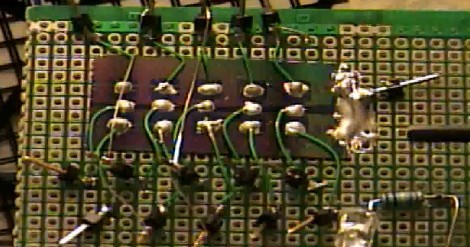
If manufacturing printed circuit boards has become too easy you should try your hand at producing transistors. [Jeri Ellsworth] put together a collection of videos outlining the process. These go way beyond the IC fabrication we saw from her in the past. It doesn’t take much, a 1000 degree oven with steam option, silicone wafers, and a variety of chemicals. We’ve embedded the instructional video as well as two demonstrations of her N-style FET after the break. Continue reading “Transistor Fabrication: So Simple A Child Can Do It”

Bill Paxton Pinball

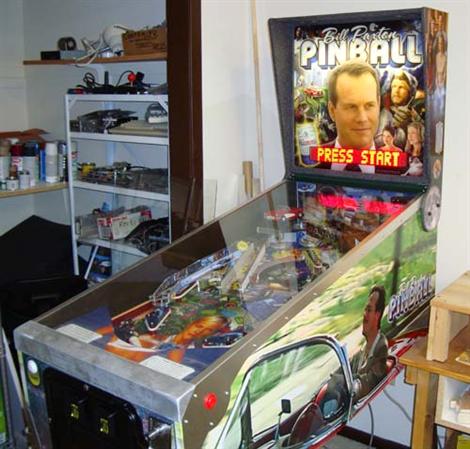
No, your eyes do not deceive you, you are looking at a [Bill Paxton] pinball machine. [Ben Heck], commonly known for his portable gaming system modifications has finally finished his pinball machine build. We’ve had our eye on it ever since [Jeri Ellsworth] challenged him to see who got theirs done first. As you can see, he’s done a fantastic job on the machine itself. He has also documented it fantastically, there’s a build log, a gallery, demonstration videos etc.

[thanks Matt]