A graph of current versus time for circuits with and without inductors

A Deep Dive Into Inductors

[Prof MAD] runs us through The Hidden Power of Inductors — Why Coils Resist Change.

The less often used of the passive components, the humble and mysterious inductor is the subject of this video. The essence of inductance is a conductor’s tendency to resist changes in current. When the current is steady it is invisible, but when current changes an inductor pushes back. The good old waterwheel analogy is given to explain what an inductor’s effect is like.

There are three things to notice about the effect of an inductor: increases in current are delayed, decreases in current are delayed, and when there is no change in current there is no noticeable effect. The inductor doesn’t resist current flow, but it does resist changes in current flow. This resistive effect only occurs when current is changing, and it is known as “inductive reactance”.

After explaining an inductor’s behavior the video digs into how a typical inductor coil actually achieves this. The basic idea is that the inductor stores energy in a magnetic field, and it takes some time to charge up or discharge this field, accounting for the delay in current that is seen.

There’s a warning about high voltages which can be seen when power to an inductor is suddenly cut off. Typically a circuit will include snubber circuits or flyback diodes to help manage such effects which can otherwise damage components or lead to electric shock.

[Prof MAD] spends the rest of the video with some math that explains how voltage across an inductor is proportional to the rate of change of current over time (the first derivative of current against time). The inductance can then be defined as a constant of proportionality (L). This is the voltage that appears across a coil when current changes by 1 ampere per second, opposing the change. The unit is the volt-second-per-ampere (VsA-1) which is known as the Henry, named in honor of the American physicist Joseph Henry.

Inductance can sometimes be put to good use in circuits, but just as often it is unwanted parasitic induction whose effects need to be mitigated, for more info see: Inductance In PCB Layout: The Good, The Bad, And The Fugly.

Continue reading “A Deep Dive Into Inductors”

Tips For Homebrewing Inductors

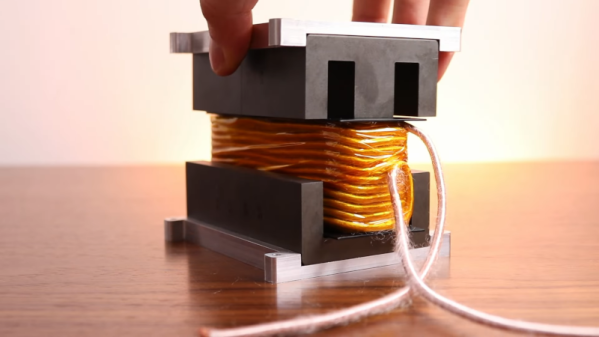
How hard can it be to create your own inductors? Get a wire. Coil it up. Right? Well, the devil is definitely in the details, and [Nick] wants to share his ten tips for building “the perfect” inductor. We don’t know about perfect, but we do think he brings up some very good points. Check out his video below.

If you are winding wire around your finger (or, as it appears in the video, a fork) or you are using a beefy ferrite core, you’ll find something interesting in the video.

Continue reading “Tips For Homebrewing Inductors”

A Number Of Microphones… Er, Inductors, Rather

There’s a famous old story about [Charles Steinmetz] fixing a generator for [Henry Ford]. He charged a lot of money for putting a chalk X in the spot that needed repair. When [Ford] asked for an itemization, the bill read $1 for the chalk, and the balance for knowing where to draw the X. With today’s PCB layout tools, it seems easy to put components down on a board. But, as [Kasyan TV] points out in the video below, you still have to know where to put them.

The subject components are inductors, which are particularly picky about placement, especially if you have multiple inductors. After all, inductors affect one another — that’s how transformers work. So there are definite rules about good and bad ways to put a few inductors on a board.

Continue reading “A Number Of Microphones… Er, Inductors, Rather”

Illustrated scheme of Sam Ben Yaakovs concept

Leakage Control For Coupled Coils

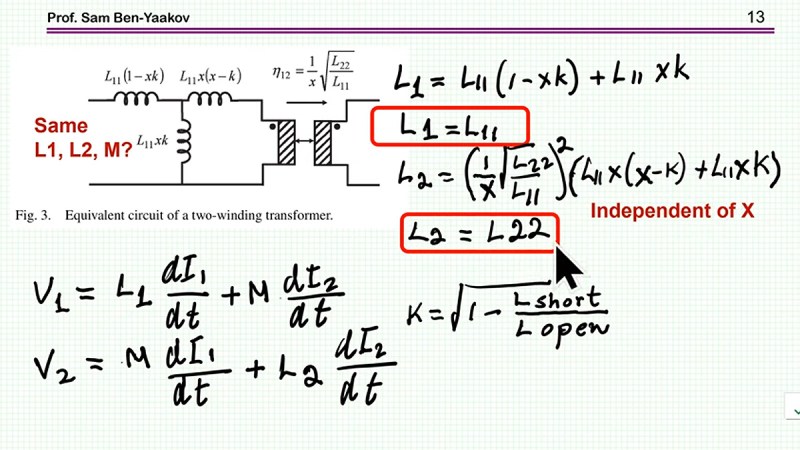
Think of a circuit model that lets you move magnetic leakage around like sliders on a synth, without changing the external behavior of your coupled inductors. [Sam Ben-Yaakov] walks you through just that in his video ‘Versatile Coupled Inductor Circuit Model and Examples of Its Use’.

The core idea is as follows. Coupled inductors can be modeled in dozens of ways, but this one adds a twist: a tunable parameter 𝑥 between k and 1 (where k is the coupling coefficient). This fourth degree of freedom doesn’t change L, L or mutual inductance M (they remain invariant) but it lets you shuffle leakage where you want it, giving practical flexibility in designing or simulating transformers, converters, or filters with asymmetric behavior.

If you need leakage on one side only, set 𝑥=k. Prefer symmetrical split? Set 𝑥=1. It’s like parametric EQ, but magnetic. And: the maths holds up. As [Sam Ben-Yaakov] derives and confirms that for any 𝑥 in the range, external characteristics remain identical.

It’s especially useful when testing edge cases, or explaining inductive quirks that don’t behave quite like ideal transformers should. A good model to stash in your toolbox.

As we’ve seen previously, [Sam Ben-Yaakov] is at home when it comes to concepts that need tinkering, trial and error, and a dash of visuals to convey. Continue reading “Leakage Control For Coupled Coils”

Motorized Coil Tunes Your Ham Antenna On A Budget

When it comes to amateur radio, one size definitely does not fit all. That’s especially true with antennas, which need to be just the right size for the band you’re working, lest Very Bad Things happen to your expensive radio. That presents a problem for the ham who wants the option to work whichever band is active, and doubly so if portable operation is desired.

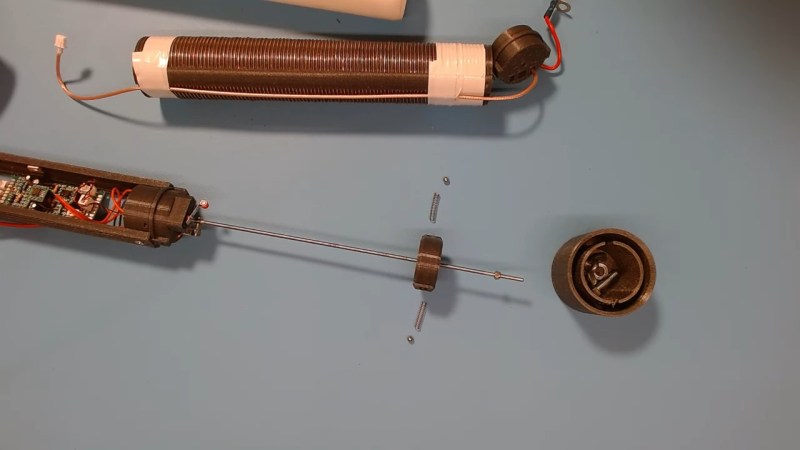
Of course, there are commercial solutions to this problem, but they tend to be expensive. Luckily [Øystein (LB8IJ)] seems to have found a way around that with this low-cost homebrew motorized antenna coil, which is compatible with the Yaesu Automatic Tuning Antenna System. ATAS is supported by several Yaesu transceivers, including the FT-891 which [Øystein] favors for field operations. ATAS sends signals up the feedline to a compatible antenna, which then moves a wiper along a coil to change the electrical length of the antenna, allowing it to resonate on the radio’s current frequency.

The video below details [Øystein]’s implementation of an ATAS-compatible tuning coil, mainly focusing on the mechanical and electrical aspects of the coil itself, which takes up most of the room inside a 50-mm diameter PVC tube. The bore of the air-core coil has a channel that guides a wiper, which moves along the length of the coil thanks to a motor-driven lead screw. [Øystein] put a lot of work into the wiper, to make it both mechanically and electrically robust. He also provides limit switches to make sure the mechanism isn’t over-driven.

There’s not much detail yet on how the control signals are detected, but a future video on that subject is promised. We’re looking forward to that, but in the meantime, the second video below shows [Øystein] using the tuner in the field, with great results.

Continue reading “Motorized Coil Tunes Your Ham Antenna On A Budget”

Fail Of The Week: The SMD Crystal Radio That Wasn’t

The crystal radio is a time-honored build that sadly doesn’t get much traction anymore. Once a rite of passage for electronics hobbyists, the classic coil-on-an-oatmeal-carton and cat’s whisker design just isn’t that easy to pull off anymore, mainly because the BOM isn’t really something that you can just whistle up from DigiKey or Mouser.

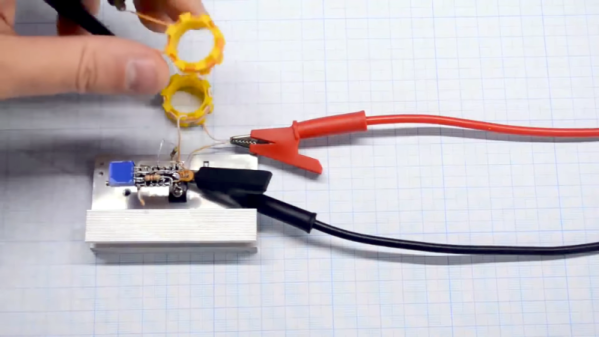
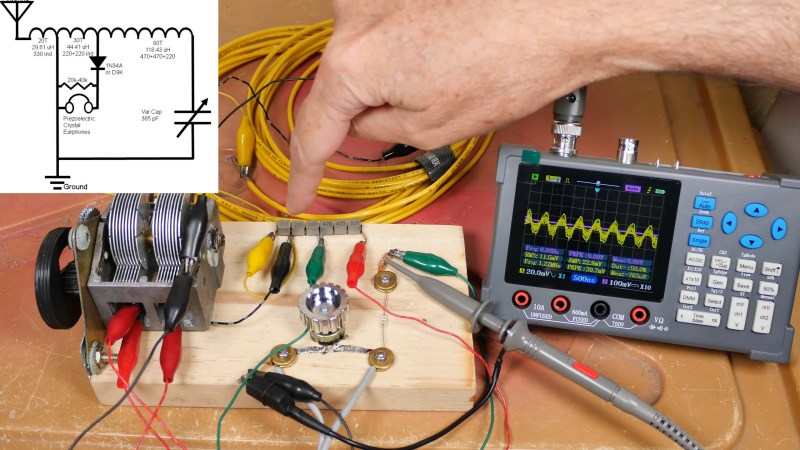
Or is it? To push the crystal radio into the future a bit, [tsbrownie] tried to design a receiver around standard surface-mount inductors, and spoiler alert — it didn’t go so well. His starting point was a design using a hand-wound air-core coil, a germanium diode for a detector, and a variable capacitor that was probably scrapped from an old radio. The coil had three sections, so [tsbrownie] first estimated the inductance of each section and sourced some surface-mount inductors that were as close as possible to their values. This required putting standard value inductors in series and soldering taps into the correct places, but at best the SMD coil was only an approximation of the original air-core coil. Plugging the replacement coil into the crystal radio circuit was unsatisfying, to say the least. Only one AM station was heard, and then only barely. A few tweaks to the SMD coil improved the sensitivity of the receiver a bit, but still only brought in one very local station.

[tsbrownie] chalked up the failure to the lower efficiency of SMD inductors, but we’re not so sure about that. If memory serves, the windings in an SMD inductor are usually wrapped around a core that sits perpendicular to the PCB. If that’s true, then perhaps stacking the inductors rather than connecting them end-to-end would have worked better. We’d try that now if only we had one of those nice old variable caps. Still, hats off to [tsbrownie] for at least giving it a go.

Note: Right after we wrote this, a follow-up video popped up in our feed where [tsbrownie] tried exactly the modification we suggested, and it certainly improves performance, but in a weird way. The video is included below if you want to see the details.

Continue reading “Fail Of The Week: The SMD Crystal Radio That Wasn’t”

A Look Under The Hood Of Intermediate Frequency Transformers

If you’ve been tearing electronic devices apart for long enough, you’ll know that the old gear had just as many mysteries within as the newer stuff. The parts back then were bigger, of course, but often just as inscrutable as the SMD parts that populate boards today. And the one part that always baffled us back in the days of transistor radios and personal cassette players was those little silver boxes with a hole in the top and the colorful plug with an inviting screwdriver slot.

We’re talking about subminiature intermediate-frequency transformers, of course, and while we knew their purpose in general terms back then and never to fiddle with them, we never really bothered to look inside one. This teardown of various IF transformers by [Unrelated Activities] makes up somewhat for that shameful lack of curiosity. The video lacks narration, relying on captions to get the point across that these once-ubiquitous components were a pretty diverse lot despite their outward similarities. Most had a metal shell protecting a form around which one or more coils of fine magnet wire were wrapped. Some had tiny capacitors wired in parallel with one of the coils, too.

Perhaps the most obvious feature of these IF transformers was their tunability, thanks to a ferrite cup or slug around the central core and coils. The threaded slug allowed the inductance of the system to be changed with the turn of a screwdriver, preferably a plastic one. [Unrelated] demonstrates this with a NanoVNA using a nominal 10.7-MHz IFT, probably from an FM receiver. The transformer was tunable over a 4-MHz range.

Sure, IFTs like these are still made, and they’re not that hard to find if you know where to look. But they are certainly less common than they used to be, and seeing what’s under the hood scratches an itch we didn’t even realize we had.

Continue reading “A Look Under The Hood Of Intermediate Frequency Transformers”