Scanner Music

scanjet

Continuing our trend of peripherals modified to perform functions that aren’t actually useful: here’s how to play music on your scanner. The HP ScanJet 3c/4c have a variable speed scan head that is driven by a stepper motor. The Play Tune command can be used to move the head at different frequencies. Here’s a video of a scanner playing F?Elise. The site we’re linking to has the source code to do this, but newer HP scanners may have hardware activation built-in, according to these two Easter eggs.

Continue reading “Scanner Music”

Optical Mouse Based Scanner

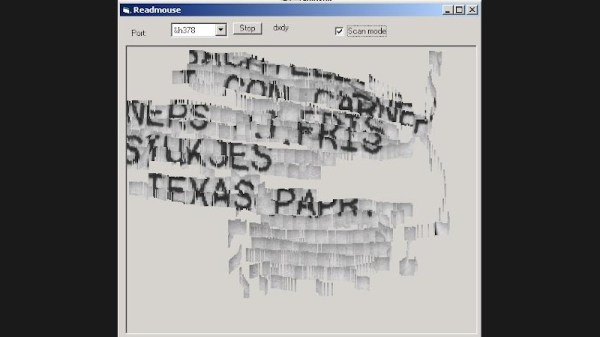
Ever wonder what your desk surface looks like up close? No. No one has. Not even [Sprite_tm], but upon disassembling his optical mouse and discovering its 18×18 CCD he decided to put it to use (well, a different use). The optical chip outputs serial information to the USB chip in the mouse. [Sprite_tm] wired the optical chip to a parallel port and wrote a simple program to interpret the data. Not really useful, but it does generate some interesting pictures. Program provided, natch.

5 Foot Long PATA Cable From Cat5e

pata

Not one to be constrained by specifications, Montac decided to construct an ATA cable that was well over the 18 inch maximum length.  PATA cables use 80 conductor wire, even though they only have 40 pin connectors. The extra 40 lines are all tied to ground. The cable was constructed from 10 pieces of Cat5e with one line from each twisted pair going to ground. The construction is as tedious as it sounds and at each end there are a few signal lines that also need to be pulled to ground. Once the cable was finished with heat-shrink tubing it was tested. The cable performed as well as, if not slightly better than the standard cables.

[thanks Luke Skaff]

Continue reading “5 Foot Long PATA Cable From Cat5e”

Xbox 360 ATX Power Supply

power supply

Reader Ran Mokady took a pretty big gamble with this project, but didn’t really have any other choice: his power supply was broken and he couldn’t get a replacement. He ended up replacing it with a standard ATX power supply. Follow along for all of the details.

For anyone who is having problems with their Xbox 360 power supply, or who (like me) have managed to end up with a burnt out PSU and can’t get a replacement, here’s how I managed to run the console off a standard ATX computer power supply.

Continue reading “Xbox 360 ATX Power Supply”

Stirling Engine From Aluminum Cans

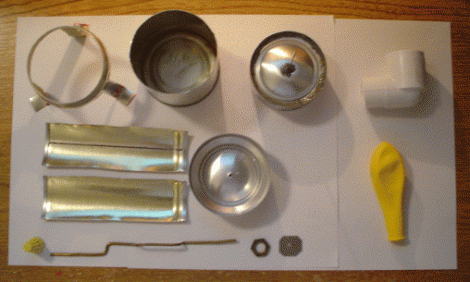
The Stirling engine seems like an odd-ball design when you’ve only encountered gas and Diesel engines. Even though the Stirling engine is piston based it doesn’t use valves. It has a sealed working fluid and no exhaust gas. Stirling engines aren’t very common, but are being produced commercially as cryocoolers and for use in solar farms. Here are some thorough plans for constructing a model Stirling engine from aluminum cans.

[thanks haq]

Continue reading “Stirling Engine From Aluminum Cans”

22C3 Day 10 And 11 Round Up

bb
Now that the CCC is over, we finally dug ourselves out of a ginormous pile of cables (Kabelsalat ist gesund!) to bring you this round up post about the best stuff from the last two days of the con.

First up on day 10 was I See Airplanes!, Eric Blossom’s excellent speech on creating hardware for making homebrew radars and software using the GnuRadio project. He uses bistatic passive receivers in the 100 MHz range doing object detection using other peoples’ transmitters. The project has a lot yet to accomplish including the use of helical filters (if there are any antenna freaks reading this, contact Eric, he’s looking for a bit of help).

Next on the third day we attended Ilja van Sprundel‘s huge fuzzing  extravaganza. Fuzzers generate bad data that is designed to look like good data and will hopefully break something in an interesting way. Our fav part? When the list of irc clients broken by his ircfuzz tool was so long he had to use 10pt font to get it all on one slide (see slide 53)! His paper can be found here and the slides here.

We then wandered to Harald Welte‘s talk on hacking the Motorola EZX series phones (which we’ve reported on here before). In case you forgot, the EZX series has a linux kernel. Incidentally the phone runs lots of stuff it really doesn’t need (like glibc, 6 threads for just sound processes, and even inetd). He presented the project for the first time in an official context since we saw him at 0Sec in October. Apparently lots of kinks have been worked out and there’s an official code source tree here.

The clincher for day 11 was FX and FtR of Phenoelit‘s semi-controversial talk on Blackberry security (covering both handheld devices and server based RIM products). This talk was a bit of a wake up call for RIM and thus the slides are still not available online so keep a sharp eye out for the video when it’s released by the CCC.

Also available from the CCC are the full proceedings in a downloadable pdf (also available in paper format for you physical-space-doodle-in-the-margin freaks).

Continue reading “22C3 Day 10 And 11 Round Up”

Snake Robots

snake robot

Dr. Gavin Miller has been investigating snake robots for over ten years. His first models, S1 and S2, use one servo at each joint. S3 used a pair of servos to create a sidewinding motion along with the more common horizontal undulations. S4 was an attempt to power the snake with just one motor, but ran into problems because of high torque in the u-joints. S5 was the first to have all CNC parts, which made for a more compact package. The larger snake did require the use of a second microprocessor. S6 was another attempt at a single motor snake, this time using a complicated gear train. It still had problems. S7 is the most recent prototype and is an attempt at rectilinear motion like that of a python (undulations in the direction of movement).

[thanks joeboy]

Continue reading “Snake Robots”