Toorcamp: MC Hawking Robotic Wheelchair

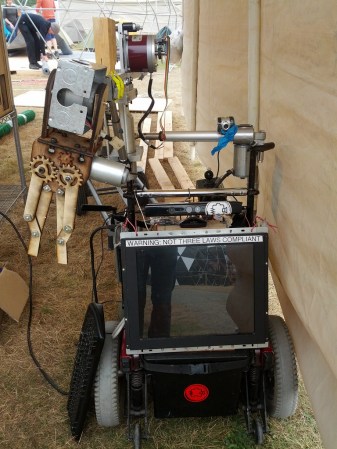
This is the MC Hawking robot built by the Noisebridge hackerspace in San Francisco. It’s a robotic electric wheelchair outfitted with a PC, an XBox Kinect, and an Arduino. On the software side, it uses Ubuntu and the open source ROS platform. A few folks from Noisebridge were hacking away on the robot at Toorcamp to add a robotic arm and other upgrades.

One goal of the project was to build a hardware platform that lets software hackers work on autonomous applications without having to delve in to the complexities of the hardware. Since an autonomous wheelchair could get dangerous, it clearly boasts that it does not behave by Asimov’s three laws.

An example of an autonomous application for the MC Hawking is a facial tracking. This uses the Kinect’s sensors to follow people around. The platform is now being used to develop the DORA Opensource Robot Assistant project, which hopes to use the robotic arm to grab a soda from the fridge 51 days from now.

[Jake] from Noisebridge pointed out that they are seeking people who are interested in working on the software side of the project. If you are in the Bay Area and haven’t visited Noisebridge, you need to. Check their website for lots of information on the group.

Check out a video of MC Hawking partying at Toorcamp after the break.

Continue reading “Toorcamp: MC Hawking Robotic Wheelchair”

Toorcamp: The American Hacker Camp

Toorcamp is all wrapped up after four great days of talks, hacking, and parties. Located in Neah Bay, Washington, Toorcamp was a four day event modelled after European hacker camps. This is the second time Toorcamp has been run, and it’s clear that both the organizers and attendees know how to throw an awesome stateside hacker camp.

The camp featured talks, including keynotes by [Joe Grand] and [George Dyson], and villages for hardware hacking, lock picking, crafting, and welding. Workshops ranging from Arduino for Total Newbies with [Mitch Altman] to Wifi Hacking with [Darren Kitchen] let attendees get their hands dirty in a variety of activities. Hackerspaces and other collectives set up fantastic campsites featuring full kitchens, ham radios, questionably legitimate wifi networks, and bike jousting.

Some of the highlights include a giant laser that required FAA approval to fire into the sky, an elaborate tribute to the classic arcade game Robotron: 2084, and a working hand-held Tesla Gun. Stay tuned for coverage about these hacks and more.

If you missed Toorcamp, you’ll be glad to know that the organizers plan to run it on alternating years, which means the next one will be in 2014. You should also check out Toorcon San Diego in October and WorldToor in Antarctica. It looks like Toorcamp will only get better with time, and Toorcamp 2014 should be a great open air hacking event that you won’t want to miss.

Hackaday Is Going To ToorCamp!

Last month, we lamented that Toorcamp was coming but we weren’t going to be able to attend. Since then, we’ve brought a new writer on board that will be going to Toorcamp! [Eric Evenchick] will be attending and supplying coverage for Hackaday.

For those who haven’t heard yet, Toorcamp is a 4 day hacker event being held near Neah bay Washington. They described it as “burning man with less drugs and more hacking”.  We can’t wait to see what [Eric] shares from this event!

Hackaday Has Won 1st Place In The RedBull Creation Contest!

The people have spoken. Hackaday has won the Redbull creation challenge by popular vote.  Despite a few bumpy spots in the voting process, our project, the Minotaur’s Revenge (gameplay footage around the 2min mark in the video), got the most votes from the public winning us $5000 for our hackerspace and a trip to the World MakerFaire in New York.

Thanks to everyone who was able to actually vote, and we totally understand about those who didn’t.

Arduino, Resistor, And Barrel Plug Lay Waste To Millions Of Hotel Locks

The security flaws on this common hotel keycard lock are nothing short of face-palmingly stupid. Look closely at the picture above. This is a hotel room door swinging open. The device he holds in his hand is an Arduino connected to the OUTSIDE portion of the door lock. It takes approximately 200 milliseconds from the time an attacker plugs the device in, until the door can be opened. Yes, in less than 1/4 of one second an Arduino can open any of the millions of these locks in service.

The exploit in Onity programmable keycard locks was revealed by [Cody Brocious] at the Blackhat conference. Apparently the DC barrel jack on the outside of the lock serves as a one-wire protocol interface. Once communications are established a 32-bit sitecode can be read from any of the locks and immediately used to open the door. There is no authentication or encryption used to obfuscate this kind of attack. To make matters worse, you can even read out master key and skeleton key codes. These codes facilitate ‘magic’ keys used to open a variety of different doors through the system.

We’re no strangers to easy hotel beak-ins. But how can a digital lock possibly be sold with this type of vulnerability present? Really!?

Here’s the white paper on the exploit as well as the slides from his talk (PDF).

[via Reddit]

Kansas City MakerFaire: Greentechweekly’s Coverage

We hadn’t been at the MakerFaire long when we ran into a couple hackaday fans lugging around camera equipment and microphones. I agreed to a quick interview for their show greentechweekly.tv which was fairly painless, then we all went our separate ways. [EcoGeeco] later sent me the footage and I couldn’t help but think… these guys did a better job than I did!  They asked some great questions, got some great footage, somehow managed to get decent audio too!

Continue reading “Kansas City MakerFaire: Greentechweekly’s Coverage”

MakerFaire K.C.: Power Wheels Racing

[vimeo=44644726]

This section of the MakerFaire almost deserves an entire event of its own. I know I would happily attend a monthly match of the power racing series in my home town. To compete, you must have a modded Power Wheel. Yes, those electric kids vehicles that go really slowly across your lawn, those power wheels. You tear it apart, soup it up, and race it.

Continue reading “MakerFaire K.C.: Power Wheels Racing”