2026 Green Powered Challenge: The Eternal Headphones

Noise cancelling headphones are a great way to insulate yourself from the bustle of the city, but due to their power requirements, continuous use means frequent recharging. [Alessandro Sgarzi] has an elegant and unique solution — powering the noise cancelling electronics by harvesting energy from the ambient noise of the city via a sheet of piezoelectric film.

This impressive feat is achieved using a LTC3588-1 power harvesting IC and a pair of supercapacitors, while an STM32L011K4T6 microcontroller processes the input from a MEMS microphone and feeds a low-power class D amplifier. This circuit consumes an astounding 1.7 nW, a power that a noisy city is amply able to supply. Audio meanwhile comes via a traditional 3.5 mm connector, which we are told is the cool kids’ choice nowadays anyway.

We like this project, and since it’s part of our 2026 Green Powered Challenge, it’s very much in the spirit of the thing. You’ve just got time to get your own entry in, so get a move on!

SolMate Charger

2026 Green Powered Challenge: SolMate Charges On The Move

We’ve all had those times when your electrical device of choice is running low on battery. Sometimes you even plan ahead and are also carrying a battery pack, but what happens when you’ve forgotten to charge the battery pack? This is the problem that [Arnov Sharma] addressed with the SolMate, a portable solar panel that keeps a battery bank topped up.

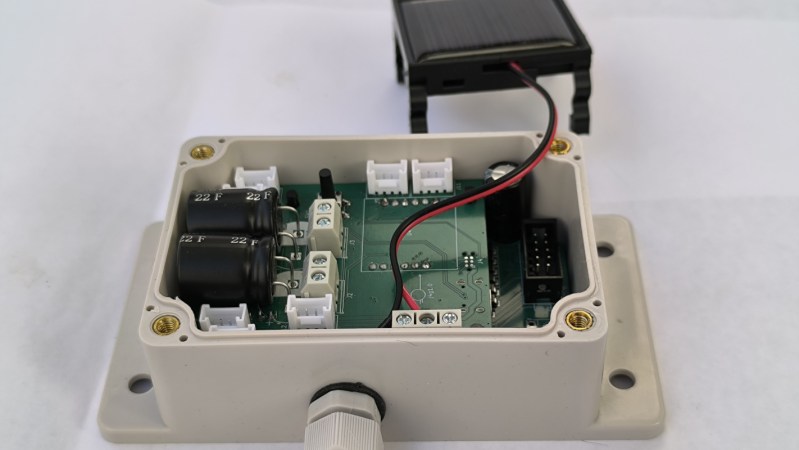
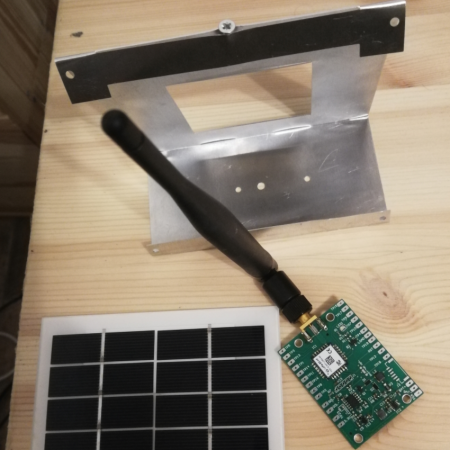
The SolMate is built around an efficient 2 W photovoltaic panel that’s not much bigger than a cellphone. This panel can supply 5 V at 400 mA on a sunny day. The solar output is more than enough to keep the internal 2000 mAh battery topped up and ready for use. Charging the Li-ion battery is handled by an IP5306 power management chip, which pulls double duty: it safely regulates charging while boosting the battery’s 3.7 V to the 5 V expected at the USB charge ports. Speaking of charge ports, the SolMate includes both a USB-A and a USB-C port, plus a switch to enable or disable the unit.

The case is all 3D printed, with some clever design choices. Offsetting the bulk of the battery and PCB storage area to one side lets the SolMate naturally cant toward the sun. Even the clip used to attach it to a backpack is printed.

Be sure to check out the other entries into our latest challenge!

Get Your Green Power On!

Nobody likes power cords, and batteries always need recharging or replacing. What if your device could run on only the power it could gather together by itself from the world around it? It would be almost like free energy, although without breaking the laws of physics.

Hackaday’s 2026 Green-Powered Challenge asks you to show us your devices, contraptions, and hacks that can run on the power they can harvest. Whether it’s heat, light, vibration, or any other source of energy that your device gathers to keep running, we’d like to see it.

The top three entries will receive $150 shopping sprees courtesy of the contest’s sponsor, DigiKey, so get your entry in before April 24, 2026, to be eligible to win.

Honorable Mentions

As always, we have several honorable mention categories to get your creative juices flowing:

  • Solar: In terms of self-powered anything, photovoltaic cells are probably the easiest way to go, but yet good light-harvesting designs aren’t exactly trivial either. Let’s see what you can run on just the sun. (Or even room lighting?)
  • Anything But PV: Harnessing the light is too easy for you, then? How about piezo-electric power or a heat generator? Show us your best self-powering projects that work even when it’s dark out.
  • Least Power: Maybe the smartest way to make your project run forever is to just cut down on the juice. If your project can run on its own primarily because of clever energy savings, it’s eligible for this mention.
  • Most Power: How much of a challenge is building a solar-powered desk calculator in 2026? How about pushing it to the other extreme? Let’s see how much power you can consume while still running without batteries or cords. Does your off-grid shack count here? Let’s see it!

Prior Art

We’ve seen a lot of green-powered projects on Hackaday over the years, ranging from a solar-powered web server to a microcontroller powered by a BPW34 photodiode. Will your entry run off the juice harvested by an LED? It’s not inconceivable!

Solar cells only work when the sun shines, though. As long as your body is putting out heat, this Seebeck-effect ring will keep on running. (Matrix vibes notwithstanding!) Or maybe you want to go straight from heat to motion with a Stirling engine. And our favorite environmental-energy-harvester of all has to be the Beverly Clock and its relatives, running on the daily heat cycles and atmospheric pressure changes.

Your Turn

So what’s your energy-harvesting project? Batteries are too easy. Take it to the next level! All you have to do to enter is put your project up on Hackaday.io, pull down the “Submit Project to…” widget on the right, and you’re in. It’s that easy, and we can’t wait to see what you are all up to.

And of course, stay tuned to Hackaday, as we pick from our favorites along the way.

Congratulations To The 2025 Component Abuse Challenge Winners

For the Component Abuse Challenge, we asked you to do the wrong thing with electrical parts, but nonetheless come out with the right result. It’s probably the most Hackaday challenge we have run in a long time, and you all delivered! The judging was tight, but in the end three projects rose up to the top, and will each be taking home a $150 DigiKey gift certificate, but that doesn’t mean you shouldn’t give all of the projects a look.

So without further ado, let’s check out the winners and all the others that tickled the hacky regions of our judges’ brains. Continue reading “Congratulations To The 2025 Component Abuse Challenge Winners”

2025 Component Abuse Challenge: The VIA Makes Noise, Again

In the days of 8-bit home computing, the more fancy machines had sound chips containing complete synthesizers, while budget machines made do with simple output ports connected to a speaker — if they had anything at all. [Normal User] appears to be chasing the later route, making PCM sound by abusing the serial port on a 6522 VIA chip.

A serial port is when you think about it, a special case of a one-bit output port. It’s designed for byte data communication but it can also carry a PCM data stream. We’ve seen this used with microcontrollers and peripherals such as the I2S port plenty of times here at Hackaday, to produce such things as NTSC video. The 1970s-spec equivalent might not be as fast as its modern equivalent, but it’s capable of delivering audio at some level. The machine in question is a Ben Eater breadboard 6502 with a World’s Worst Video Card, and as you can hear in the video below the break, it’s not doing a bad job for the era,

If you think this hack sounds a little familiar then in a sense you’re right, because Ben Eater himself made noises with a 6522. However it differs from that in that he used the on-board timers instead. After all, the “V” in “VIA” stands for “versatile”.

Continue reading “2025 Component Abuse Challenge: The VIA Makes Noise, Again”

2025 Component Abuse Challenge: Relay Used As Guitar Pickup

We’ve all built projects that are a rats’ nest of wiring and feature creep, but the best projects in the end are usually those that use a simple solution to elegantly solve a problem. [Kauz] had been thinking about a unique type of electric guitar pickup for a while and rather than purchase an expensive option or build a complex microcontroller-based system he found his elegant solution in the form of a common electronic component.

The core of this idea is that guitar pickups are essentially coils of wire, and are surprisingly similar to the coils of wire found in electromechanical relays. [Kauz] has used six small relays, left them unmodified, and then built an amplifier circuit for each to allow the vibrations of the guitar strings to resonate in the relay coils, eventually producing a sound. Not only do the relays work perfectly well as pickups, but [Kauz] also created a mixing board that allows the six relays to be combined into two channels, allowing for options like stereo sound for different strings directly out of the guitar or for different effects to be applied to different strings.

The build also allows for some interesting options in future versions as well. [Kauz]’s plans are eventually to build this into an instrument which can output polyphonic MIDI signals, where various strings can behave as different instruments. In theory, with six circuits six different instruments can be produced, and we’re excited to see what the next versions will look and sound like. In the meantime, be sure to check out some other guitar pickups we’ve seen that use even simpler parts found lying around the workbench.

Continue reading “2025 Component Abuse Challenge: Relay Used As Guitar Pickup”

2025 Component Abuse Challenge: Light An LED With Nothing

Should you spend some time around the less scientifically informed parts of the internet, it’s easy to find “Free power” stories. Usually they’re some form of perpetual motion machine flying in the face of the laws of conservation of energy, but that’s not to say that there is no free power.

The power just has to come from somewhere, and if you’re not paying for it there’s the bonus. [joekutz] has just such a project, lighting up LEDs with no power source or other active electronics.

Of course, he’s not discovered perpetual motion. Rather, while an LED normally requires a bit of current to light up properly, it seems many will produce a tiny amount of light on almost nothing. Ambient electromagnetic fields are enough, and it’s this effect that’s under investigation. Using a phone camera and a magnifier as a light detector he’s able to observe the feeble glow as the device is exposed to ambient fields.

In effect this is using the LED as the very simplest form of radio receiver, a crystal set with no headphone and only the leads, some wires, and high value resistors as an antenna. The LED is after all a diode, and it can thus perform as a rectifier. We like the demonstration even if we can’t quite see an application for it.

While we’re no longer taking new entries for the 2025 Component Abuse Challenge, we’ve still got plenty of creative hacks from the competition to show off. We’re currently tabulating the votes, and will announce the winners of this particularly lively challenge soon.