AM/FM SOS Beacon Saves Your Bacon

bacon_beacon_breadboard

[BadWolf] sent us a device called the “Bacon Beacon“, which is his 555 Design Contest entry. In short, it’s a life-saving device that emits an S.O.S. signal in Morse code over both the AM and FM bands. The device uses five 555 timers to get the job done, each of them dedicated to a specific task. Three of the timers are used for clocking and Morse generation, while the remaining two are used to produce and transmit an audible signal over the air waves. Currently, the signal can be received about a mile away from the source, which would theoretically allow for a search and rescue team to locate you with a simple radio and directional antenna.

The current design is still a bit rough around the edges, but the final plans would have the circuit built into a flashlight-like device equipped with red and green signaling LEDs. It’s a clever project and would make for a great tool if you got lost while hiking, or in the event of a zombie apocalypse.

Stick around for a quick video of the Bacon Beacon in action, and swing by [BadWolf’s] site if you want to know why his project has such a strange moniker (hint: it’s not because it can “save your bacon”).

Continue reading “AM/FM SOS Beacon Saves Your Bacon”

DIY Hot Air Hand Dryer – An OCD Sufferer’s Best Friend

diy_hot_air_hand_dryer

[haqnmaq] admits that he suffers from Obsessive Compulsive Disorder and on occasion, can be found washing his hands up to 20 times an hour. Very distrustful of cloth towels, he exclusively uses paper towels to dry his hands, to the tune of 2-3 rolls a day. In an effort to lessen the impact his OCD has on the environment and his wallet, he decided to build an automated hot air hand dryer using a 555 timer, which doubles as his entry in the 555 Design Contest.

The concept behind his project is to use a hair dryer as a hot air source, relying on a phototransistor and a pair of IR LEDs to detect when hands are placed under the dryer. When a pair of hands are detected, a relay is triggered and the hair dryer is turned on. Once the dryer has run for a pre-determined but adjustable time, the relay is opened, and the hair dryer turns off.

It’s a pretty simple project, but one that is quite useful, whether you suffer from OCD or not. The only thing he might want to watch out for is the restricted air flow to the dryer, since it is mounted in a sealed plastic container – a few seconds with a hole saw should remedy the problem quite easily.

Want to see the hand dryer in action? Keep reading for a short video demonstration.

[Thanks Ryan]

Continue reading “DIY Hot Air Hand Dryer – An OCD Sufferer’s Best Friend”

Hear That? It’s A 555 Timer AM Radio

555_timer_am_radio

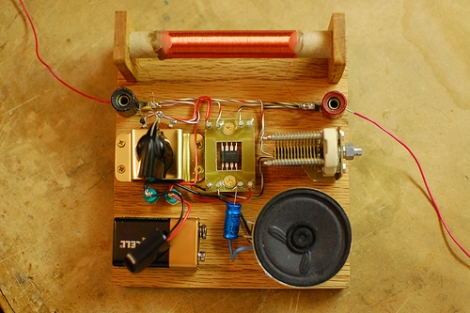
[Eric] recently built an AM radio based on a 555 timer, and posted a few pictures to the Hack-a-Day Flickr pool. He used the 555 timer as an AM demodulator and power amplifier in order to drive the speaker. A hand-wound inductor is used to tune the signal which is then superimposed over the ramp signal produced by the circuit he built. [Eric] points out that he chose a CMOS 555 timer because of its superior performance in this particular application since the timer is used in a bit of a nontraditional manner. He shared his circuit diagram as well as a great video walking through each part of his design, finishing off with a demonstration of the radio, which can be seen below.

This is yet another great project that will be entered in the 555 Design Contest – simple and elegant. We love seeing these, so keep them coming!

If you want to see more cool projects made by Hack-a-Day readers, be sure to check out our Flickr pool as well as the forums.

Continue reading “Hear That? It’s A 555 Timer AM Radio”

555 Timer-based Charge Controller

555_charging_controller_circuit

Several years ago [Michael Davis] built a charge controller for his wind turbine and published his construction plans online. This build became quite popular, especially among people that live in remote regions. He states that he is flooded with email each day with questions about his charge controller from people trying to troubleshoot its construction or from people who are unable to source the proper parts.

In order to make things easier for people, he decided to revisit his controller design to see what could be improved, and more importantly, what could be removed. The revision was shelved for awhile, but while in the process of working on another project, he realized that most of his original circuit could be easily replaced with a 555 timer. Since the 555 chip is so ubiquitous, he figured it was a fantastic way to simplify his charger, even if he wasn’t using the chip in the manner for which it was originally designed.

He continued revising his charger, sourcing very basic components and simplifying the circuitry enough that even he was able to build it correctly the first time around. Needless to say, this charging circuit will be his entry in the 555 Design Contest.

Be sure to keep reading for a quick video of his charger in action.

Continue reading “555 Timer-based Charge Controller”

555 Timer Circuit Simulation Software

ltspiceiv_demo

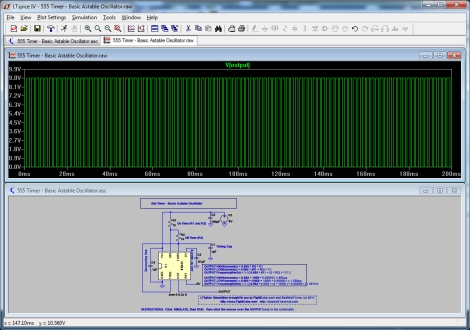
[FightCube] wrote in recommending a very helpful piece of circuit simulation software for those of you still constructing entries for the 555 design contest.   LTSpiceIV, available from Linear Technology, allows you to construct moderately complex 555 driven circuits including common components such as capacitors, resistors, diodes, FETs, and more.  Once you have constructed your circuit, you can view the results in an easy to use visualization window, without ever having to touch your soldering iron or a breadboard.  According to [FightCube], the software is fairly easy to use, and best of all, it’s free.

He has shared one basic circuit he built as a demonstration of the software’s capabilities, and promises to share more in order to motivate others to enter the contest.

Chrome In The Pwn2Own Contest

Google has announced that it will be sponsoring a $20,000 prize at the 2011 CanSecWest Pwn2Own Contest. $20,ooo will be given to the first person to escape Chrome’s sandbox through Google-written code in the first day. If researchers are unsuccessful on the first day, then days two and three will be opened up to non-Google-written code. In addition to the cash, there is also a Google CR-48 running ChromeOS offered as a prize, but it will not be the actual platform used to hack Chrome. We look forward to seeing what comes out of this contest.

[via GearLog]

Reminder: Santa-Pede Challenge Ending Soon

This is just a friendly reminder that our Santa-Pede challenge will be ending soon. Please send your submissions to us by emailing them to bbb@hackaday.com or by posting them in the projects section of our forum (did we mention we have a forum now?) by the end of January to be considered. We don’t care how silly, stupid, simple,or slick it is, just send it to us! We have some fun prizes from Adafruit and Make and even have [Phillip Torrone] as a judge. Get those submissions in ASAP.