Using Solar Air Heating To Dry Clothes

About a month ago, [Greenhill Forge] built a few solar panels to collect energy from the sun. Unlike solar photovoltaics, which turn sunlight directly into electricity, these were designed to gather solar thermal energy with air. These types of panels can gather a tremendous amount of energy for a very low cost, and although the first video only went into the theory of their operation, his latest video actually shows us how to use that energy in a practical way.

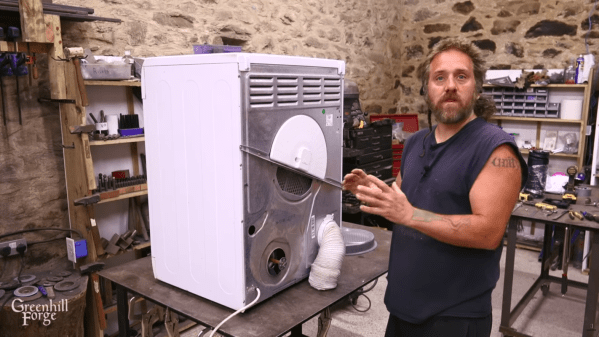
The video starts by building a new solar panel, using upgraded materials and building methods compared to the previous versions which should improve the efficiency. There’s some data analysis of the performance, but at the end of the video [Greenhill Forge] actually hooks one of these up to a clothes dryer to explore its real-world efficacy. This process involves disconnecting the electric heater, removing one of the blower fans, and building a new flange to accept the heated air from the solar panel. A microcontroller keeps an eye on the incoming air temperature and controls a fan to try to hit the target temperature.

After an hour of drying, the test clothing was completely dry, with the only electricity used to turn the drum in the dryer. This is more than an order of magnitude of reduction in the power needed to dry clothes, which is fairly impressive. [Greenhill Forge] also notes that systems like these could augment off-grid systems not only for clothes drying but for home heating, greenhouse heating, or drying out various crops and that they could reduce strain on an electrical system that otherwise relies on resistive heating methods. There are many ways of building these panels, so be sure to check out his first video for ideas. Continue reading “Using Solar Air Heating To Dry Clothes”
Inside Dyson’s Over-Engineered ₤1000 Hand Dryer

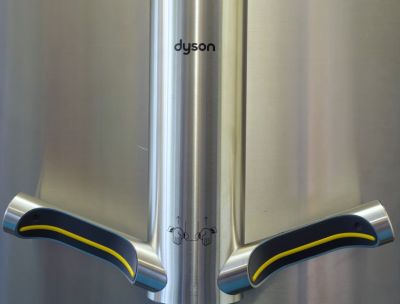
It seems fair to say that Dyson sits at the intersection of impressive engineering and borderline ridiculous products. The Dyson Airblade 9KJ hand dryer that [ElectrArc240] recently took to bits would definitely seem to fall under the latter, combining an incredible amount of engineering all for the simple task of drying wet hands.

These hand dryers are rated for a cool 900 Watts, with an 0.5 W standby power consumption, though you can also switch it to a 650 W ‘eco mode’ when installing it. The air that gets sucked into the dryer first passes through a HEPA filter before it hits the heating element and then gets blown out of the handles onto one’s hands.

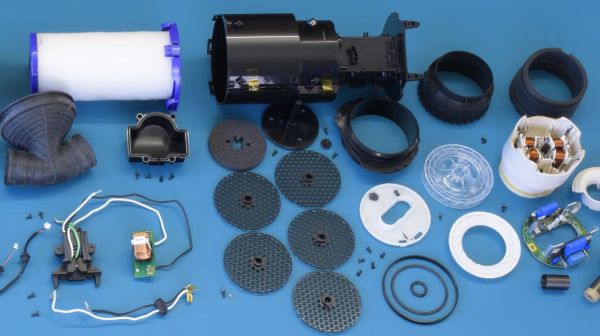
Both of these handles come with a presence sensor in the form of an ST VL53L3CX time-of-flight sensor, along with a path for the heated air towards the thin slits. Returning to the section just past the HEPA filter is the compressor, with a rather fancy airflow path that involves various stacked meshes. As can be seen in the video, where you’d expect basically a simple blower motor or so, there is a truly astounding amount of parts as the teardown progresses.

The motor disassembly is the first part where some desoldering and breaking of glue bonds is really necessary, but it gives full access to the driver board. The circuit used here is your typical IGBT-based driver, though with a mystery PIC MCU to do things. Following this the tear-down turns fully destructive, giving access to the motor internals.

Following an analysis of these internals we marvel at the carbon-fiber rotor that keeps the single magnet in one piece. This is another engineering choice that serves to justify the 1,000 quid price tag. All so that rest room visitors do not have to suffer the humility of using paper towels.

Continue reading “Inside Dyson’s Over-Engineered ₤1000 Hand Dryer”

Heat Pump Dryer Explained

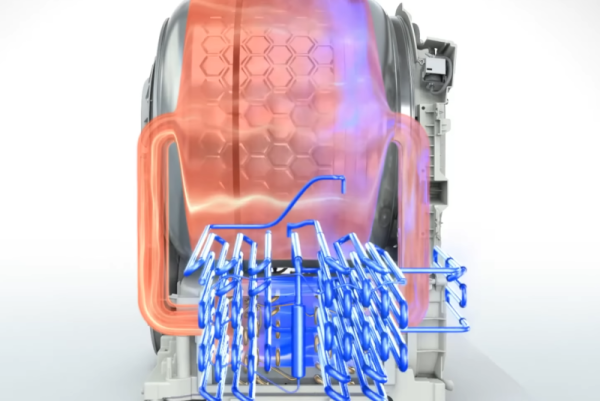
Historically, having a washer and a dryer in your house requires “a hookup.” You need hot and cold water for the washer as well as a drain for wastewater. For the dryer, you need either gas or — in the US — a special 220 V outlet because the heating elements require a lot of wattage, and doubling the voltage keeps the current levels manageable. You also need a bulky hose to vent hot moist air out of the house. But a relatively new technology is changing that. Instead of using a heater, these new dryers use a heat pump, and [Matt Ferrell] shows us his dryer and discusses the pros and cons in a video you can below. We liked it because it did get into a bit of detail about the principle of operation.

These dryers are attractive because they use less power and don’t require gas or a 220 V outlet. They also don’t need a vent hose which means they can sit much closer to the wall and take up less space. Heat pumps don’t convert electrical energy into heat like a normal heating element. Instead, it uses a compressor to move heat from one place to another. In this case, the dryer heats the air using the heat pump. That causes water in the clothes to evaporate into the air. The heat pump dryer then uses a second loop to cool the air, condensing the water out so the it can reheat the air and start the whole cycle over again.

Continue reading “Heat Pump Dryer Explained”

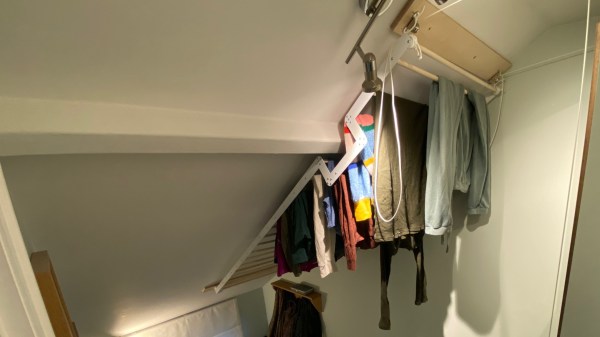
A white stairwell ceiling with a rack holding clothes. The rack follows the slope of the ceiling and is attached to a series of ropes and pulleys to let it got up and down.

Stairway Drying Rack Rises Above The Rest

Finding space to dry clothes can be challenging in smaller spaces. [Tom Parker] solved this conundrum in his one bedroom apartment by putting a drying rack in his stairwell.

By making the laundry rack fold up above the stairwell, [Parker] can dry his clothes without them taking up a lot of precious floor space. A pole is used to is raise and lower a dowel rod attached to two lines of paracord running over pulleys and to the end of the rack. Each moving corner of the rack also has a set length of cord attached to prevent the rack from rotating too far down as well as providing a safety mechanism should one of the other lines of cord snap.

The rack is bolted-together, laser cut 1.5mm thick mild steel with 15 mm dowels attached to the sides via threaded inserts. Spacing is set for the raised rack to put clothes at 75 mm apart. Plywood pieces interface the rack with the wall to avoid damaging the drywall.

If you’re looking for more laundry hacks, check out this Smart Clothes Dryer or How Robots Suck at Folding Laundry.

Hackaday Prize 2022: Drying Clothes With Ultrasound

Clothes dryers are great, and a key part of modern life, but they do use a lot of energy. [Mike Rigsby] decided to see if there was a more efficient method of drying clothes that could compete with resistive heating for efficiency. Thus, he started work on an ultrasonic clothes dryer.

In early testing, he found ultrasonic transducers could indeed blast droplets of moisture away from fabric, effectively drying it. However, unlike heat, the ultrasonic field doesn’t effectively permeate through a pile of clothes, nor can it readily be used with a spinning drum to dry many garments at once.

[Mike]’s current experiments are centered around using a basket-type system, with a bed of ultrasonic transducers at the bottom. The idea is that the basket will shake back and forth, agitating the load of clothing and allowing the different garments to effectively contact the transducers. It’s still a work in progress, but it’s an interesting approach to the problem. We’d love to see a comparison of the energy use of a full-scale build versus a regular dryer.

We’ve heard of the ultrasonic drying concept before, too, with the Department of Energy researching the matter. It could just be that we’ll all be using ultrasonic dryers in decades to come!

Most FDM Printers Are Also Filament Dryers (with A Little Help)

If you’ve printed with an FDM printer, you probably know there are many interrelated factors to getting a good print. One key item is the dryness of the filament. When you first crack your plastic open, it should be dry. Most filament is packed in a sealed bag with desiccant in it. But if you have the filament out for a while, it soaks up moisture from the air and that causes lots of problems. [Design Prototype Test] has built and bought filament dryers before, but now he would like to point out that every FDM printer with a heated bed can act as a filament dryer. You can see the details in the video below.

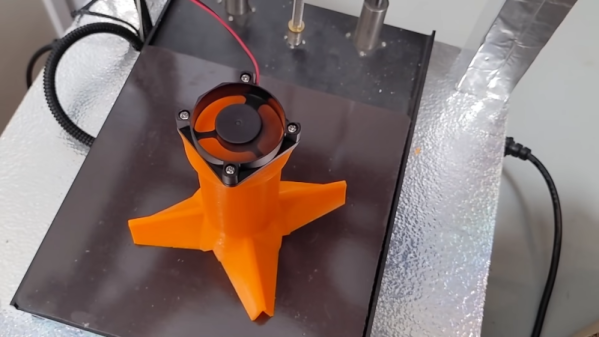
It turns out that the idea isn’t original, but it doesn’t seem to be one that has caught on. What the video shows though, is to take the idea and run with it. A 3D printed support sits on the bed and accepts a cheap PC fan. The whole affair gets boxed up with cardboard and can dry the filament.

Continue reading “Most FDM Printers Are Also Filament Dryers (with A Little Help)”

Upcycled Dryer Motor Makes Budget Disk Sander

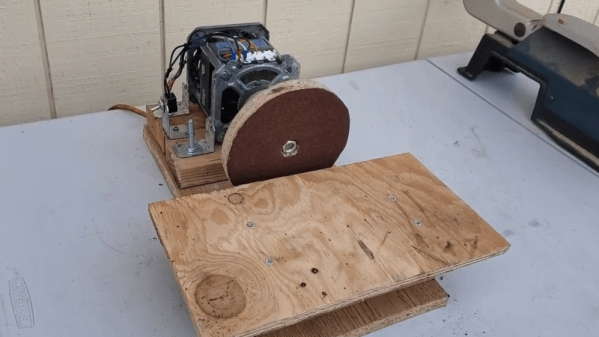
At the most basic level, most shop tools are just a motor with the right attachments. But the details are often far from simple. [DuctTapeMechanic] took a junker clothes dryer, yanked the electric motor from it, and converted it into a disk sander. The price was right at about $10. You can see it all after the break.

As you might imagine, having the motor is only half the battle. You also need a way to mount the thing securely and a way to affix the sanding disk. While this doesn’t pose the same challenges as, say, a drill press, it does take some thought. The motor in the donor dryer didn’t have threads on the shaft, so a bolt and some welding time took care of that. We suspect that’s tricky because you need the shaft and the bolt to be concentric and level.

Once you have a threaded shaft, the rest of the build is anti-climatic. A little carpentry and a little electrical. We would probably cover up the electrical connections a bit more. It seems like you’d want to know which way the motor spins so you could use a reverse thread, if necessary. From the video, we think the motor he has was spinning the right way, but we don’t know if that’s always true.

There’s something satisfying about building your own tools. If you work on smaller things, we’ve seen a miniature sander that might be handy to have around. If you want to go the other way, try finding an old floor polisher instead of a dryer.

Continue reading “Upcycled Dryer Motor Makes Budget Disk Sander”