Retrotechtacular: The History Of ANSI And ASCII Art

These slides may not be the style of character art you remember from the days of 2400 baud modems; they’re more advanced than what was out there in the beginning. It turns out there is still some life left in this art subculture. For this week’s installment of Retrotechtacular we look in on [Doug Moore’s] talk on the history and survival of ANSI and ASCII art given at this year’s BSides conference.

ASCII is still a common character encoding so chances are you’re already familiar with it. ANSI on the other hand is a rather confusing term as it’s been lost in obscurity when referring to character sets. In this case it refers to a set of extended characters which is better described as Windows Code Pages.

Most of what we know about the ANSI art scene is from watching BBS: The Documentary (which is on our ten best hacking videos list). We certainly remember seeing the vertically scrolling art after connecting to a dial-up BBS back in the day. But understanding the factions that formed around the creation, bundling, and distribution of this is art is fascinating. [Doug] does a great job of covering this history, sharing side-by-side examples of the shunned practice of “ripping” another artists work. This image is actually not a rip. Later in his talk he discusses the continued existence of the subculture, showing what a modern take on the same subject looks like.

If you’re merely into the technical the first half of the video below is worth watching. But we bet it’ll be hard not to continue to the end for a side-trip into art history.

Retrotechtacular is a weekly column featuring hacks, technology, and kitsch from ages of yore. Help keep it fresh by sending in your ideas for future installments.

Continue reading “Retrotechtacular: The History Of ANSI And ASCII Art”
Retrotechtacular: Understanding A Voltage Doubler

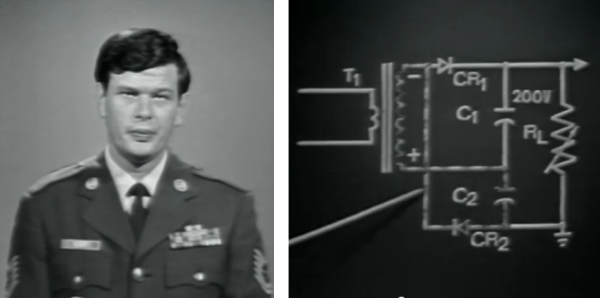
This very stern looking gentleman is about to explain how voltage doubles work in a plodding, yet satisfyingly thorough manner.

We’re not certain when this US Air Training Command video was produced. Obviously it was used to train servicemen who were responsible for keeping electronics running during war time. We’re glad for that, as they really found just the right balance to present a concept that required some knowledge, but is approachable for even the most basic of new electronics hackers.

The demonstration board shown on the right is the voltage circuit highlighted in the lesson. Here the pointing stick is being used to trace out the circuit function during one phase of the input transformer. The capacitor/diode pairs rectify the voltage, with the capacitors discharging in parallel series to double the output voltage. But how does the variable load (RL) affect the output? This is demonstrated under several different conditions using an oscilloscope to illustrate the change.

The discussion of how the diodes work reminded us of a modern tutorial we just ran across this weekend. It’s a bit bizarre, but explains the PN junction in a different way than we’re accustomed to. In this case you will already need to be familiar with how semiconductors work to understand the presentation.

Both clips can be found below the jump.

Continue reading “Retrotechtacular: Understanding A Voltage Doubler”

Retrotechtacular: Singing Bird Automata

retrotechtacular-birdsong-automata

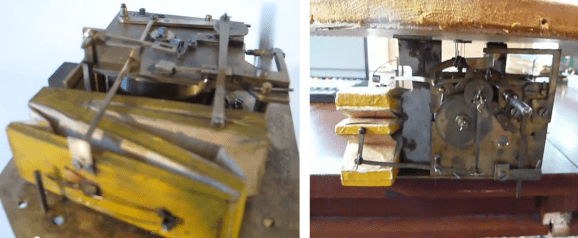
Our cats were both sleeping near the computer and these videos were driving them nuts. To our ears these birdsongs sound pretty good. They didn’t trick the cats into stalking mode, but they did spark an audible complaint. So the predators aren’t drooling but the mechanical engineers reading this should be. These automata combine the precision of a mechanical clock with a bellows and specialized whistle to recreate birdsong.

You’ve got to hear it for yourself to appreciate the variety produced by the mechanisms. The first video shows off the device seen on the left. This particular model is from the 1890’s and the demo gives a good look at the arms that open and block a passageway to alter the sound. After seeing that link — which was sent in by [Stefan] — we started searching around for more info on the devices. The one pictured to the right turned up. It’s from YouTube user [Singing Bird Boxes] who has many videos showcasing these types of devices. We picked this one because he tried to explain how each part of the mechanism works. These are still being made today, but there’s something magical about seeing one built during the steam age.

We’d like to make Retrotechtacular a weekly feature every Tuesday. Help us out by sending in links to projects that highlight old technology, instructional videos of yore, tours of museums or similar relics.

Continue reading “Retrotechtacular: Singing Bird Automata”