Retrotechtacular: Linotype Machines, Mechanical Marvels

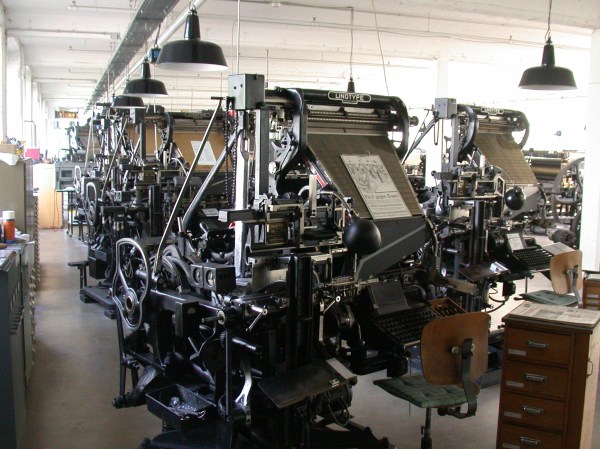
For this week’s Retrotechtacular we’re looking at Linotype Machines; mechanical marvels that brought about the mass production of printed media.

It was a cold dreary day in 1876, when a German inventor living in America named [Ottmar Mergenthaler] was approached by [James O. Clephane], who required a faster way of producing legal briefs. Various patents existed for newspaper typewriters but they did not work very well, so [Mergenthaler] set to work on a new design. Traditionally type sets were cast on one machine, and stamped on another to create the text. On a train [Mergenthaler] thought, why not just combine the machines? And with that the idea for a revolutionary machine was born.

The Linotype Machine has a library of matrices, which are character molds that create the slug — the name for a cast line-of-type. The operator uses a keyboard to input the line of text, which then releases the matrices of the corresponding letters. These are then transferred to the casting station, where type metal is cast into the matrices in a process called hot metal typesetting. The matrices are then returned to the library, and the cast lines of text are cooled, removed, and used for stamping in the mass production of printed media. It sounds simple enough, but now realize the entire machine is mechanically automated; as long as you keep filling it with type metal, you can continue producing slugs simply by typing on the keyboard.

The machines were used from the late 19th century all the way up to the 60’s and 70’s until they were replaced by more efficient offset lithography and computer typesetting.

After the break, check out the fascinating documentary from the 1960’s, you will marvel at the mechanical workings of the machine. If you don’t have 35 minutes to blow, at least check out 1:30 to 6:45 for the basic overview. But you probably won’t be able to stop watching.

Continue reading “Retrotechtacular: Linotype Machines, Mechanical Marvels”

Retrotechtacular: The Apollo Guidance Computer

There is so much amazing technology that came out of the space race. For this week’s Retrotechtacular we’re looking at the guidance computer used in the Apollo program undertaken by NASA in the 1960’s.

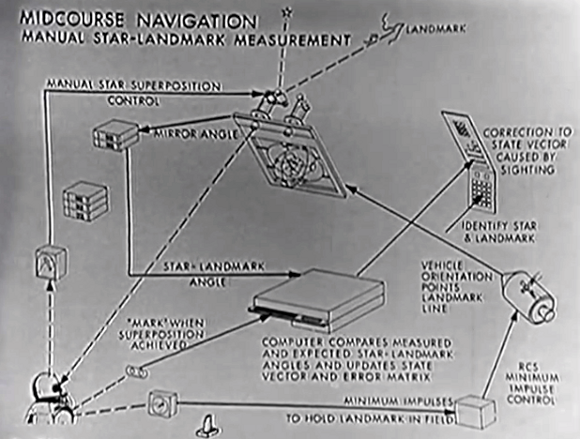
One of the main components of this system is the Inertial Measurement Unit or IMU. That’s a familiar term for hackers who build quadcopters or other devices for which spacial awareness is paramount. In this case the IMU provided critical information about the motion and orientation of the capsule during it’s trip from the Earth to the Moon and back. But it wasn’t just high tech electronics along for the flight. To determine actual position a sextant was used for triangulating position. Yes, this is the same type of measuring device used for centuries. The method of using the sextant is displayed above. The spacecraft was turned until the sextant pointed at a landmark on Earth. The instrument was the adjusted to line up a star as a landmark, then the computer calculated position based on time and the angles of the two points being sighted. There’s a lot more shown in this thirty-minute film including in-depth assembly and testing of the computer components.

Before we point you to a few related articles we’d like to mention that our stash of really cool Retrotechtacular tips is running low. So if you know of some old footage that’s awesome to watch please send us a tip about it.

Now if you can’t get enough about NASA electronics you should check out the LVDC board which [Fran] got her hands on. Also, it’s worth checking out the unbelievable soldering techniques specified in the NASA manual. There’s a pretty good discussion about that going on in the Reddit thread.

Continue reading “Retrotechtacular: The Apollo Guidance Computer”

Retrotechtacular: 6CH Industrial Robot

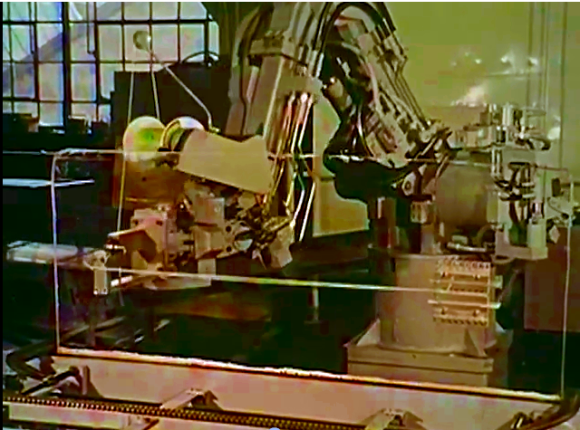
retrotechtacular-6ch-robot-arm

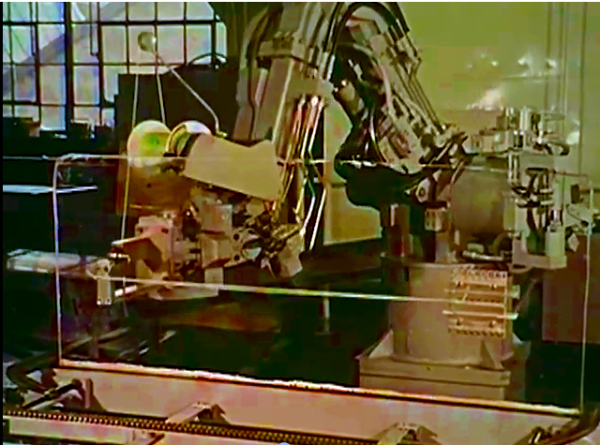
With this robotic arm demo video from 1975 the future really is now. Think about it, there are entire factories full of the descendants of this technology where the human workers simply feed the beast and fix it when it breaks.

We’re pretty impressed by what’s shown off below. Not because we see something we didn’t know was possible, but because the technology was so advanced nearly forty years ago. Here the arm is laying out a wiring harness on a jig. We wonder if using a single color of wire is going to make it a major pain when they add the connectors?

Obviously the mechanics were solid. Time has brought further advances in precision, reduced costs that make robots available for even small factories (often palletizing products is done by a machine similar to this), and improvements in how tasks are programmed. After all, the ability to print a hard copy of the program as a punch tape isn’t quite cutting edge for this decade.

What does that mean for you? If you look hard enough you might be able to find an older generation robot arm to hack on.

Continue reading “Retrotechtacular: 6CH Industrial Robot”

Retrotechtacular: The 10-year Anniversary Of Plastic

retrotechtacular-plastic-ten-year-anniversary

This footage called Industry on Parade is a unique look back at the golden age of plastics. We also value the footage as a look at America’s manufacturing sector at its height.

We remember a middle-school teacher recalling his father — who was a research scientist working at Dow — bringing home a pair of discs for him to play with. His first ever encounter with plastic. Here we see a snapshot ten years after plastic manufacturing went mainstream. It starts off with a tour of an injection-molding factory. The screenshot seen above is from the second vignette which tours a production line for naval ship models which will be used to train Navy personnel and as props for strategic planning maps. The film wraps up with the production of plastic fabrics starting with raw materials and ending with synthetic bug screen.

Just to prove it’s an authentic blast from the past, hang in there for the last two minutes when you get an anti-communism PSA. Classic.

Continue reading “Retrotechtacular: The 10-year Anniversary Of Plastic”

Retrotechtacular: The History Of ANSI And ASCII Art

These slides may not be the style of character art you remember from the days of 2400 baud modems; they’re more advanced than what was out there in the beginning. It turns out there is still some life left in this art subculture. For this week’s installment of Retrotechtacular we look in on [Doug Moore’s] talk on the history and survival of ANSI and ASCII art given at this year’s BSides conference.

ASCII is still a common character encoding so chances are you’re already familiar with it. ANSI on the other hand is a rather confusing term as it’s been lost in obscurity when referring to character sets. In this case it refers to a set of extended characters which is better described as Windows Code Pages.

Most of what we know about the ANSI art scene is from watching BBS: The Documentary (which is on our ten best hacking videos list). We certainly remember seeing the vertically scrolling art after connecting to a dial-up BBS back in the day. But understanding the factions that formed around the creation, bundling, and distribution of this is art is fascinating. [Doug] does a great job of covering this history, sharing side-by-side examples of the shunned practice of “ripping” another artists work. This image is actually not a rip. Later in his talk he discusses the continued existence of the subculture, showing what a modern take on the same subject looks like.

If you’re merely into the technical the first half of the video below is worth watching. But we bet it’ll be hard not to continue to the end for a side-trip into art history.

Retrotechtacular is a weekly column featuring hacks, technology, and kitsch from ages of yore. Help keep it fresh by sending in your ideas for future installments.

Continue reading “Retrotechtacular: The History Of ANSI And ASCII Art”

Retrotechtacular: Understanding A Voltage Doubler

This very stern looking gentleman is about to explain how voltage doubles work in a plodding, yet satisfyingly thorough manner.

We’re not certain when this US Air Training Command video was produced. Obviously it was used to train servicemen who were responsible for keeping electronics running during war time. We’re glad for that, as they really found just the right balance to present a concept that required some knowledge, but is approachable for even the most basic of new electronics hackers.

The demonstration board shown on the right is the voltage circuit highlighted in the lesson. Here the pointing stick is being used to trace out the circuit function during one phase of the input transformer. The capacitor/diode pairs rectify the voltage, with the capacitors discharging in parallel series to double the output voltage. But how does the variable load (RL) affect the output? This is demonstrated under several different conditions using an oscilloscope to illustrate the change.

The discussion of how the diodes work reminded us of a modern tutorial we just ran across this weekend. It’s a bit bizarre, but explains the PN junction in a different way than we’re accustomed to. In this case you will already need to be familiar with how semiconductors work to understand the presentation.

Both clips can be found below the jump.

Continue reading “Retrotechtacular: Understanding A Voltage Doubler”

Retrotechtacular: Singing Bird Automata

retrotechtacular-birdsong-automata

Our cats were both sleeping near the computer and these videos were driving them nuts. To our ears these birdsongs sound pretty good. They didn’t trick the cats into stalking mode, but they did spark an audible complaint. So the predators aren’t drooling but the mechanical engineers reading this should be. These automata combine the precision of a mechanical clock with a bellows and specialized whistle to recreate birdsong.

You’ve got to hear it for yourself to appreciate the variety produced by the mechanisms. The first video shows off the device seen on the left. This particular model is from the 1890’s and the demo gives a good look at the arms that open and block a passageway to alter the sound. After seeing that link — which was sent in by [Stefan] — we started searching around for more info on the devices. The one pictured to the right turned up. It’s from YouTube user [Singing Bird Boxes] who has many videos showcasing these types of devices. We picked this one because he tried to explain how each part of the mechanism works. These are still being made today, but there’s something magical about seeing one built during the steam age.

We’d like to make Retrotechtacular a weekly feature every Tuesday. Help us out by sending in links to projects that highlight old technology, instructional videos of yore, tours of museums or similar relics.

Continue reading “Retrotechtacular: Singing Bird Automata”