Fitting A Cold, Metal Heart In An Altoids Tin

sim

[James] has been building a heart rate monitor using a very cool TI chip. He needed a way to test his device, and commercial ECG simulators, like all biotech devices, are absurdly expensive. [James] decided to build his own heart rate simulator, and in the process made a great tool and one of the most well documented projects we’ve ever seen.

Of course, if you’re building an ECG simulator, you’re going to need a good sample of a heart’s electrical pattern. To get this sample, [James] found an old army manual with a diagram of an ideal ECG pattern. [James] took this PDF manual, screen capped the diagram, and used a Python script to generate an array in C the Arduino could repeat over and over.

The rest of the build consisted of a D/A converter, a pot to change the heart rate, a very nice seven-segment display, and a few banana jacks to connect to [James]’ heart monitor. Everything is up in a git, including an amazingly well documented (87 pages!) tutorial for building your own Arduino heart simulator.

[Ben Krasnow] Builds A CT Scanner

gif

After building a homebrew x-ray backscatter imager, [Ben Krasnow] realized he had nearly all the components to build his own CT scanner, able to make a 3D model of the inside of a frozen chicken.

Basically, a CT scanner takes dozens of x-rays of an object and reassembles them with the help of fancy algorithms to allow doctors to peer inside a human body. The CT scanners you’ll find at your local hospital are monstrous devices, rotating an x-ray tube and sensor around a patient with the help of some very heavy duty electromechanical engineering. [Ben] wanted to keep his build rather small, so instead of rotating the x-ray tube and screen around an object, he simply made a stepper motor-driven lazy suzan to rotate his frozen bird.

[Ben] set a digital camera off to the side of his build and captured 45 images of a rotating chicken. After correcting for the perspective distortion, the images were thrown into 3D Slicer to create a true 3D representation of a x-rayed chicken.

Continue reading “[Ben Krasnow] Builds A CT Scanner”

Modifying An EEG Headset For Lucid Dreaming

moddedmindwave4

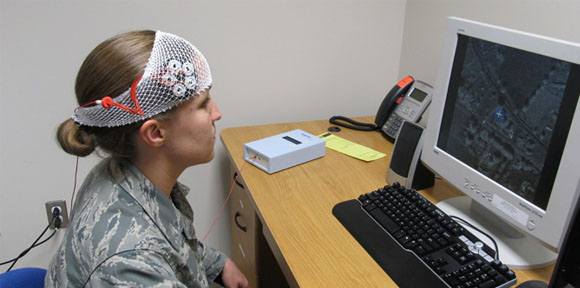
[Michael], [Tom], and a few other people on the Lucid Scribe Database project have been using off-the-shelf EEG equipment to invoke lucid dreaming. Yes, that’s where you take control of your dreams and become a god. This requires wearing an EEG setup while you sleep, and these products aren’t very comfortable sleeping wear. [Tom] decided to take apart a NeuroSky MindWave and turn it into something comfortable to wear all night.

The folks at the Lucid Scribe Database log their dreams with consumer-level EEG equipment, usually something made by NeuroSky. The NeuroSky MindWave is the smallest and cheapest EEG headset available, but it’s still a hard plastic device not conducive to sleeping.

[Tom] removed all the guts and electronic goodies out of his MindWave and attached them to an elastic headband. The MindWave has two sensors – a forehead and ear lobe sensor. For the forehead sensor, [Tom] simply soldered a piece of wire to a penny and attached it to the elastic. The ear lobe sensor in the stock MindWave is a simple clip that was kept in the stock configuration for [Tom]’s mod.

Now that [Tom] has a much more comfortable EEG setup, he can get on with improving his lucid dreaming skills and even try communicating via Morse from inside a dream.

Pulse Oximeter Displays Blood Oxygen Levels On A PC

The last time you were in the emergency room after a horrible accident involving a PVC pressure vessel, a nurse probably clipped a device called a pulse oximeter onto one of your remaining fingers. These small electronic devices detect both your pulse and blood oxygen level with a pair of LEDs and a photosensor. [Anders] sent in a great tutorial for building your own pulse oximeter using a fancy ARM dev board, but the theory behind the operation of this device can be transferred to just about any microcontroller platform.

The theory behind a pulse oximeter relies on the fact that hemoglobin absorbs red and infrared light differently based on its oxygenation levels. By shining a red and IR LED through a finger onto a photoresistor, it’s possible to determine a person’s blood oxygen level with just a tiny bit of math.

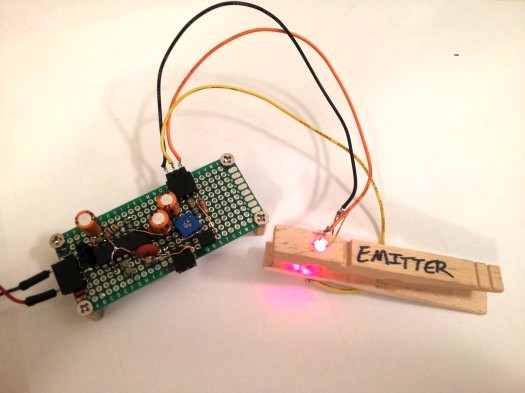
Of course a little bit of hardware needs to be thrown into the project; for this, [Anders] used an EMF32 Gecko starter kit, a great looking ARM dev board. After connecting the LEDs to a few transistors and opamps, [Anders] connected his sensor circuit to the ADC on the Gecko board. From here it was very easy to calculate his blood oxygen level and even display his pulse rate to a PC application.

Yes, for just the price of a dev board and a few LEDs, it’s possible to build your own medical device at a price far below what a commercial pulseox meter would cost. FDA approval not included.

Prosthetic Foot And Ankle Have Amazingly Natural Movement

The natural movement and functional power of the ankle and foot during a step , while appearing fairly simple, are amazingly difficult to replicate with a prosthetic. Usually it requires a fast and fairly powerful motor to provide the forward push and then whip that foot up as we pull our leg forward. However, recent projects have managed to do some amazing jobs at achieving this difficult task. Belgium’s Vrije Universiteit Brussel has released the video (below the break) of the “AMP-Foot 2.0” that pulls this off very well.

The main idea behind the AMP-Foot 2.0 is to have the actuator work longer with a lower power rating while the produced energy is stored in elastic elements and released when needed for propulsion. The device is designed to provide 100% of push-off for a 75 kg subject walking at normal cadence on ground level.

[via Engadget]

Continue reading “Prosthetic Foot And Ankle Have Amazingly Natural Movement”

Controlling A Cockroach Leg With Your Mind

If one hack that controls amputated cockroach legs this week wasn’t enough for you, we’ve got another.

Earlier this week we saw two neuroscientists at Backyard Brains put on a show at a TED talk by connecting an amputated cockroach leg (don’t worry, they grow back) to a $100 electronic device called the SpikerBox. The SpikerBox allows students to explore the world of axons and action potentials by listening in on the electronic signals generated by the hair on the legs of a cockroach. For the finale for their TED talk, the SpikerBox guys attached an MP3 player to the cockroach leg, causing the now dead appendage to dance a little jig.

This new build – the Salt Shaker from Thinker Thing again allows students to amputate cockroach legs, pin them down with electrodes, and cause muscle contractions with the sound of science. Thinker Thing took this one step further than the neuroscientists at Backyard Brains; now you can control a cockroach leg with your mind.

The folks at Thinker Thing are using an off the shelf EEG system from Emotiv to capture the alpha, beta, and delta brainwaves of their new human test subjects. By interpreting these brain signals, they can convert these small variations in cerebral electrical activity to sound files. From there, it’s simply a matter of plugging in the Salt Shaker and moving a cockroach leg with your mind.

In the video after the break you can check out the folks at Thinker Thing playing around with their Salt Shaker and controlling a cockroach leg with a team member’s mind.

Continue reading “Controlling A Cockroach Leg With Your Mind”

Learning Neuroscience With Cockroach Legs

Neuroscientists [Tim Marzullo] and [Greg Gage] wanted a way to get kids interested in neuroscience. What they came up with isn’t terribly far from something found in Frankenstein’s lab; by amputating a cockroach’s leg and attaching electrodes, they’re able to listen to the sound of neurons firing. For an even cooler demonstration, they’re able to apply a little bit of current to the leg and make the leg dance to the beat of the Beastie Boys.

The guys published an article in PLOS One and gave a TED talk demonstrating their SpikerBox, as they call their invention, to the masses. The basic idea is to amplify the electricity generated by cockroach neurons firing. By listening in on the neurons with an iPad app, [Tim] and [Greg] can set the threshold of the recording to detect the action potential of an individual neuron, and listen in on exactly what happens when a single neuron fires.

It seems like a great tool to explain the very basics of what a nervous system – and a brain, both cockroach and human – actually is. In the video after the break, you can see [Greg] playing around with individual cockroach neurons. After that, [Greg] plays the Beastie’s High Plains Drifter into the leg making the muscles contract. Truly, The Sounds of Science.

Continue reading “Learning Neuroscience With Cockroach Legs”