Hearing What The Bats Hear

[Iftah] has been exploring the sounds beyond what we can hear, recording ultrasound and pitching it down. He made a short video on the practice, and it’s like a whole new world of sounds exists just outside of our hearing.

For instance, a dropped toothpick sounds like you’ve just dropped a piece of lumber, a broken lightbulb sounds like a shattered window, and a blackbird sounds like a blue whale. Besides simply sounding super, [Iftah] speculates that there’s some regularity here: that as you slow down the sound it sounds like it came from sources that are physically bigger. He follows this up in a second video, but if you just think about the basic physics, it makes sense.

If you’re interested in recording your own ultrasound, there are a bunch of options on the market. With modern audio processors running up to 192 kHz or even 384 kHz out of the box, all that’s missing is the high-frequency-capable microphone. Those aren’t unobtainable anymore either with many MEMS mics performing well above their rated frequency response specs. Recording ultrasound sounds like a fun and not-too-expensive project to us!

Of course, most of the ultrasound recording we’ve seen has been about the bats. Check out the Pipistrelle or this pair of DIY bat detectors for some good background. But after watching [Iftah]’s video, we’re no longer convinced that the cute little insectivores are the coolest thing going on in the ultrasound.

Continue reading “Hearing What The Bats Hear”

Who’d Have Guessed? Graphene Is Strange!

Graphene always sounds exciting, although we aren’t sure what we want to do with it. One of the most promising features of the monolayer carbon structure is that under the right conditions, it can superconduct, and some research into how that works could have big impacts on practical superconductor technology.

Past experiments have shown that very cold stacks of graphene (two or three sheets) can superconduct if the sheets are at very particular angles, but no one really understands why. A researcher at Northeaster and another at Harvard realized they were both confused about the possible mechanism. Together, they have started progressing toward a better description of superconductivity in graphene.

Continue reading “Who’d Have Guessed? Graphene Is Strange!”

Growing A Gallium-Arsenide Laser Directly On Silicon

As great as silicon is for semiconductor applications, it has one weakness in that using it for lasers isn’t very practical. Never say never though, as it turns out that you can now grow lasers directly on the silicon material. The most optimal material for solid-state lasers in photonics is gallium-arsenide (GaAs), but due to the misalignment of the crystal lattice between the compound (group III-V) semiconductor and silicon (IV) generally separate dies would be produced and (very carefully) aligned or grafted onto the silicon die.

Naturally, it’s far easier and cheaper if a GaAs laser can be grown directly on the silicon die, which is what researchers from IMEC now have done (preprint). Using standard processes and materials, GaAs lasers were grown on industry-standard 300 mm silicon wafers. The trick was to accept the lattice mismatch and instead focus on confining the resulting flaws through a layer of silicon dioxide on top of the wafer. In this layer trenches are created (see top image), which means that when the GaAs is deposited it only contacts the Si inside these grooves, thus limiting the effect of the mismatch and confining it to within these trenches.

There are still a few issues to resolve before this technique can be prepared for mass-production, of course. The produced lasers work at 1,020 nm, which is a shorter wavelength than typically used, and there are still some durability issues due to the manufacturing process that have to be addressed.

How Do We Deal With Microplastics In The Ocean?

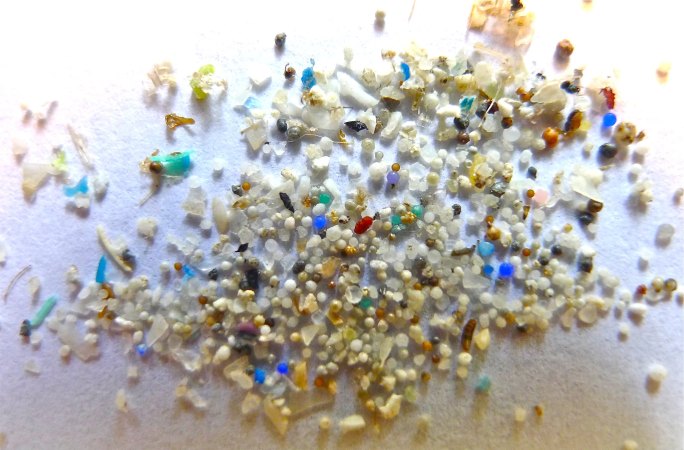
Like the lead paint and asbestos of decades past, microplastics are the new awful contaminant that we really ought to do something about. They’re particularly abundant in the aquatic environment, and that’s not a good thing. While we’ve all seen heartbreaking photos of beaches strewn with water bottles and fishing nets, it’s the invisible threat that keeps environmentalists up at night. We’re talking about microplastics – those tiny fragments that are quietly infiltrating every corner of our oceans.

We’ve dumped billions of tons of plastic waste into our environment, and all that waste breaks down into increasingly smaller particles that never truly disappear. Now, scientists are turning to an unexpected solution to clean up this pollution with the aid of seashells and plants.

Continue reading “How Do We Deal With Microplastics In The Ocean?”

Sleeping arctic fox (Alopex lagopus). (Credit: Rama, Wikimedia)

Investigating Why Animals Sleep: From Memory Sorting To Waste Disposal

What has puzzled researchers and philosophers for many centuries is the ‘why’ of sleep, along with the ‘how’. We human animals know from experience that we need to sleep, and that the longer we go without it, the worse we feel. Chronic sleep-deprivation is known to be even fatal. Yet exactly why do we need sleep? To rest our bodies, and our brains? To sort through a day’s worth of memories? To cleanse our brain of waste products that collect as neurons and supporting cells busily do their thing?

Within the kingdom of Animalia one constant is that its brain-enabled species need to give these brains a regular break and have a good sleep. Although what ‘sleep’ entails here can differ significantly between species, generally it means a period of physical inactivity where the animal’s brain patterns change significantly with slower brainwaves. The occurrence of so-called rapid eye movement (REM) phases is also common, with dreaming quite possibly also being a feature among many animals, though obviously hard to ascertain.

Most recently strong evidence has arisen for sleep being essential to remove waste products, in the form of so-called glymphatic clearance. This is akin to lymphatic waste removal in other tissues, while our brains curiously enough lack a lymphatic system. So is sleeping just to a way to scrub our brains clean of waste?

Continue reading “Investigating Why Animals Sleep: From Memory Sorting To Waste Disposal”

What Happens If You Die In Space?

There are no two ways about it—space will kill you if you give it half a chance. More than land, sea, or air, the space environment is entirely hostile to human existence. Precision-engineered craft are the bare minimum just to ensure human survival. Even still, between the vacuum, radiation, micrometeorites, and equipment failures, there are plenty of ways for things to go catastrophically wrong beyond Earth’s atmosphere.

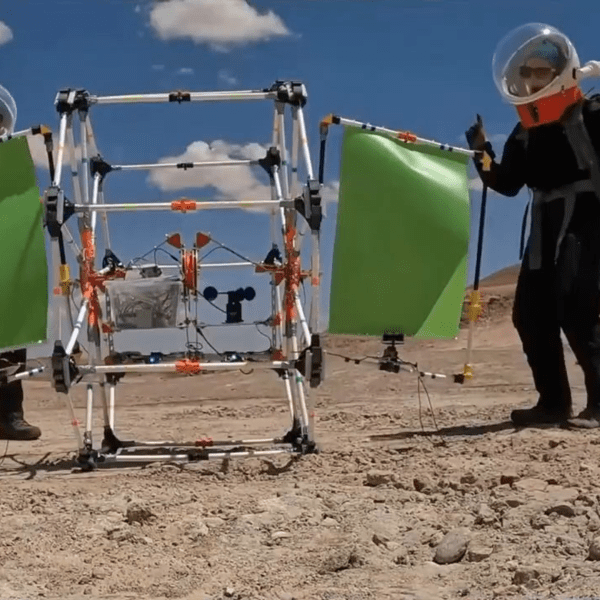
Despite the hazards, most spacefaring humans have completed their missions without injury. However, as we look to return to the Moon, tread on Mars, and beyond, it’s increasingly likely that future astronauts could pass away during longer missions. When that inevitably happens, the question is simple—how do you deal with death in space?

Continue reading “What Happens If You Die In Space?”

Is Fire Conductive Enough To Power A Lamp?

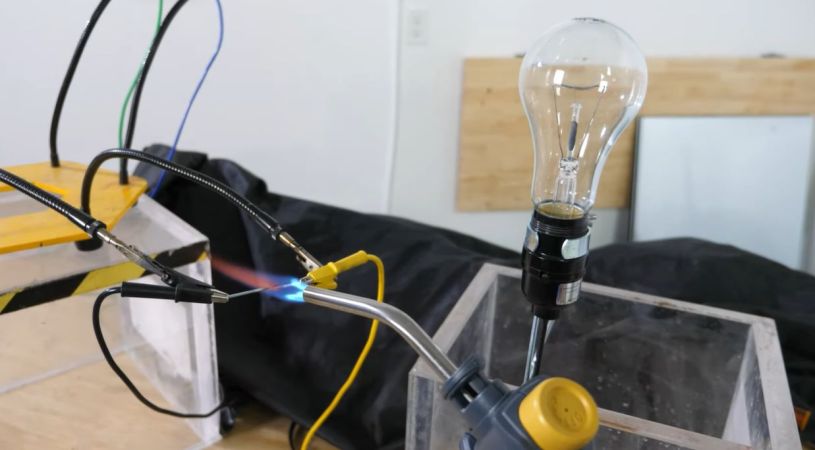
Is fire conductive? As ridiculous that may sound at first glance, from a physics perspective the rapid oxidation process we call ‘fire’ produces a lot of substances that can reduce the electrical insulating (dielectric) properties of air. Is this change enough to allow for significant current to pass? To test this, [The Action Lab] on YouTube ran some experiments after being called out on this apparent fact in the comments to an earlier video.

Ultimately what you need to make ‘fire’ conductive is to have an appreciable amount of plasma to reduce the dielectric constant, which means that you cannot just use any rapid oxidation process. In the demonstration with lights and what appears to be a (relatively clean-burning) butane torch, the current conducted is not enough to light up an incandescent or LED light bulb, but can light up a 5 mm LED. When using his arm as a de-facto sensor, it does not conduct enough current to be noticeable.

The more interesting experiment here demonstrates the difference in dielectric breakdown of air at different temperatures. As the dielectric constant for hot air is much lower than for room temperature air, even a clean burning torch is enough to register on a multimeter. Ultimately this seems to be the biggest hazard with fire around exposed (HV) electrical systems, as the ionic density of most types of fire just isn’t high enough.

To reliably strike a conductive plasma arc, you’d need something like explosive (copper) wire and a few thousand joules to pump through it.

Continue reading “Is Fire Conductive Enough To Power A Lamp?”