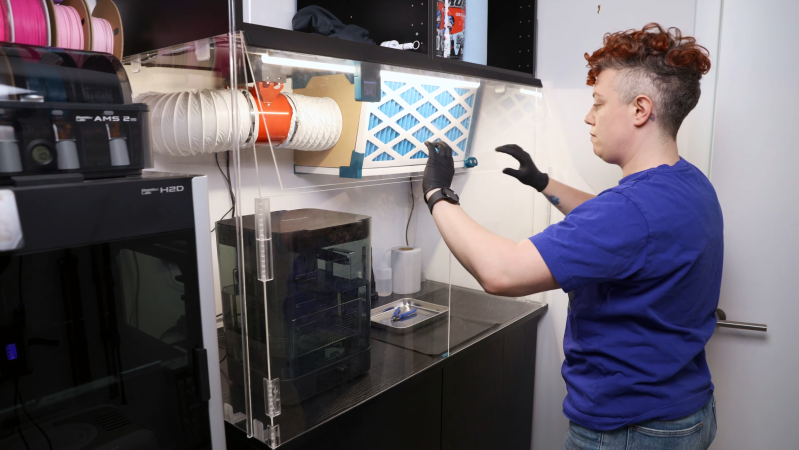
A person is standing in front of an acrylic enclosure, lowering a door on the enclosure. The enclosure contains the space between two sets of cabinets, and has three doors on the front. Inside the enclosure is an air filter and a washing station.

A Fume-Control Cabinet For Resin 3D Printing

For a certain kind of intricate, highly-detailed manufacturing, there’s really no substitute for a resin 3D printer, and it’s therefore unfortunate that they require so many poisonous chemicals. The resin itself usually contains irritating acrylates and methacrylates, it can emit a wide spectrum of volatile organic compounds (VOCs) during printing, and even the isopropyl alcohol used in cleaning is moderately toxic. [Allie Katz] accordingly built this fume-control enclosure for resin printing and other ventilation-critical processes.

The biggest constraint was space: [Allie]’s workspace had a fairly limited volume available, and the enclosure needed to hold an SLA printer, an isopropyl alcohol washing station, a UV curing chamber, and miscellaneous supplies. Most of the enclosure was made out of IKEA cabinets, using some large cabinets at the base to hold the printer and curing station, a countertop over these to hold the washing station, and more cabinets above to hold supplies. An MDF backing panel and acrylic side panels enclose the workspace between the cabinets. There was no safe way to exhaust fumes, so the enclosure recycles its air: a fan pulls air in through an activated-carbon filter mounted above the work area and into the plenum behind the chamber, from which it passes through the printer’s cabinet back into the workspace enclosure. Panel filters surround the carbon filter to catch particulate matter.

The enclosure uses four ESP32-based boards for automation: one uses a touchscreen to display data, and three are paired with BME680 sensors, primarily to report VOC concentrations. One, which also has a particulate matter sensor, senses air quality in the main chamber and plenum, one monitors air quality in the rest of the shop, and the third detects clogging from within the filter enclosure. The first real test of the chamber was to 3D print and paint some handles for the cabinets. It worked as expected, detecting the increased VOCs and ramping up the fan to keep them in check.

We’ve seen a ventilated printer enclosure before, that time for an FDM printer. Although their hazards are less blatant, they too can produce dangerous fumes, which could possibly be carcinogenic.

Thanks to [Keith Olson] for the tip!
DIY Filtered Positive Pressure Suit Shows Fine Workmanship

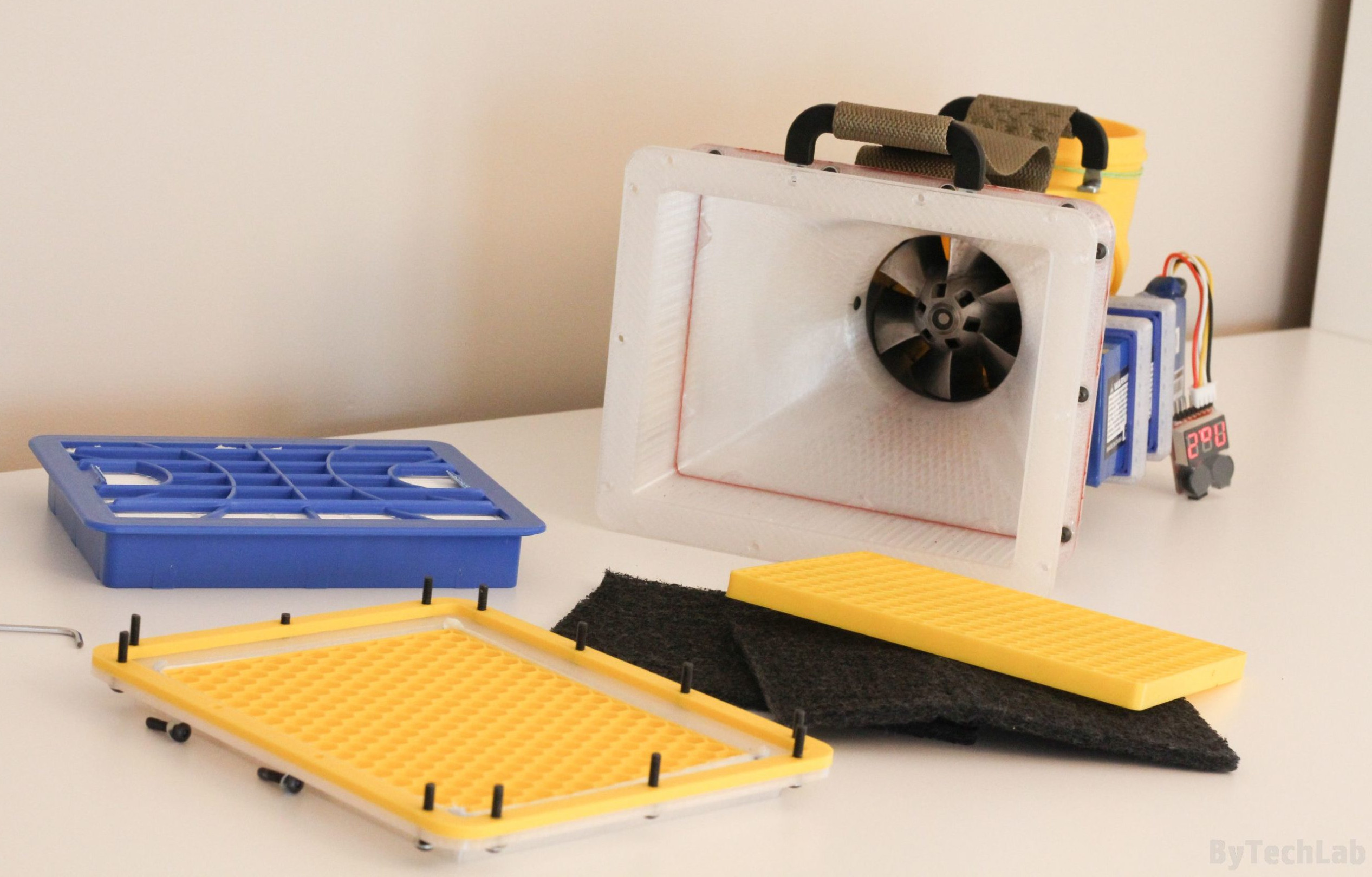
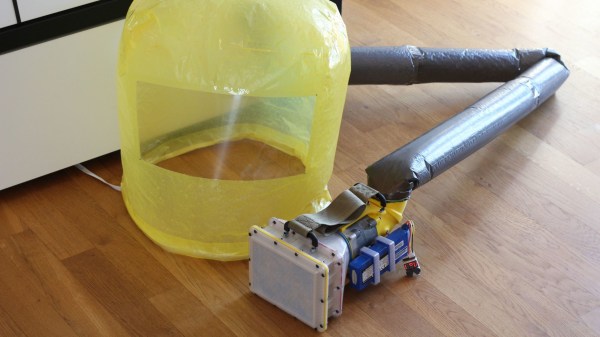
[Andrew]’s Air filtering unit & positive pressure supply might look like something off the set of Ghostbusters, but it’s an experiment in making a makeshift (but feasible) positive pressure suit. The idea is to provide an excess of filtered air to what is essentially an inflatable soft helmet. The wearer can breathe filtered air while the positive pressure means nothing else gets in. It’s definitely an involved build that uses some specific hardware he had on hand, but the workmanship is great and shows some thoughtful design elements.

The unit has three stacked filters that can be easily swapped. The first stage is medical mask material, intended to catch most large particles, which is supported by a honeycomb frame. The next filter is an off-the-shelf HEPA filter sealed with a gasket; these are available in a wide variety of sizes and shapes so [Andrew] selected one that was a good fit. The third and final stage is an activated carbon filter that, like the first stage, is supported by a honeycomb frame. The idea is that air that makes it through all three filters is safe (or at least safer) to breathe. There isn’t any need for the helmet part to be leakproof, because the positive pressure relative to the environment means nothing gets in.

Air is sucked through the filters and moved to the helmet by an HP BLc7000 server fan unit, which he had on hand but are also readily available on eBay. These fan units are capable of shoveling a surprising amount of air, if one doesn’t mind a surprising amount of noise in the process, so while stacked filter stages certainly impede airflow, the fan unit handles it easily. The BLc7000 isn’t a simple DC motor and requires a driver, so for reference [Andrew] has a short YouTube video of how the fan works and acts.

All the 3D models and design files are available online should anyone wish to take a closer look. It’s certainly a neat experiment in making a filtered positive pressure supply and head cover with materials that are fairly common. If [Andrew] ever wants to move to a whole-body suit, maybe repurpose an old Halloween costume into a serviceable positive pressure suit.

Breathe Easy With A Laser Cutter Air Filter

A laser cutter is a great tool to have in the shop, but like other CNC machines it can make a lousy neighbor. Vaporizing your stock means you end up breathing stuff you might rather not. If you’re going to be around these fumes all day, you’ll want good fume extraction, and you might just consider a DIY fume and particulate filter to polish the exhausted air.

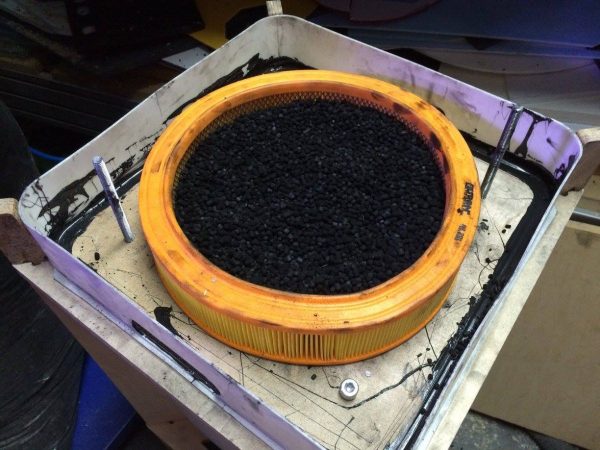
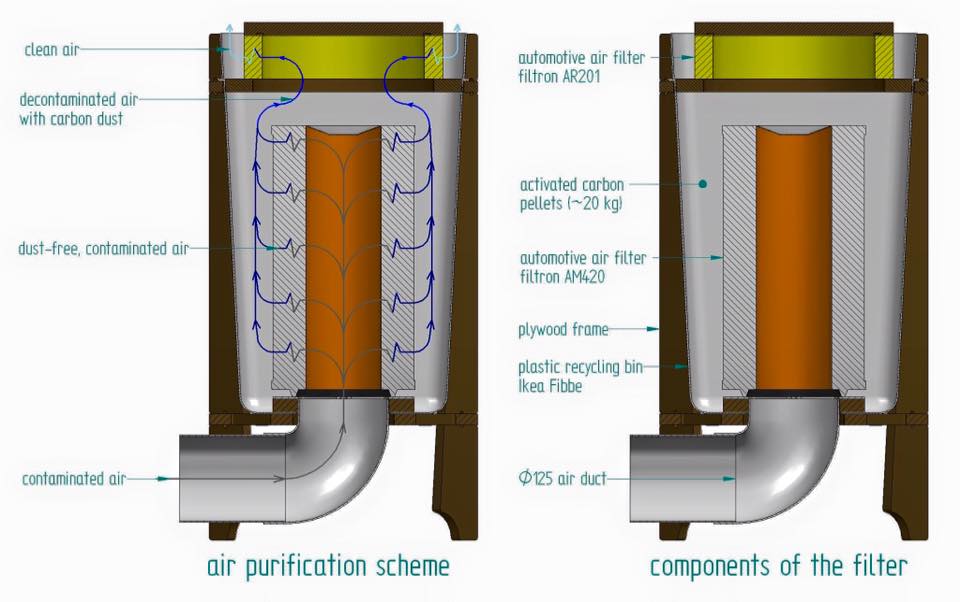
15203365_644939182347358_619032134291602214_nWhile there’s no build log per se, [ZbLab]’s Facebook page has a gallery of photos that show the design and build in enough detail to get the gist. The main element of the filter is 25 kg of activated charcoal to trap the volatile organic compounds in the laser exhaust. The charcoal is packed into an IKEA garbage can around a prefilter made from a canister-style automotive air cleaner – [ZbLab] uses a Filtron filter that crosses to the more commonly available Fram CA3281. Another air cleaner element (Fram CA3333) makes sure no loose charcoal dust is expelled from the filter. The frame is built of birch ply and the plumbing is simple PVC. With a 125mm inlet it looks like this filter can really breathe, and it would easily scale up or down in size according to your needs.

No laser cutter in your shop to justify this filter, you say? Why not build one? Or, if you do any soldering, this downdraft fume extractor is a good way to clear the air.

Home Brew Supercapacitor Whipped Up In The Kitchen

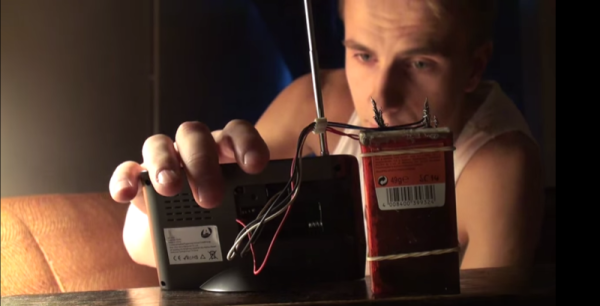
[Taavi] has a problem – a wonky alarm clock is causing him to repeatedly miss his chemistry class. His solution? Outfit his clock radio with a supercapacitor, of course! But not just any supercapacitor – a home-brew 400 Farad supercap in a Tic Tac container (YouTube video in Estonian with English subtitles.)

[Taavi] turns out to be quite a resourceful lad with his build. A bit of hardware cloth and some stainless steel from a scouring pad form a support for the porous carbon electrode, made by mixing crushed activated charcoal with epoxy and squeezing them in a field-expedient press. We’ll bet his roommates weren’t too keen with the way he harvested materials for the press from the kitchen table, nor were they likely thrilled with what he did to the coffee grinder, but science isn’t about the “why?”; it’s about the “why not?” Electrodes are sandwiched with a dielectric made from polypropylene shade cloth, squeezed into a Tic Tac container, and filled with drain cleaner for the electrolyte. A quick bit of charging circuitry, and [Taavi] doesn’t have to sweat that tardy slip anymore.

The video is part of a series of 111 chemistry lessons developed by the chemistry faculty of the University of Tartu in Estonia. The list of experiments is impressive, and a lot of the teaser stills show impressively exothermic reactions, like the reduction of lead oxide with aluminum to get metallic lead or what happens when rubidium and water get together. Some of this is serious “do not try this at home” stuff, but there’s no denying the appeal of watching stuff blow up.

As for [Taavi]’s supercap, we’ve seen a few applications for them before, like this hybrid scooter. [Taavi] may also want to earn points for Tic Tac hacks by pairing his supercapacitor with this Tic Tac clock.

[Thanks, Lloyd!]