Damage To Arecibo Leaves Gaping Hole In Astronomy

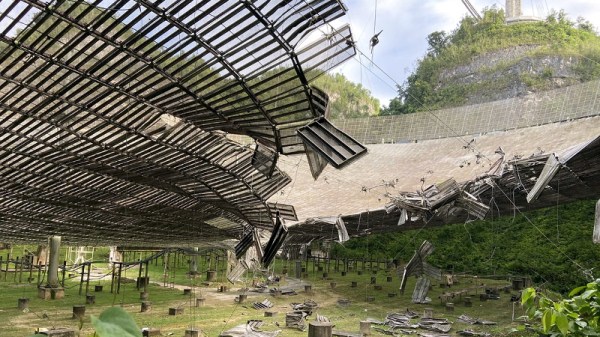
In the early morning hours of August 10th, a support cable at the Arecibo Observatory pulled lose from its mount and crashed through the face of the primary reflector below. Images taken from below the iconic 305 meter dish, made famous by films such as Contact and GoldenEye, show an incredible amount of damage. The section of thick cable, estimated to weigh in at around 6,000 kilograms (13,000 pounds), had little difficulty tearing through the reflector’s thin mesh construction.

Worse still, the cable also struck the so-called “Gregorian dome”, the structure suspended over the dish where the sensitive instruments are mounted. At the time of this writing it’s still unclear as to whether or not any of that instrumentation has been damaged, though NASA at least has said that the equipment they operate inside the dome appears to have survived unscathed. At the very least, the damage to the dome structure itself will need to be addressed before the Observatory can resume normal operations.
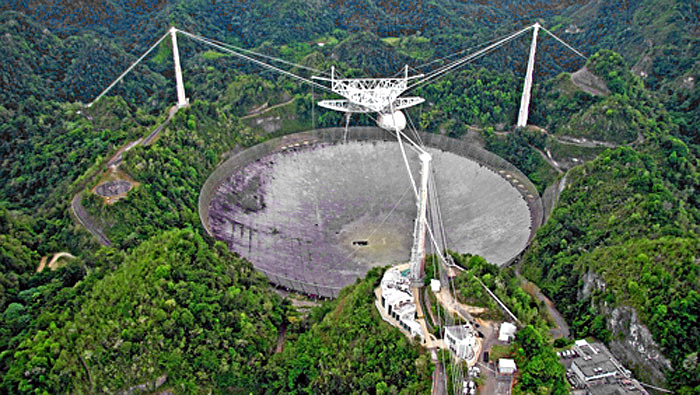
The Arecibo Observatory by JidoBG [CC-BY-SA 4.0]
But how long will the repairs take, and who’s going to pay for them? It’s no secret that funding for the 60 year old telescope has been difficult to come by since at least the early 2000s. The cost of repairing the relatively minor damage to the telescope sustained during Hurricane Maria in 2017 may have been enough to shutter the installation permanently if it hadn’t been for a consortium led by the University of Central Florida. They agreed to share the burden of operating the Observatory with the National Science Foundation and put up several million dollars of additional funding.

It’s far too early to know how much time and money it will take to get Arecibo Observatory back up to operational status, but with the current world situation, it seems likely the telescope will be out of commission for at least the rest of the year. Given the fact that repairs from the 2017 damage still haven’t been completed, perhaps even longer than that. In the meantime, astronomers around the globe are left without this wholly unique resource.

Continue reading “Damage To Arecibo Leaves Gaping Hole In Astronomy”
The WISE In NEOWISE: How A Hibernating Satellite Awoke To Discover The Comet

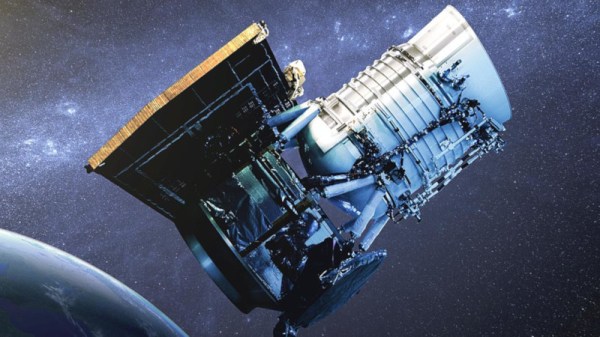
Over the last few weeks the media has been full of talk about NEOWISE, one of the brightest and most spectacular comets to ever pass through our solar system that you can still see if you hurry. While the excitement over this interstellar traveler is more than justified, it’s also an excellent opportunity to celebrate the Wide-field Infrared Survey Explorer (WISE) space telescope it was named after. The discovery of this particular comet is just the latest triumph in the orbiting observatory’s incredible mission of discovery that’s spanned over a decade, with no signs of slowing down anytime soon.

In fact, WISE has been operational for so long now that its mission has evolved beyond its original scope. When it was launched in December 2009 from California’s Vandenberg Air Force Base, its primary mission was scheduled to be completed in less than a year. But like many NASA spacecraft that came before it, WISE achieved its original design goals and found itself ready for a new challenge. Though not before it spent almost three years in hibernation mode as the agency decided what to do with it.

Continue reading “The WISE In NEOWISE: How A Hibernating Satellite Awoke To Discover The Comet”

The Science Of Landing On An Asteroid

Exploiting the resources of the rock-strewn expanse of space between Mars and the outer planets has been the stuff of science fiction for ages. There’s gold in them ‘thar space rocks, or diamonds, or platinum, or something that makes them attractive targets for capitalists and scientists alike. But before actually extracting the riches of the asteroid belt, stuck here as we are at the bottom of a very deep gravity well that’s very expensive to climb out of, we have to answer a few questions. Like, how does one rendezvous with an asteroid? What’s involved with maneuvering near a comparatively tiny celestial body? And most importantly, how exactly does one land on an asteroid and do any useful work?

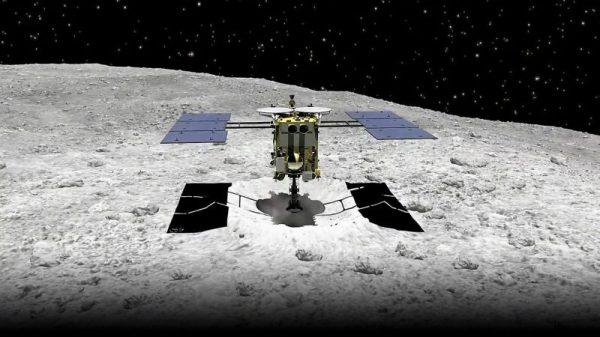
Back in June, a spacecraft launched by the Japanese Aerospace Exploration Agency (JAXA) finally caught up to an asteroid named Ryugu after having chased it for the better part of four years. The Hayabusa2 was equipped to answer all those questions and more, and as it settled in close to the asteroid with a small fleet of robotic rovers on board, it was about to make history. Here’s how they managed to not only land on an asteroid, but how the rovers move around on the surface, and how they’ll return samples of the asteroid to Earth for study.

Continue reading “The Science Of Landing On An Asteroid”

Hackaday 10th Anniversary: Hacking Your Way To NASA

[Steve] drives spacecraft for a living. As an engineer at the Jet Propulsion Laboratory, he’s guided probes to comets, asteroids, Mars, and Jupiter, figured out what happens when telemetry from these probes starts looking weird, and fills the role of the Space Hippy whenever NASA needs some unofficial PR.

Like most people who are impossibly cool, [Steve]’s career isn’t something he actively pursued since childhood. Rather, it’s something that fell in his lap. With qualifications like building a robotic computer to typewriter interface, a custom in-car navigation system in the late 80s, and a lot of work with an Amiga, we can see where [Steve] got his skills.

The earliest ‘hack’ [Steve] can remember was just that – an ugly, poorly welded sidecar for his bicycle made in his early teens. From there, he graduated to Lasertag landmines, Tesla coils, and building camera rigs, including a little bit of work on Octopussy, and a rig for a Miata. It helps when your dad is a cinematographer, it seems.

In college, [Steve] used his experience with 6502 assembler to create one of the first computerized lighting controllers (pre-DMX). After reading a biography on [Buzz Aldrin], [Steve] realized doing his thesis on orbital rendezvous would at least be interesting, if not an exceptionally good way to get the attention of NASA.

Around this time, [Steve] ran into an engineering firm that was developing, ‘something like Mathematica’ for the Apple II, and knowing 6502 assembly got him in the door. This company was also working to get the GPS constellation up and running, and [Steve]’s thesis on orbital mechanics eventually got him a job at JPL.

There’s several lifetimes worth of hacks and builds [Steve] went over at the end of his talk. The highlights include a C64 navigation system for a VW bug, a water drop high voltage machine, and a video editing system built from a few optical encoders. This experience with hacking and modding has served him well at work, too: when the star sensor for Deep Space 1 failed, [Steve] and his coworkers used the science camera as a stand in navigation aid.

One final note: Yes, I asked [Steve] if he played Kerbal Space Program. He’s heard of it, but hasn’t spent much time in it. He was impressed with it, though, and we’ll get a video of him flying around the Jool system eventually.

Pocket Sized Sattelites For Asteroid Detection

satellite

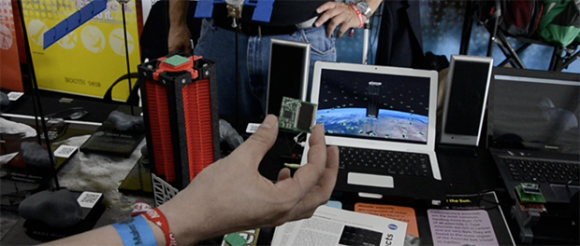
We’ve seen kicksats before, small pocketable single board satellites designed to orbit Earth. At this year’s Maker Faire, the team behind these kicksats has a new plan: using them to determine the orbits of earth-passing asteroids and hopefully not giving us any forewarning of our imminent extinction.

Instead of simply orbiting Earth, the new plan for these kicksats is to deploy them into the path of an oncoming asteroid such as Apophis so the radio transmissions from each satellite can pinpoint where exactly the asteroid is, something Earthbound optical and radio telescopes struggle with.

Despite the small size, the hardware on each kicksat is pretty impressive; each mini satellite has a solar cell on each side, a low-power MSP430 microcontroller with a radio module, and a few sensors. The system is designed so anyone can pick up the telemetry from these satellites with a small Yagi antenna and an RTL SDR TV tuner dongle.

An impressive bit of kit, but if holding a satellite or asteroid in your hand is more your thing, the same team behind the kicksat put up a whole bunch of 3D models of asteroids and space probes. They’re actually quite impressive when they’re printed out.