
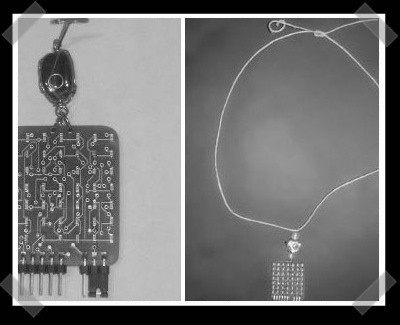
Here’s an interesting kit put together just to help you work on your SMD soldering skills. It’s got 49 SMD LEDs on the front with a programming header and switch jumper. The back has an ATtiny26L and a coin cell. At only 3V, power management is essential; all of the example programs are only addressing one LED at a time (imperceptible to the human eye). If you turn on too many LEDs at the same time, the voltage drop could cause the AVR to reset. Included example programs are a scrolling marque, bouncing balls, and Conway’s game of life. SparkFun has tutorials for regular SMD soldering and using a reflow skillet. The video below shows the kit builder attaching just one LED using the heat and slide method.
attiny183 Articles
Deogen, Tiny Monitor Tester
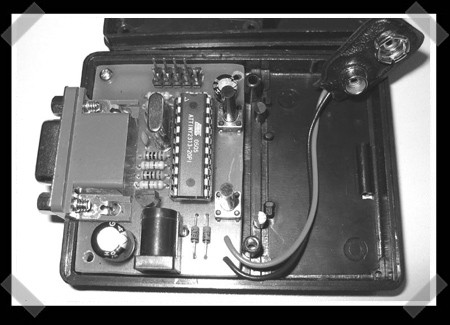
Deogen is a small, self contained device for testing monitors. It was designed back in 2000 to reduce the amount of space and effort required to test monitors in a computer shop. The initial design used an AT90S1200 microcontroller to generate test patterns for the monitors. Being about the size of a portable CD player, it was much easier to take to any monitor and plug in for testing.
Version two of the device, pictured above, is much smaller, being about the width and height of a credit card. The depth is slightly larger than a 9 volt battery. Compared to the last vga test project we ran, this one is tiny. The unit boasts a decent set of features, such as; eight test patterns at four different resolutions, battery or DC power, and small form factor.
The processor of version two is an ATtiny2313 at 20MHz, and controls the H sync and V sync signals directly. The RGB is converted to analog using a resister network. The power circuit is custom made for low power consumption, though they note that a 78L05 equivalent unit could be used in its place.
The plans for the PCB and the software are available from their site. Head on over and check out some pictures of it in action.
[Thanks, Philip Fitzgerald]
Synchronizing Fireflies NG
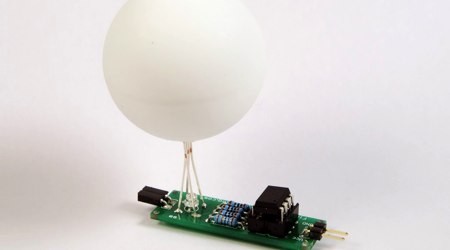
[Alex] from Tinkerlog has revisited an old project with Synchronizing Fireflies NG. Fascinated by how fireflies blink at same rate and synchronize with each other, he built a digital version. Each board has an RGB LED and a phototransistor or photoresistor. A ping-pong ball is used as a diffuser. The blink rate is controlled by an ATtiny13v. The board power can be daisy chained, but each firefly mote operates independently of the others. The microcontroller has a fixed flash rate and monitors for other flashes. It attempts to sync by flashing earlier. The color of the LED expresses how satisfied the firefly is with its current sync. You can see a video of eight fireflies attempting to self organize embedded below.
Breath Controlled LED Candles
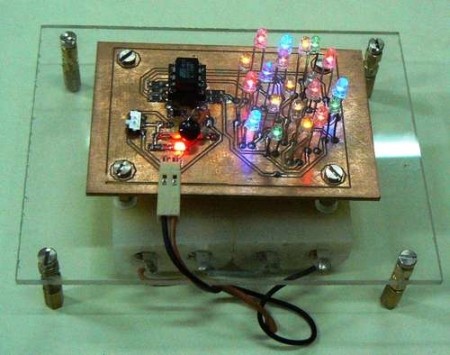
Instructables user [cedtlab] has posted an interesting LED project that simulates birthday candles. The circuit runs on an AVR ATTiny45, and is powered by 4 AA or AAA batteries. By using a Charliplexing technique, they are able to drive all 20 LEDs with only 5 pins of the ATTiny. A thermistor is used for detecting breath by measuring temperature changes, and then blocks of LEDs turn off depending on the change detected. They have provided schematics and source code for everything. Make sure to check out the video of the “ficticious birthday party” after the break.
Perceptual Chronograph
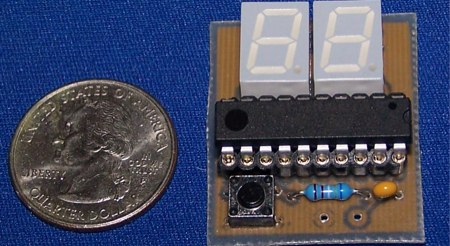
All praise to [Limor] for uncovering this incredibly odd project. [magician]’s perceptual chronograph is designed to test whether time “slows down” in stressful situations. The device flashes a random number on the display very quickly so that it is impossible to perceive what is actually being displayed. If you can read the number while under stress, it means that your ability perceive time has increased. It’s hard to believe, but check out the video embedded after the break that investigates the phenomenon. We can’t help, but wonder how [magician] personally plans on testing this.
Random USB Caps Locker
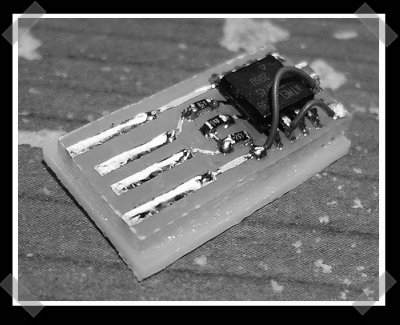
This is one of the most original April fools gags I’ve seen. [Garrett] sent in his USB caps locker. It’s built from an ATTiny45 and puts out an intermittent signal to set the caps lock key. Considering what day it is, it appears to be legit. After you’re done screwing with your co-worker for the day, you might be even more interested in the easylogger project that it’s based on.
Simple Capacitance Meter
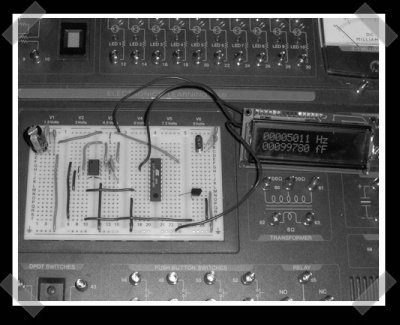
[Mike] sent in a project he’s been working on lately. This little circuit can measure the capacitance of a capacitor by generating a frequency that’s inversely related to the capacitance. He originally got it working with his o-scope, and followed up by building a stand alone version that uses an ATTiny2313 and a text LCD.









