At Hackaday we’re all about DIY. However, projects can have many components, and so there’s sometimes a choice between making something or buying it. In this case, [GreatScott!] wondered if it would be cheaper to make or buy a lithium-ion battery pack for his new eBike kit. To find out, he decided to make one.
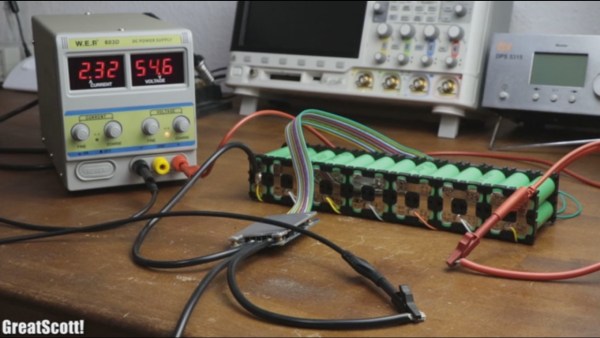
After some calculations, he found he’d need thirteen 18650 cells in series but decided to double the capacity by connecting another thirteen in parallel. That gave him a 5 Ah capacity battery pack with a nominal voltage of 48.1 V and one capable of supplying a constant current of 40 A. Rather than connect them by soldering the nickel strips, he purchased a kWeld battery spot welder, adding to the cost of the build. He charged his new battery pack using his bench power supply but being concerned about uneven charging of the cells over the battery pack’s lifetime, he added a Battery Management System (BMS). The resulting battery pack powers his eBike motor just fine.
After adding up all the costs, he found it was only a tiny bit cheaper than prices for comparable battery packs on eBay, which were €24.4 per Ah (US$29.5 per Ah). The only way it would be cheaper is if he made multiple packs, spreading out the one-time cost of the battery spot welder. So that means it’s really up to your preference. See his video below to judge for yourself if you’d rather do it the DIY way. And then let us know what you’d do in the comments below.
Continue reading “Comparing Making To Buying A Lithium Ion Battery Pack”