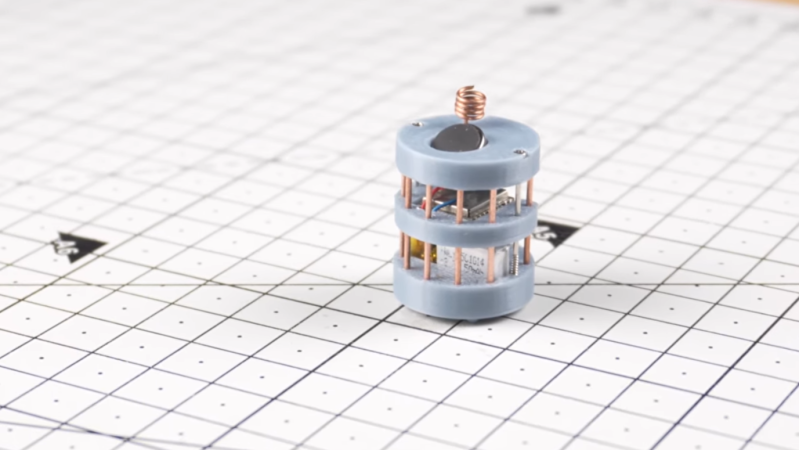
A cylindrical grey robot sits on a white mat. The robot is made of three grey sections connected by a series of radially-arranged copper pillars.

Controlling A Vibrobot With Only One Motor

The vibrobot – a vibrating motor and battery attached to the head of a brush – isn’t truly a robot, since its movement can’t be controlled, but it’s whetted the interest of many future roboticists. With a clever control method, though, it is in fact possible to drive them in any desired direction while using only one motor.

[Namaskar Mitro] based the design of this robot on this research paper; if the vibrating motor is mounted at an angle above the base of the robot, it causes the bot to rotate, and if the motor is mounted off-center from the center of mass, the robot moves in a circle. Crucially, reversing the direction of the motor’s rotation reverses the direction of the robot’s rotation. By rapidly switching the direction of rotation, the bot can move in a series of short, shallow arcs which approximate a straight line.

The robot which [Namaskar] built was based on an ESP-01F microcontroller, which let it be remote-controlled over Wi-Fi. It used a DRF8212 motor driver to control a vibrating pager motor, which was housed inside a 3D-printed enclosure. To move in a straight line, the ESP-01F switches the motor’s direction every 250 milliseconds, which still produces a slightly erratic movement. It can, however, approximately follow a traced path.

This adds to the previous vibrobot control methods we’ve seen: a pair of differentially-driven vibrating motors or a weight-shifting mechanism.

Thanks to [110y6] for the tip!
Black Line Follower: A Modern Bristlebot

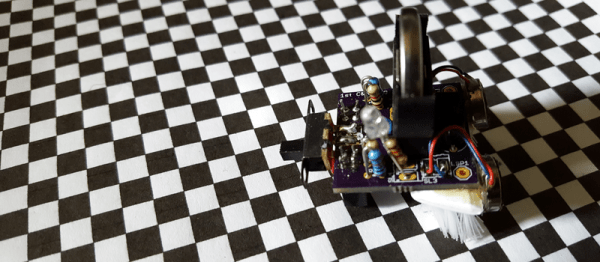
It’s been a while since we’ve seen much action on the bristlebot front, which is too bad. So we’re happy to see [Extreme Electronics]’s take on the classic introductory “robot”: the Black Line Follower. The beauty of these things is their simplicity, so we’ll just point you to his build instructions and leave the rest to you.

The original bristlebot is a fantastic introduction to electronics, because it’s simple enough that you can cobble one together in no time. A battery, a pager motor, and a toothbrush head are all you need. But it goes where it wants, rather than where you want it to go.

Adding steering is as simple as tying two bristlebots together and firing one motor at a time to execute a turn. The Black Line Follower is of this style.

Of course, any good idea can be taken to extremes, as in this giant weight-shifting bristlebot, or this super-tiny IR-controlled bristlebot.

But that was more than five years ago now. What happened to the mighty engines of bristlebot creativity? Has the b-bot seen its finest hour? Or are we just waiting for the next generation to wiggle up to the plate?

Continue reading “Black Line Follower: A Modern Bristlebot”

3D Printed Bristle Bots (Robot Cockroaches!)

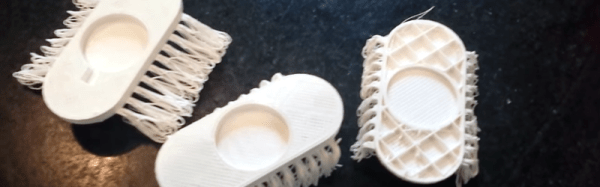
Bristlebots are one of our favorite projects to teach young hackers the basics of electronics. They’re easy to build, fun, and most importantly — cute. Usually you make them out of the head of an old toothbrush and a cellphone vibrating motor, but [Kevin Osborn] figured out a way to 3D print the entire thing!

He got the idea from [Mark Peeters] who figured out how to turn one of the disadvantages of FDM style printers, into a new way of producing more abstract 3D prints… He calls it the Drooloop method, and you can make some really cool 3D printed flowers with it! Basically, it means you design parts without support structures and design in a droop. If you do it right, you can create the bristles for your Bristlebot!

Continue reading “3D Printed Bristle Bots (Robot Cockroaches!)”