

Figuring Out What James Webb’s Mysterious Little Red Dots Are

After the James Webb Space Telescope (JWST) began operations in 2022, it soon made a tantalizing discovery in the form of mysterious red dots: small, red-tinted astronomical objects of unknown origin and composition. So far well over 300 of such little red dots (LRDs) have been identified, with many theories on what they are. Fortunately the Chandra X-ray Observatory recently added some more clues as detailed in an accompanying paper.
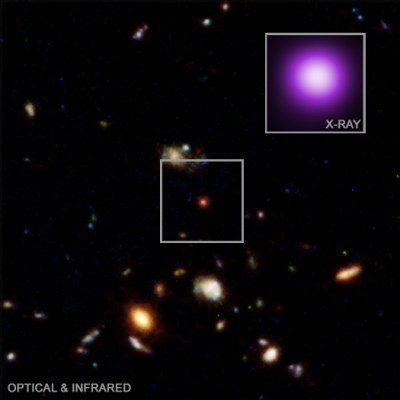
Current theories include them being a form of primordial galaxy, or a supermassive black holes embedded in a dense gas cloud. The LRD discussed in the paper with the designation 3DHST-AEGIS-12014 was found to emit X-rays unlike other LRDs. By comparing the data between JWST and Chandra for this LRD it lends credence to the theory that these LRDs are a transitional phase as a supermassive black hole ingests the material of said gas cloud.

X-rays produced during this can sometimes make it out of the gas cloud, after which we can observe it. If that’s the case, these LRDs should cease to exist the moment the black hole has consumed enough of the cloud, which is something that we may be able to find evidence for if we’re lucky.

This adds just another reason why keeping the Chandra X-ray Observatory mission funded, after it narrowly got saved in 2024.


Chandra X-ray Observatory Threatened By Budget Cuts

Launched aboard the Space Shuttle Columbia in July of 1999, the Chandra X-ray Observatory is the most capable space telescope of its kind. As of this writing, the spacecraft is in good health and is returning valuable scientific data. It’s currently in an orbit that extends at its highest point to nearly one-third the distance to the Moon, which gives it an ideal vantage point from which to make its observations, and won’t reenter the Earth’s atmosphere for hundreds if not thousands of years.

Yet despite this rosy report card, Chandra’s future is anything but certain. Faced with the impossible task of funding all of its scientific missions with the relative pittance they’re allocated from the federal government, NASA has signaled its intent to wind down the space telescope’s operations over the next several years. According to their latest budget request, the agency wants to slash the program’s $41 million budget nearly in half for 2026. Funding would remain stable at that point for the next two years, but in 2029, the money set aside for Chandra would be dropped to just $5.2 million.

Drastically reducing Chandra’s budget by the end of the decade wouldn’t be so unexpected if its successor was due to come online in a similar time frame. Indeed, it would almost be expected. But despite being considered a high scientific priority, the x-ray observatory intended to replace Chandra isn’t even off the drawing board yet. The 2019 concept study report for what NASA is currently calling the Lynx X-ray Observatory estimates a launch date in the mid-2030s at the absolute earliest, pointing out that several of the key components of the proposed telescope still need several years of development before they’ll reach the necessary Technology Readiness Level (TRL) for such a high profile mission.

With its replacement for this uniquely capable space telescope decades away even by the most optimistic of estimates, the  potential early retirement of the Chandra X-ray Observatory has many researchers concerned about the gap it will leave in our ability to study the cosmos.

Continue reading “Chandra X-ray Observatory Threatened By Budget Cuts”







