
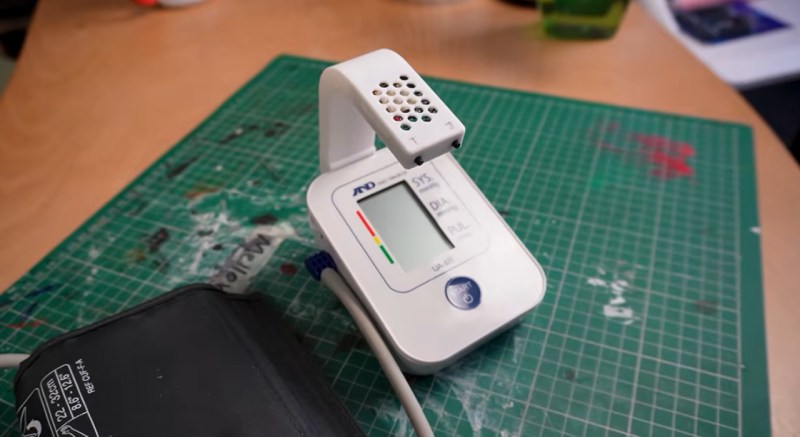
Given the modern trend of interconnecting anything and everything, we have no doubt that somebody sells a blood pressure monitor that will push its measurements out to all sorts of cloud services on your behalf. We’re equally sure that doing so requires you to sign up for some new account or service, and that there may even be a subscription cost hiding in there as well.
Looking to record his vitals on his own terms, [Tomasz Burzy] set out to modify a basic blood pressure monitor so that it would send its data out over WiFi. He succeeds in the end, but as is so often the case around these parts, the journey ended up being just as interesting as the final destination.
His initial idea was to tap into the monitor’s PCB with his logic analyzer. He quickly found a test point that let him pull the raw value from the unit’s pressure sensor, and with a little massaging, he even got some code running that turned that into a fair estimation of his actual blood pressure. But it didn’t quite match what the display showed, and doing some research, he found that these monitors generally employ some unknowable Secret Sauce to derive the final result from the raw data.
Efforts to intercept the final number from the device’s main chip before it was sent off to the display driver were stymied by the fact that it was the display driver. The unit was so well integrated, presumably to drive down the cost, that there was a single IC handling essentially all aspects of its operation. So much for the logic analyzer route.
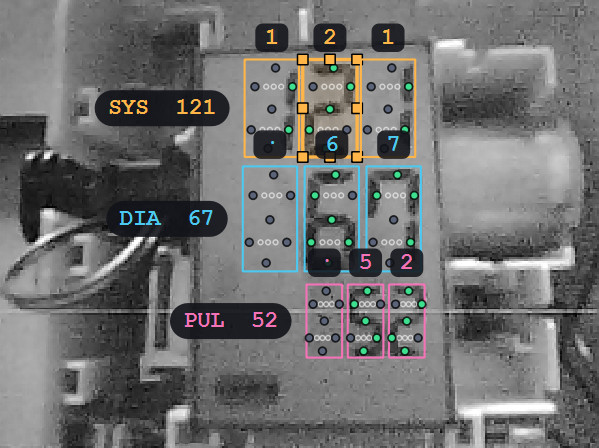
In the end, [Tomasz] took the nuclear option and used a camera mounted to the top of the unit to pull data off the display optically. But instead of a full-fat computer running some computer vision software, he’s able to pull it off on an ESP32-CAM module. How? Because he knows exactly where each segment of the LCD is, he simply needs to check a set array of coordinates in the camera’s image to see if they are lit up or not. This greatly reduces the complexity of the task, and brings it within the capabilities of the lowly microcontroller.
Although we love the idea of developing hacker-friendly medical devices that give up their data without having to jump through so many hoops, we appreciate the effort [Tomasz] put into this, and think it’s a fantastic example for similar reverse engineering efforts.











Those cheapo blood pressure monitors are about as accuratre as throwing peanuts at the toilet seat. If you want real reading, pay up or get a calibrated analog meter.
A for effort
F for results
That has nothing to do with the digital part, or are your implying that the ADC makes it inaccurate?
All cheap BPMs are inaccurate, analog or digital.
Doctors and hospitals all use digital BPMs nowadays.
So what? It’s not about a 0,1% accuracy, measuring blood pressure with a stethoscope is even less reliable and less repeatable.
Is this still easier than tapping into the LCD drive lines?
I don’t know if I would trust OCR. I have done the same exact project (also for reading a BP instrument!) but using an app that I made AI write for me. It doesn’t work very well, I tried fixed bounding boxes in the viewfinder, tried alternating between models trained on segment data vs larger generic text data. Nothing made it fool proof
I did actually look into tapping the display after the fact, but it’s actually a lot more difficult because of multiplexing and AC signals. the readings have been very reliable for me, but I have had a couple suggestions that could make it even more accurate in some edge cases. which I might implement with a simple update.
its AC in theory, afaik in practice lcd is driven with digital signal. Dave EEVBlog had a series of videos about speccing custom LCDs and driving theory/practice.
I like this project.
I designed a Fluke 8060 LCD that was featured on Hackaday… Before doing so I investigated sampling the LCD drive signals with a microcontroller but it’s not trivial, as mellow_labs also found. Its a quasi-digital signal but processing it is a pain (I have scope captures in my writeup), and there were 23 drive lines I’d need to sample and process! Just wiring them all up was a nightmare. The blood pressure display appears to have 24 drive lines, but everything is so much smaller than what I was dealing with… I think the camera route is easier.
The problem is that you can’t make AI make anything smarter than you.
booo. he copped out with the camera.
Cracking the chip to get the raw data is the “golden egg” achievement.
The part thats the “secret sauce” is the mathematical formula the company used for converting a time-series sensor reading into a discrete number suitable for clinical usage.
If your numbers are wrong, you get sued because people died.
This is super, and will fit quite nicely with the digital rain gauge I’ve been wanting to enable remote data collection from.
AI way of engineering, let’s point a camera at the screen.
Why don’t you show some of your non-AI projects? Oh right, you don’t have any 😂
what about providing the AI both the raw data from the sensor, timestamps and the actual readings from the screen and ask for a fitting formula? I have seen this method working quite good when copying trading indicators.