The Hackaday Communicator Badge, Re-Imagined With New Firmware

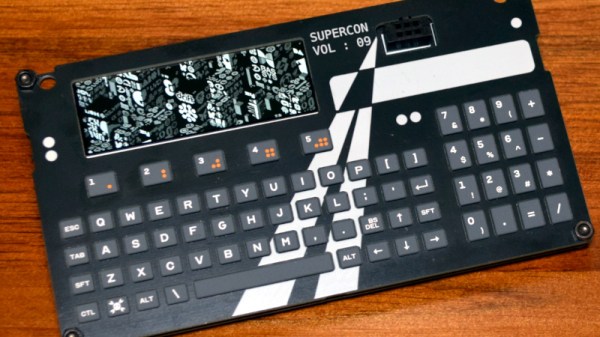
Our recently concluded event in Europe saw the return of the Hackaday Communicator badge — a stylish handheld gadget with a QWERTY keyboard, a LoRa radio, and an ESP32. It came complete with a simple messaging app built into its MicroPython firmware, and by all accounts it was a great success.

But there was certainly room for improvement, which is where [Giovi321]’s new firmware for the badge comes in. It brings support for Meshtastic proper, as well as longer battery life support for GPS module. To install this firmware you will need to have the ESP-IDF but fortunately there are very comprehensive instructions provided to help you. Under the hood it’s running FreeRTOS.

It’s something which is so often missing with an event badge, any sense of how it might have a life after the event rather than becoming a piece of e-waste. The Communicator badge is such a nice physical design that it obviously has potential, so this firmware unlocks it and gives the badge a use out in the real world. We really like it for this, and we’ll be flashing a few of our badges over to give it a shot shorlty.

If you’re looking to upgrade the hardware on your Communicator, check out the custom RGB keyboard we covered last week.
An RGB Keyboard For Your Hackaday Communicator Badge

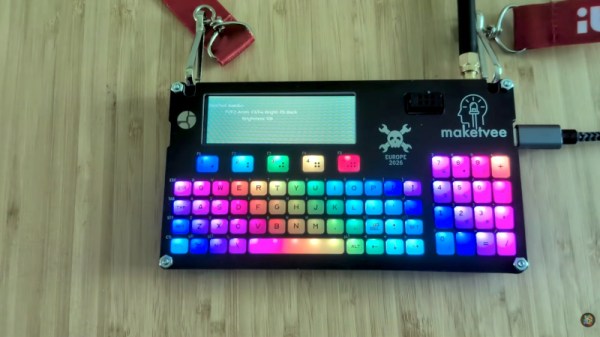
The most recent Hackaday event badge has been the Communicator, a handheld wireless terminal with a rather nice QWERTY keyboard. It’s good enough as delivered, but [makeTVee] has gone one better and made his Communicator keyboard into a fully RGB light-up experience.

The feat is achieved with the help of a new front panel holding some very thin side-emitting addressable LEDs. The keys are custom-printed, and there’s a TPU mat to hold them all together. The LEDs are driven from one of the device’s GPIOs.

We saw this badge in real life at the recent Hackaday Europe conference in Lecco, Italy. It really is as good as it looks in the video below, the care and attention which has gone into the build is extremely impressive.The original badge used a silicone cast set of keys, and we’d say if you are making a device with a keyboard then these might make a very good option.

If you’re not familiar with the Communicator, it’s worth having a look at the launch announcement.

Continue reading “An RGB Keyboard For Your Hackaday Communicator Badge”

Combadge Project Wants To Bring Trek Tech To Life

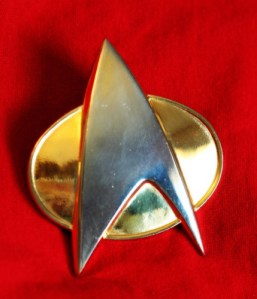
While there’s still something undeniably cool about the flip-open communicators used in the original Star Trek, the fact is, they don’t really look all that futuristic compared to modern mobile phones. But the upgraded “combadges” used in Star Trek: The Next Generation and its various large and small screen spin-offs — now that’s a tech we’re still trying to catch up to.

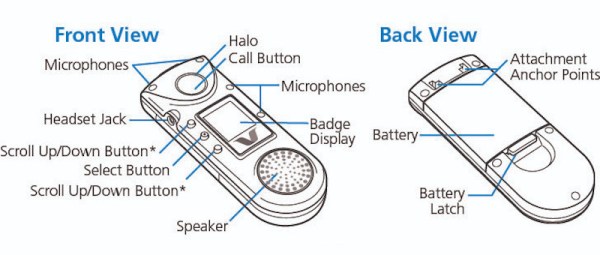
As it turns out, it might not be as far away as we thought. A company called Vocera actually put out a few models of WiFi “Communication Badges” in the early 2000s that were intended for hospital use, which these days can be had on eBay for as little as $25 USD. Unfortunately, they’re basically worthless without a proprietary back-end system. Or at least, that was the case before the Combadge project got involved.

Designed for folks who really want to start each conversation with a brisk tap on the chest, the primary project of Combadge is the Spin Doctor server, which is a drop-in replacement for the original software that controlled the Vocera badges. Or at least, that’s the goal. Right now not everything is working, but it’s at the point where you can connect multiple badges to a server, assign them users, and make calls between them.

It also features some early speech recognition capabilities, with transcriptions being generated for the voices picked up on each badge. Long-term, one of the goals is to be able to plug the output of this server into your home automation system. So you could tap your chest and ask the computer to turn on the front porch light, or as the documentation hopefully prophesies, start the coffee maker.

There hasn’t been much activity on the project in the last year or so, but perhaps that’s just because the right group of rabid nerds dedicated developers has yet to come onboard. Maybe the Hackaday community could lend a hand? After all, we know how much you like talking to your electronics. The hardware is cheap and the source is open, what more could you ask for?

Sci-Fi Contest Roundup: Star Trek

Star Trek Banner

Ah yes, how could we miss Star Trek? To be honest, we’re surprised there aren’t more entries of Star Trek related projects in our Sci-Fi Contest!

Star Fleet Communicator Badge

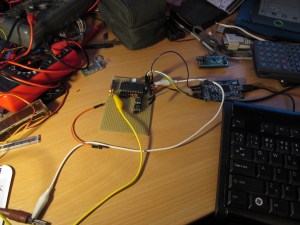
4053121396952461870There’s actually no info on this project yet, but we have to admit — it’s a pretty cool (albeit nerdy) concept. They want to fit a Bluetooth headset with a loudspeaker into a Star Fleet Communicator Badge, activated by tapping on it gently.
Just don’t wear a red shirt with it…


Star Trek: The Mirror Universe Pinball Machine

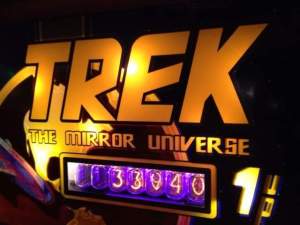
star trek the mirror universeThis ones a really cool hack. A team of four have taken a 1978 Bally Star Trek Pinball machine, and converted it into a Star Trek  Mirror Universe Pinball machine based on the TOS episode Mirror, Mirror where Kirk and his crew are transported to a parallel (mirrored) universe!
Notable features include the custom CNC machined table with custom artwork, a Nixie tube score board, and that they’ve made the design open source! Minus copyrighted artwork of course…


JJ Tricorder

The JJ Tricorder, named after its team [Julia] and [Jaromir] is planned out to look just like the SR-580 type Tricorder — except its going to be backed with 21st century technology.

jj tricorderThe main goal of the project is to have it be able to detect and analyse electromagnetic, geographic and environmental parameters. There’s lots of inspiration for it, like the now-open-source Berkeley Tricorder or the Tricorder Project itself!



Still haven’t entered the contest? Don’t worry — there’s still time for you to put an awesome Sci-Fi project together to win some crazy cool prizes! It just needs to be done and documented by April 29, 2014!