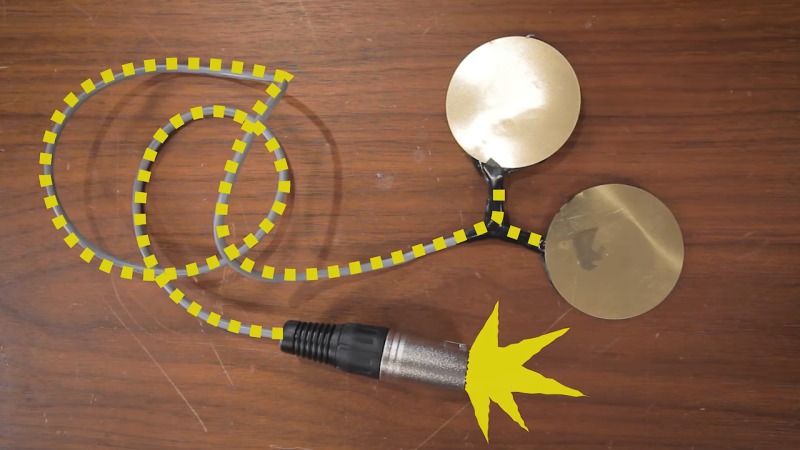
We’re most familiar with sound as vibrations that travel through the atmosphere around us. However, sound can also travel through objects, too! If you want to pick it up, you’d do well to start with a contact mic. Thankfully, [The Sound of Machines] has a great primer on how to build one yourself. Check out the video below.
The key to the contact mic is the piezo disc. It’s an element that leverages the piezoelectric effect, converting physical vibration directly into an electrical signal. You can get them in various sizes; smaller ones fit into tight spaces, while larger ones perform better across a wider frequency range.
[The Sound of Machines] explains how to take these simple piezo discs and solder them up with connectors and shielded wire to make them into practical microphones you can use in the field. The video goes down to the bare basics, so even if you’re totally new to electronics, you should be able to follow along. It also covers how to switch up the design to use two piezo discs to deliver a balanced signal over an XLR connector, which can significantly reduce noise.
There’s even a quick exploration of creative techniques, such as building contact mics with things like bendable arms or suction cups to make them easier to mount wherever you need them. A follow-up explores the benefits of active amplification. The demos in the video are great, too. We hear the sound of contact mics immersed in boiling water, pressed up against cracking spaghetti, and even dunked in a pool. It’s all top stuff.
These contact mics are great for all kinds of stuff, from recording foley sounds to building reverb machines out of trash cans and lamps.