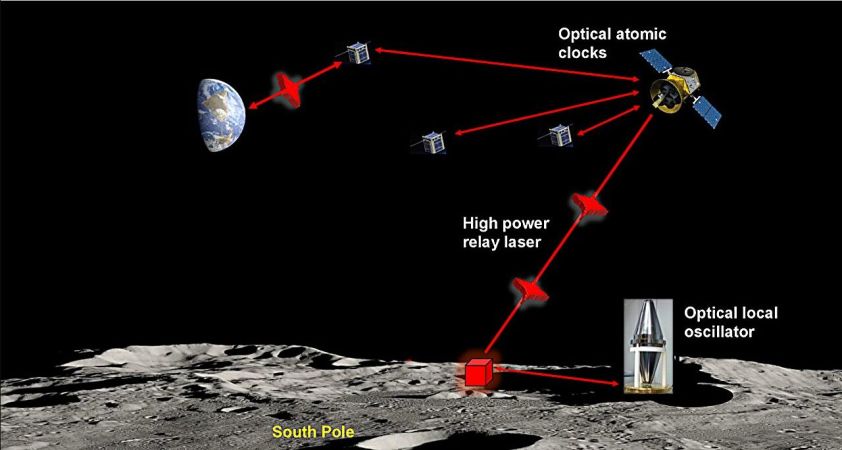
Creating An Ultra-Stable Lunar Clock With A Cryogenic Silicon Cavity Laser

Phase-coherent lasers are crucial for many precision tasks, including timekeeping. Here on Earth the most stable optical oscillators are used in e.g. atomic clocks and many ultra-precise scientific measurements, such as gravitational wave detection. Since these optical oscillators use cryogenic silicon cavities, it’s completely logical to take this principle and build a cryogenic silicon cavity laser on the Moon.
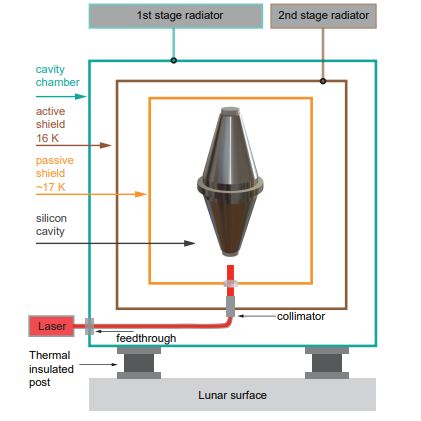
In the pre-print article by [Jun Ye] et al., the researchers go through the design parameters and construction details of such a device in one of the permanently shadowed regions (PSRs) of the Moon, as well as the applications for it. This would include the establishment of a very precise lunar clock, optical interferometry and various other scientific and telecommunication applications.

Although these PSRs are briefly called ‘cold’ in the paper’s abstract, this is fortunately quickly corrected, as the right term is ‘well-insulated’. These PSRs on the lunar surface never get to warm up due to the lack of an atmosphere to radiate thermal energy, and the Sun’s warm rays never pierce their darkness either. Thus, with some radiators to shed what little thermal energy the system generates and the typical three layers of thermal shielding it should stay very much cryogenic.

Add to this the natural vacuum on the lunar surface, with PSRs even escaping the solar wind’s particulates, and maintaining a cryogenic, ultra-high vacuum inside the silicon cavity should be a snap, with less noise than on Earth. Whether we’ll see this deployed to the Moon any time soon remains to be seen, but with various manned missions and even Moon colony plans in the charts, this could be just one of the many technologies to be deployed on the lunar surface over the next few decades.

Dry Ice From Seashells, The Hard (But Cheap) Way

[Hyperspace Pirate] wants to make his own dry ice, but he wants it to be really, really cheap. So naturally, his first stop is… the beach?

That’s right, the beach, because that’s where to find the buckets of free seashells that he turned into dry ice. Readers may recall previous efforts at DIY dry ice, which used baking soda and vinegar as a feedstock. We’d have thought those were pretty cheap materials for making carbon dioxide gas, but not cheap enough for [Hyperspace Pirate], as the dry ice he succeeded in making from them came out to almost ten bucks a pound. The low yield of the process probably had more to do with the high unit cost, in truth, so cheaper feedstocks and improved yield would attack the problem from both ends.

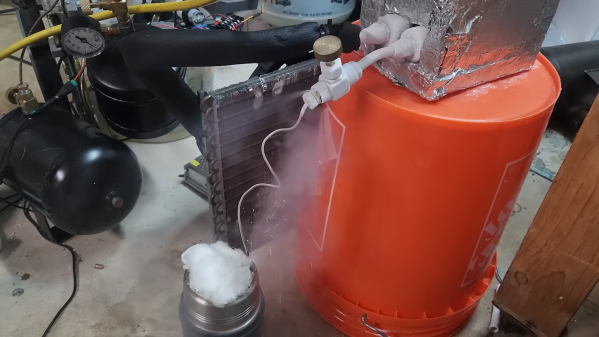
With a supply of zero-cost calcium carbonate from the beach and a homemade ZVS-powered induction heater tube furnace at the ready, [Hyperspace Pirate] was ready to make quicklime and capture the CO2 liberated in the process. That proved to be a little more difficult than planned since the reaction needed not just heat but a partial vacuum to drive the CO2 off. An oil-free vacuum pump helped, yielding a little CO2, but eventually he knuckled under and just doused the shells in vinegar. This had the fun side effect of creating calcium acetate, which when distilled not only corrodes the copper still plumbing but also makes a lousy but still flammable grade of acetone. Once enough CO2 was stored in a couple of beach balls, the process of cooling and condensing it into dry ice was pretty much the same as the previous method, except for taking advantage of the Joule-Thomson cryocooler he built a while back.

The result is a hundred or so grams of dry ice snow, which isn’t great but still shows promise. [Hyperspace Pirate] feels like the key to improving this process is more heat to really drive the calcination reaction. Might we suggest a DIY tube furnace for that job?

Continue reading “Dry Ice From Seashells, The Hard (But Cheap) Way”

About As Cold As It Gets: The Webb Telescope’s Cryocooler

If you were asked to name the coldest spot in the solar system, chances are pretty good you’d think it would be somewhere as far as possible from the ultimate source of all the system’s energy — the Sun. It stands to reason that the further away you get from something hot, the more the heat spreads out. And so Pluto, planet or not, might be a good guess for the record low temperature.

But, for as cold as Pluto gets — down to 40 Kelvin — there’s a place that much, much colder than that, and paradoxically, much closer to home. In fact, it’s only about a million miles away, and right now, sitting at a mere 6 Kelvin, the chunk of silicon at the focal plane of one of the main instruments aboard the James Webb Space telescope makes the surface of Pluto look downright balmy.

The depth of cold on Webb is all the more amazing given that mere meters away, the temperature is a sizzling 324 K (123 F, 51 C). The hows and whys of Webb’s cooling systems are chock full of interesting engineering tidbits and worth an in-depth look as the world’s newest space telescope gears up for observations.

Continue reading “About As Cold As It Gets: The Webb Telescope’s Cryocooler”