
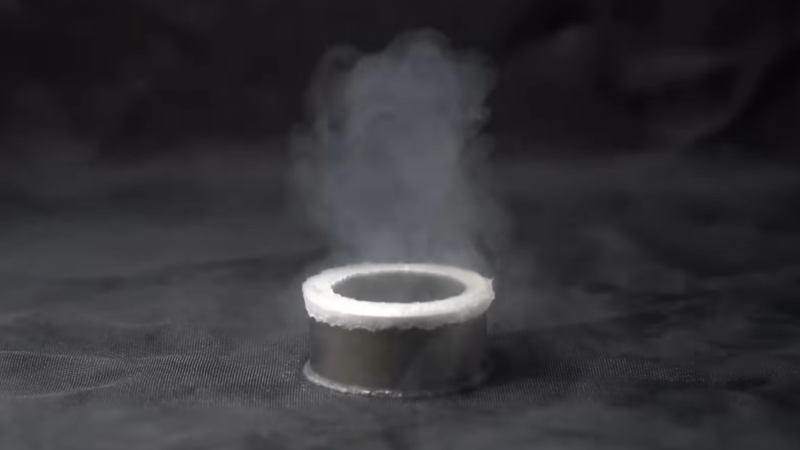
A cylindrical neodymium-iron-boron magnet in shown on a grey background. A white line of boiling liquid surrounds the top edge of the magnet, and a cloud of condensing vapor hangs over it.

Homemade Liquid Oxygen Demonstrates Paramagnetism

Liquid nitrogen isn’t exactly an everyday material, but it’s acquired conveniently enough to be used in extreme overclocking experiments, classroom demonstrations, chemistry and physics experiments, and a number of other niche applications. Liquid oxygen, by contrast, is dangerous enough that it’s only really used in rocket engines. Nevertheless, [Electron Impressions] made some of his own, and beyond the obvious pyrotechnic experimentation, demonstrated its unusual magnetic properties. Check out the video, below.

The oxygen in this case was produced by electrolysis through a proton-exchange membrane, which vented the hydrogen into the atmosphere and routed the oxygen into a Dewar flask mounted at the cold end of a Stirling cryo-cooler. The cooler had enough power to produce about 30 to 40 milliliters of liquid oxygen per hour, enough to build up an appreciable amount in short order. As expected, the pale blue liquid caused burning paper to disappear in a violent flame, and a piece of paper soaked in it almost exploded when ignited.

Continue reading “Homemade Liquid Oxygen Demonstrates Paramagnetism”
Homemade Liquid Nitrogen

As far as DIY cryogenics are concerned, dry ice is easy mode. You can get frozen carbon dioxide at WalMart, or from a nozzle that screws onto a CO2 tank. It’s all very ordinary, and not really special at all. Want to know what’s cool? Making liquid nitrogen at home.

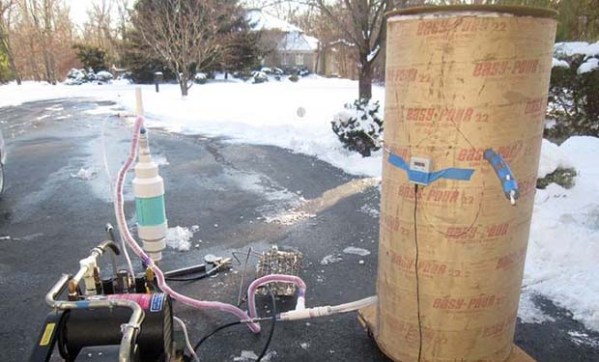
[imsmooth] is getting his nitrogen from a standard tank, sending the gas through a CO2 and H2O scrubber, compressing it, putting the compressed gas in an ice bath, and slowly diffusing the compressed, cooled gas into a vacuum reservoir. When the cold compressed gas is released into the reservoir, Boyle’s law happens and liquid nitrogen condenses in a flask.

As far as materials and equipment are concerned, [imsmooth] is using a PVC tower filled with zeolite to filter out the CO2 and H2O, a SCUBA compressor (no oil), and an almost absurd amount of stainless steel tubing for the precooler and regenerative cooling tower. Except for a few expensive valves, dewar, and the SCUBA compressor, it’s all stuff you could easily scrounge up from the usual home improvement stores.

[imsmooth] is producing about 350cc/hr of liquid nitrogen,  or more than enough for anyone who isn’t running an industrial process in their garage. Check out the video of the build below.

Continue reading “Homemade Liquid Nitrogen”









