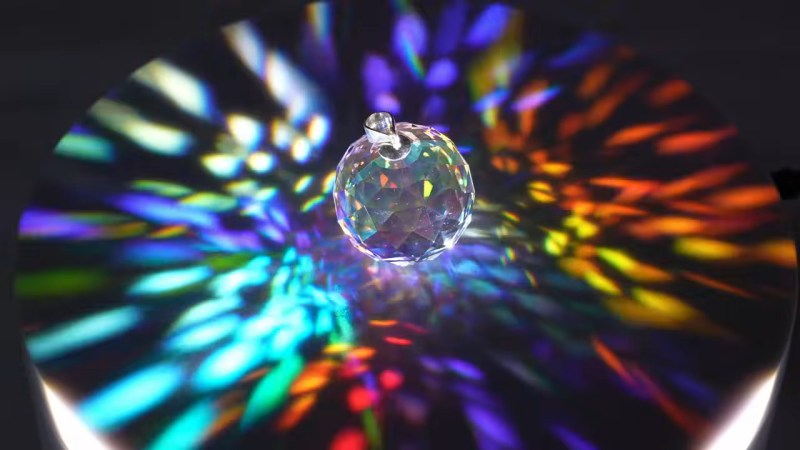
X-Cube Prism Becomes Dichroic Disco Ball

You’ve likely seen an X-cube, a dichroic prism used to split light into its constituent colours–you know, those fun little cubes you get when tearing apart a broken projector. Have you considered that the X-cube need not be a cube for its entire existence? [Matt] at “Matt’s Corner of Gem Cutting” on YouTube absolutely did, which is why he ground one into a 216-facet disco ball. 

That’s the hack, really. He took something many of us have played with at our desks thinking “I should do something cool with this” and… did something cool with it that most of us lack the tools and especially skills to even consider. It’s not especially practical, but it is especially pretty. Art, in other words.

The shape he’s using is known specifically to gemologists as “Santa’s Little Helper II” though we’d probably describe it as a kind of isosphere. Faceting the cube is just a matter of grinding down the facets to create the isosphere, then polishing them to brilliance with increasingly finer grit. This is done one hemisphere at a time, so the other hemisphere can be safely held in place with the now-classic cyanoacrylate and baking soda composite. Yes, jewelers use that trick, too.

We were slightly worried when [Matt] dumped his finished disco ball in acetone to clean off the cyanoacrylate– we haven’t the foggiest idea what optical-quality glue is used to hold the four prisms of an X-cube together and were a little worried acetone might soften the joints. That turned out not to be an issue, and [Matt] now has the most eye-catching sun-catcher we think we’ve ever seen.

We actually have seen suncatchers before, though admittedly it’s not a very popular tag around here. The closest build to this one was a so-called “hypercrystal” that combined an infinitiy mirror with a crystaline shape and dicloric tape for an effect as trippy as it sounds.

We also featured a deep-dive a while back if you want to know how these colourful, hard-to-pronounce coatings work.
Continue reading “X-Cube Prism Becomes Dichroic Disco Ball”

holding up the flavor stone

An Infinity Gem That Didn’t Make The Cut, The Flavor Stone

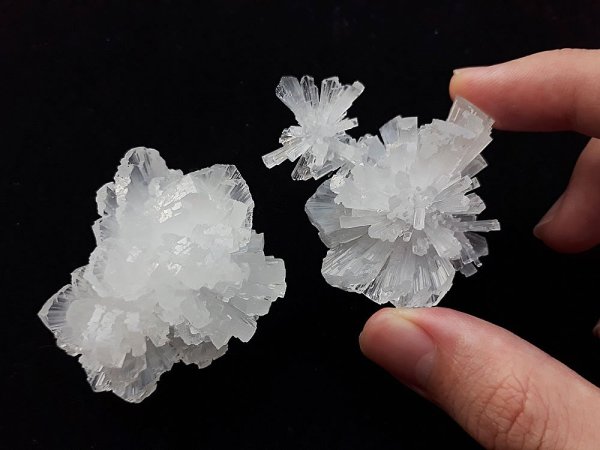
MSG (Monosodium Glutamate) is a flavor enhancer used to add a meaty/savory (often called umami) flavor to a dish. You might even have some in your pantry (though more likely it is in something that is in your pantry). What you might not know is that you can grow it into a large crystal.

[Chase] does an excellent job walking through the details of the process. MSG is one of the many common household substances that can grow into a crystal such as table salt, alum, fertilizer, sugar, or Epsom salt to name a few. The idea is quite simple —  just create a supersaturated solution with your desired crystal material and then suspend a string in it; but the execution has some nuance. To create a medium that’s super saturated, heat some water and mix in equal parts of MSG. Then let it cool once it has all dissolved and split it into two parts, one big and one small. You need to create a seed crystal, so place the small solution in a shallow dish and let a crystal percolate out over the new few days. You attach one of the seed crystals that grow to a string and suspend it in your solution. There are several gotchas around how to properly harvest the crystals but [Chase] enumerates them for you.

We’ve covered [Chase’s] efforts before when he grew crystals out of Rust. He is on a quest to grow all five flavor stones: salty, sweet, sour, umami, and bitter and we wish him all the best. What we would also love to see is the whole process of MSG from start to finish, making your own MSG.

Potassium ferrioxalate crystal

Growing Spectacular Gem-Like Crystals From Rust And Simple Ingredients

When we talk about crystals around here, we’re generally talking about the quartz variety used to make oscillators more stable, or perhaps ruby crystals used to make a laser. We hardly ever talk about homegrown crystals, though, and that’s a shame once you see how easy it is to make beautiful crystals from scratch.

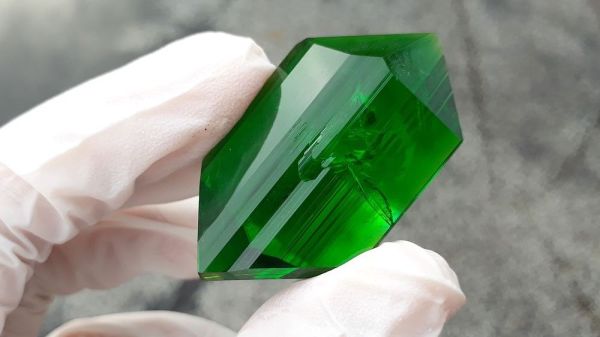
We’ve got to say that we’re impressed by the size and aesthetics of the potassium ferrioxalate crystals [Chase Lean] makes with this recipe, and Zelda fans will no doubt appreciate their resemblance to green rupees. The process starts with rust, or ferric oxide, which can either be purchased or made. [Chase] chose to make his rust by soaking steel wool in a solution of saltwater and peroxide and heating the resulting sludge. A small amount of ferric oxide is added to a solution of oxalic acid, a commonly used cleaning and bleaching agent. Once the rust is dissolved, potassium carbonate is slowly added to the solution, turning it a bright green.

The rest of the process happens more or less naturally, as crystals begin to form in the saturated solution. And boy, did they grow — long, prismatic lime-green crystals, with a beautiful clarity and crisp edges and facets. The crystals don’t last long under light, though — they quickly lose their clarity and become a more opaque green.

[Chase]’s crystal-growing efforts have shown up here before, when he turned humble table salt into beautiful cubic crystals. We find the whole crystal-growing process fascinating, and we’re looking forward to more of this in the future.