
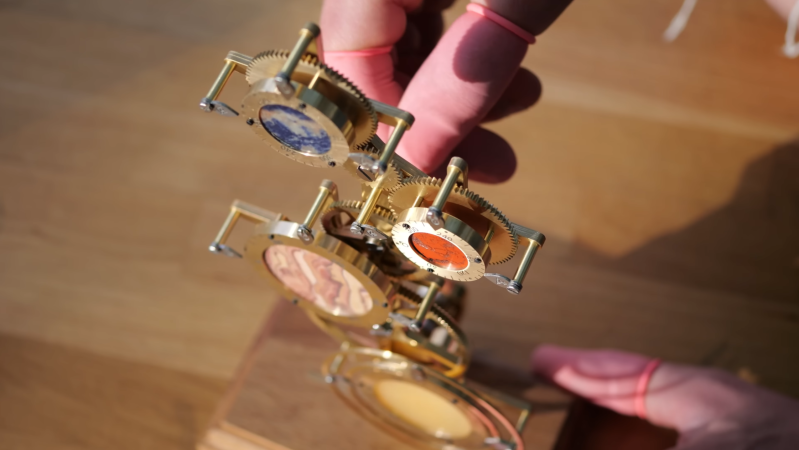
There are some clocks, mostly in or around international airports, which have multiple faces to show the time at various cities around the world. Taking more a forward-looking approach is [Chronova Engineering], who built a clock to display the time on four different planets: Earth, Mars, Jupiter, and Saturn.
The clock doesn’t have any hands, but it uses rotating dials to represent a top-down view of each planet from it’s north pole. The dials have degree markings to represent rotation relative to each planet’s prime meridian; for the gas giants, rotation is measured by the rotation of the planet’s core. Each dial’s center is made out of a circular stone tile with patterns similar to those seen on the planet; Earth, for example, is represented with sodalite. Three pointers mounted around the dial indicate the longitudes which are currently experiencing sunrise, noon, and sunset. The mechanism can be turned with a handle or a knob, and a mechanical counter keeps track of the number of Earth days that have passed.
Continue reading “Interplanetary Clock Keeps Time Across The Solar System”
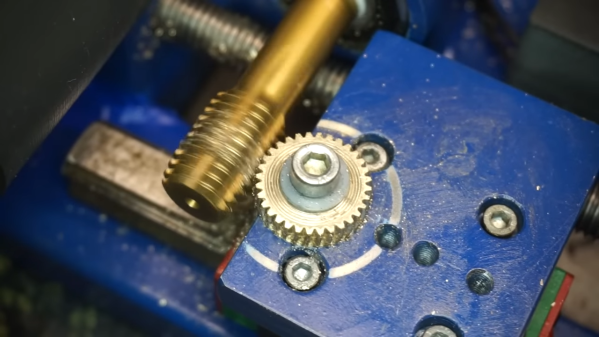
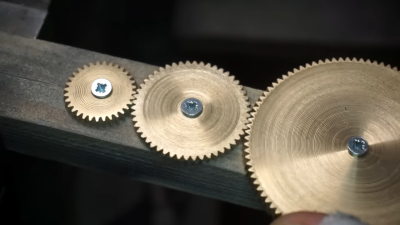 The cutting tool for the job is an M16 machine tap, chosen for the smaller flutes compared to a hand tap. This makes it more suitable for cutting gears. It’s turned by a belt driven pulley, run by a small motor. The workpiece to be cut into a gear is then fed into the cutting tool by sliding on a linear bearing, with its position controlled by a threaded rod. The rod can be slowly turned by hand to adjust the workpiece position, to allow the gear teeth to be cut to an appropriate depth.








