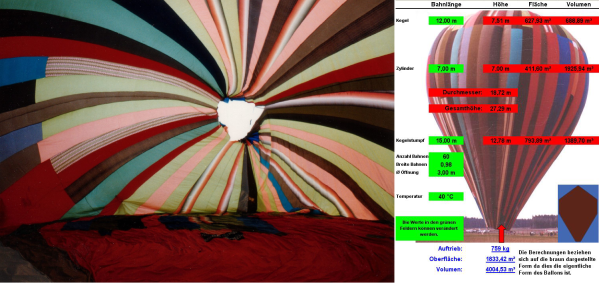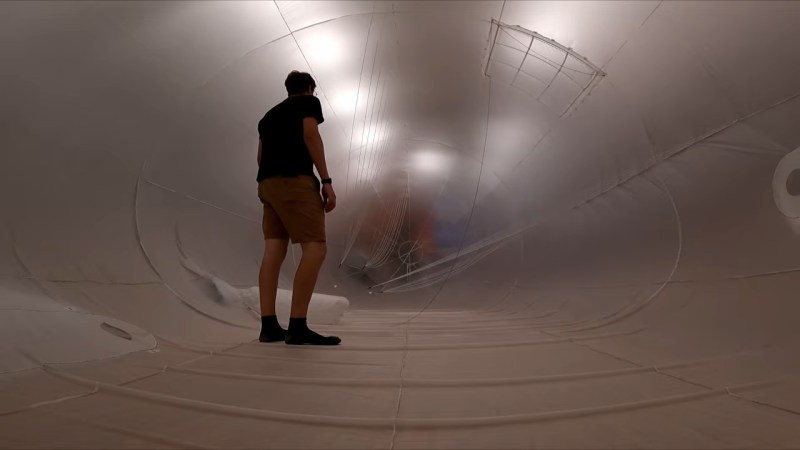
[Avery] standing inside the inflating envelope of his airship

Don’t Worry, This R/C Airship Is Supposed To Be On Fire

We’ve had a lot of flying hacks here over the years, and that includes just about any way to get airborne you can think of — but very few of those have been airships. Fewer still have been 27-foot thermal airships, like the one [Avery Flies] designed and put together recently.

A thermal airship, in case the name doesn’t give it away, is a dirigible hot air balloon. Like a hot air balloon, it gets its lift from the density difference between hot air and the regular atmosphere. Unlike a hot air balloon, it has control surfaces and an engine so it goes where you tell it to. The craft uses good-old-fashioned radio control, and except for the nylon envelope he spends the first 15 minutes of the video below designing and sewing up, the technology mostly comes from be from the world of R/C aircraft.

The big exception is of course the a propane burner used to generate heat, said propane being supplied by a pair of small green tanks such as you might use on a portable barbecue. Everything that moves is electric, though: there’s a 70 mm (about 2¾“) electric ducted fan acting to push the air up into the balloon so it keeps shape, and a great big brushless DC motor pushing an 18” (about 457 mm) prop for thrust. The steering servo is actually a repurposed winch servo from an R/C sailboat, rather than anything from the world of model aircraft. But it makes sense, as the meter-scale fabric rudder is more like a sail than the control surfaces of most R/C aircraft.

You might expect a blimp to be the biggest flying machine we’ve featured on Hackaday, but some truly giant-scale R/C aircraft have come our way in the past. We’ve also seen some pretty teeny blimps.

Continue reading “Don’t Worry, This R/C Airship Is Supposed To Be On Fire” →

Quick And Easy Solar Hot Air Balloon

[Becky Stern] likes to harness the power of the Sun. Most of us will immediately think of solar cells and other exotic solar energy techniques. But [Becky] shows how to make a hot air balloon using nothing but tape and garbage bags.

The idea is quite simple. You form a large envelope from black trash bags and fill it with air. Becky does that by just running with it, tying it off, and topping off with a little manual blowing. Once the sun heats the black bag, it floats.

Continue reading “Quick And Easy Solar Hot Air Balloon” →

Remotely Controlling A Not-So-Miniature Hot Air Balloon

Calling [Matt Barr]’s remote controlled hot air balloon a miniature is a bit misleading. Sure, it’s small compared with the balloons that ply cold morning skies with paying passengers and a bottle of champagne for the landing. Having been in on a few of those landings, we can attest to the size of the real thing. They’re impressively big when you’re up close to them.

While [Matt]’s balloon is certainly smaller, it’s not something you’d just whip together in an afternoon. Most of [Matt]’s build log concentrates mainly on the gondola and its goodies — the twin one-pound camp stove-style propane tanks, their associated plumbing, and the burner, a re-tasked propane weed torch from Harbor Freight. Remote control is minimal; just as in a full-size balloon, all the pilot can really do is turn the burner on or off. [Matt]’s approach is a high-torque RC servo to control the burner valve, which is driven by an Arduino talking to the ground over a 2.4-GHz RF link. The balloon is big enough to lift 30 pounds and appears to be at least 12 feet tall; we’d think such a craft would run afoul of some civil aviation rules, so perhaps it’s best that the test flight below was a tethered one.

Sadly, no instructions are included for making the envelope, which would be a great excuse for anyone to learn a little about sewing. And knowing how to roll your own hot air balloon might come in handy someday.

Continue reading “Remotely Controlling A Not-So-Miniature Hot Air Balloon” →

Hacking An Escape From East Germany

Some hacks are just for fun. Some make your job or your life easier. Once in a great while, a hack will save your family from an oppressive government. This is the kind of hack that [Günter] pulled off when he and [Peter] built a homemade hot air balloon to escape East Germany and the oppression of the Stasi in 1979.

Like many East Germans who weren’t in line with the Party, [Günter] found life unsatisfactory on his side of the Berlin Wall. Travel, job options, and freedom of expression were all severely limited. Aside from joining the Communist Party, the only option seemed to be escape to West Germany.

[Günter] and his wife [Petra] were inspired when [Petra]’s sister, who had escaped in 1958, came to visit. She brought with her a newspaper that covered the International Balloon Fiesta in Albuquerque, New Mexico. [Günter] and [Peter], whom he worked with, decided that they would conspire to build a hot air balloon capable of transporting them, their wives, and their four children across the border.

Theirs is an incredible story fraught with adversity. They ended up constructing three different balloons, all the while traveling further and further from home to avoid suspicion when buying large quantities of fabric. They had a lot of trouble finding the right propulsion method and ended up using pure oxygen. During the narrow window they had before [Günter] was due to report for military duty, the weather was unfavorable except for a short period after a front had passed through. They had no time for testing and just went for it.

Continue reading “Hacking An Escape From East Germany” →