
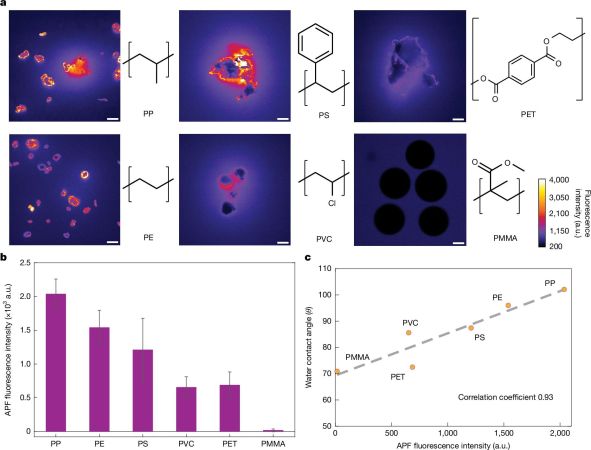
One of the often made claims about plastics is that they are chemically inert under most conditions, such as when exposed to water. This long-held belief has also challenged the notion that micro- and nanoplastics (MNPs) are dangerous to organisms such as us human animals. A hitherto unknown mechanism between common plastics as investigated by [Naixin Qian] et al. and published in Nature serves to generate highly reactive hydroxyl radicals when exposed to water.
Hydroxyl radicals (HO•) are the neutral form of the hydroxide ion (OH–). It’s a free radical that tends to be extremely short-lived due to its reactivity, much like the singular oxygen molecule that is freed at the plastic-water interface. The energy provided for this reactivity comes from the electrostatic effect, itself highly correlated with many plastics, with the six types of microplastics used in the experiment showing varying levels of free radicals, particularly for the more hydrophobic types.
This high reactivity of free radicals is a well-known problem in cellular biology, with evolution having developed many tools over the years to deal with capturing these radicals as well as repair the (DNA) damage that they can cause. The effect of these microplastics and their generated free radicals was thus studied as well.
Of note here is that the electrostatic effect itself already serves to draw charged biomolecules to it, before the impact of free radicals is considered. By using mouse red blood cells and exposing them to polystyrene (PS) microplastics fatal damage was observed to the red blood cells.
This indicates that there are at least three possible ways in which MNPs can be harmful to organisms. It also provides another clue to how this may affect the ageing of plastics, among other implications.
Currently there is still ongoing debate on whether MNPs are truly harmful and just how prevalent they may be in e.g. our bodies. Reliably detecting them in e.g. biological tissues remains a challenge, which this new study may also be helpful with, since one of our biggest blind spots is that we lack solid knowledge of how MNPs may behave inside an organism.









