
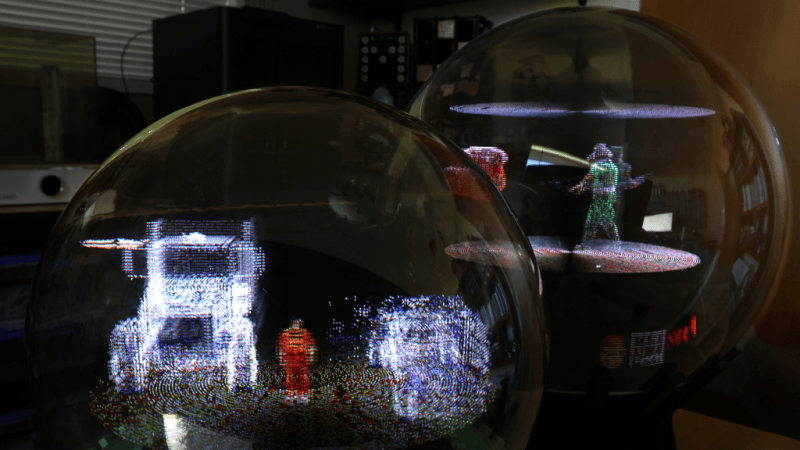
[AncientJames] gives us a detailed look at Vortex, one of his impressive volumetric displays made with two back-to-back LED panels that spin at high speed with a Raspberry Pi 4 driving it all. Vortex generates a true 3D image hanging in space that one can move around, and look at from different angles independent of anything else. The software for Vortex is up on GitHub which includes a simulator as well as CAD models for the 3D-printed parts.
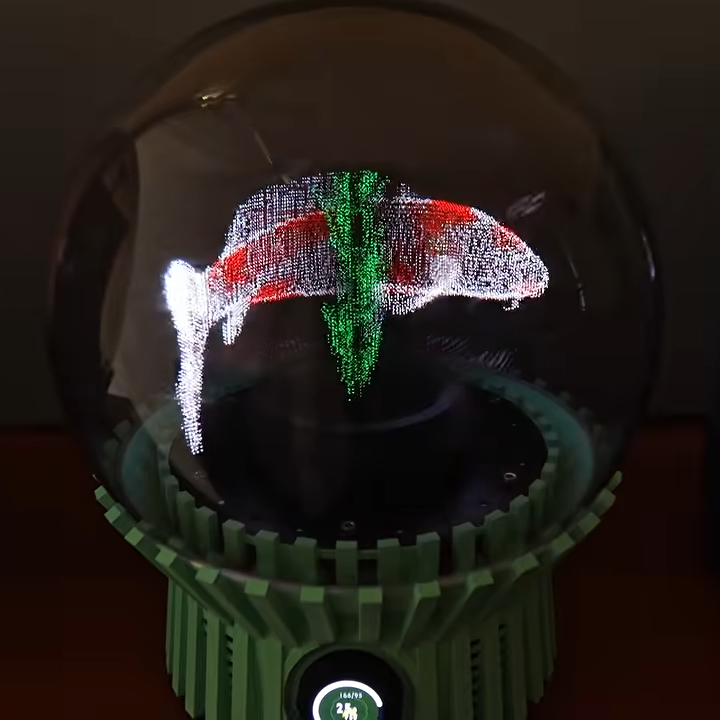
Accomplishing what Vortex does requires precisely matching the images rendered on the panels to the physical rotation. If there’s a mismatch, the displayed 3D image will drift, or appear distorted. There’s also the physical matter of ensuring the spinning elements are balanced and stable while spinning at high speeds, a nontrivial undertaking that involved more than a little trial and error.
The amazing build quality and attention to detail really shines through, not just with the design but with smart use of off-the-shelf items like a large plastic globe for the display cover. [AncientJames] uses what looks like a plastic globe shade meant for a lighting fixture, and designs a clever fixture that attaches to a small rotary tool with a cutting wheel. With that, he can carefully and precisely cut away the unneeded section. Here’s a link to him doing so (at the 15:17 mark) in the video; sometimes it’s worth making a one-off gadget if it helps get a job done right.
[AncientJames] has made many volumetric displays in the past, and they’re each a little different. Check out one that spins a perforated drum around LED panels to create a lightfield display, instead of spinning the panels themselves.












A plasma globe above it perhaps?
Very nice work!
I’m wondering: could such 3D display be made using hi-res LCD screens, instead of LED matrix?
Yes you could, but you’d need a FPGA to handle all the required bandwidth then.
What would be the order of magnitude of the bandwidth, when using 2 full HD screens?
What do you want the angular resolution to be?
Why? It has a full pi in there. a pi five has dual hdmi out. so the bandwidth is there.
How to you get 1000-4000 frames per second out of HDMI (at high resolution, anyway)? Is there an LCD that can keep up?
Modern gaming LCD displays can easily reach 400 FPS in many games if you have a GTX 5090 like me. I can’t wait to play GTA 6 it’s going to be amazing.
Not nearly enough. If you split the circle into 360 degrees with one frame per degree, you can only update the screen a little faster than 1 Hz. You need 12 Hz to maintain persistence of vision in a dimly lit environment, so you’d need at least 4320 FPS to pull it off.
LEDs can do it, LCDs can’t.
I guess you could use an optical fiber through a swivel in the axle. I’m unsure if anyone has invented it yet but since it’s just on/off should work fine.
LCD screens tend to use COG controllers with fairly basic specs. You’re locked into 50-70hz refresh rate, which is very low for something you spin to create a volumetric POV display.
This is a duplicate post from 2 years ago: https://hackaday.com/2024/09/09/doom-on-a-volumetric-display/
Not a dupe. Same guy, similar project, just a couple of versions newer.
Great project!!!!…..but the audio on the 3d printer timelapse scenes is terrible!
For compact optics
https://phys.org/news/2026-11-air-holes-silicon-wafers-flat.html
Optical black holes?
https://phys.org/news/2026-11-vibrating-mirrors-analog-black-hole.html