Betacam is not the Betamax you may have had at home– it was a professional format that lived on into the 21st century, in the “SP” form. In many places, it would have been the last tape format in use. So it is perhaps understandable that [ldursw] decided to recreate an obsolete and unobtainable IC to save a Sony broadcast-grade editing Video Tape Recorder (VTR). Still mad, perhaps, but in a way we very much appreciate.
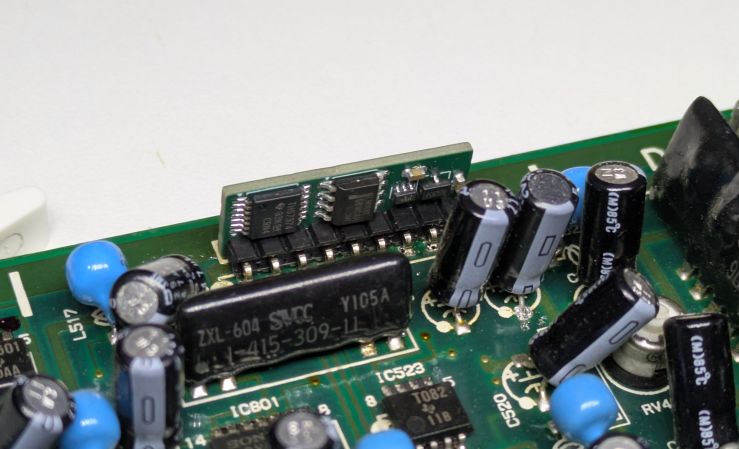
The Sony BVW-75 VTR had an odd flaw where the output lacked colour, unless paused with dynamic tracking off. Then colour would appear, but only in odd stripes. Clearly the chroma circuit was at fault. Some sluthing found that a sync separator IC– that separates the sync pulses that keep everything moving together, if the name didn’t give it away– wasn’t behaving correctly. More sluthing found that the chip in question was no longer available. Luckily, the concept of a sync separator hasn’t quite given up the ghost, and another part was available. It just didn’t fit, used a different voltage, and had an inverted output. No biggie! [ldursw] added a voltage regulator, an inverter, and a video amplifier chip, then after breadboard testing put them on a PCB with pins that match the original IC’s form-factor, making it a plug-in replacement.
That’s a GitHub link at the start of this article, by the way, so he’s open sourced the solution for anyone who needs a Toshiba TA7357P video sync separator. We don’t know who else needs this, but we’re willing to bet that whoever does, really needs it. On behalf of whoever that might be, we offer sincere thanks to [ldursw] for the hack, and for submitting it to our tips line.
This reminds us a little bit of a tape deck repair we featured previously, reviving another Sony format– D-1 tapes–to archive old media.