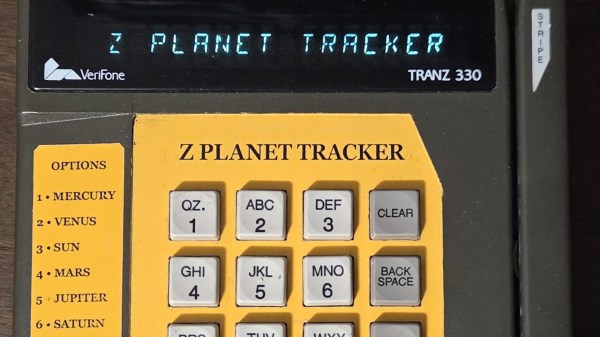
The humble credit card reader — most of us have used hundreds, perhaps even thousands of them over the years. But even for folks like us, it’s not the sort of device we give a lot of thought to. It’s just a keypad, a display, and a magnetic stripe reader. How interesting could it possibly be?
That may be true in some cases, but at least for the 1990s-era TRANZ 330, there’s a bit more to the story than that. As [CharlesD] explains, these particular readers are essentially complete Z80 computers just waiting to do something more exciting than processing PINs. In the case of this particular unit, the addition of a GPS module and some new code has turned it into an interactive guide to the solar system.
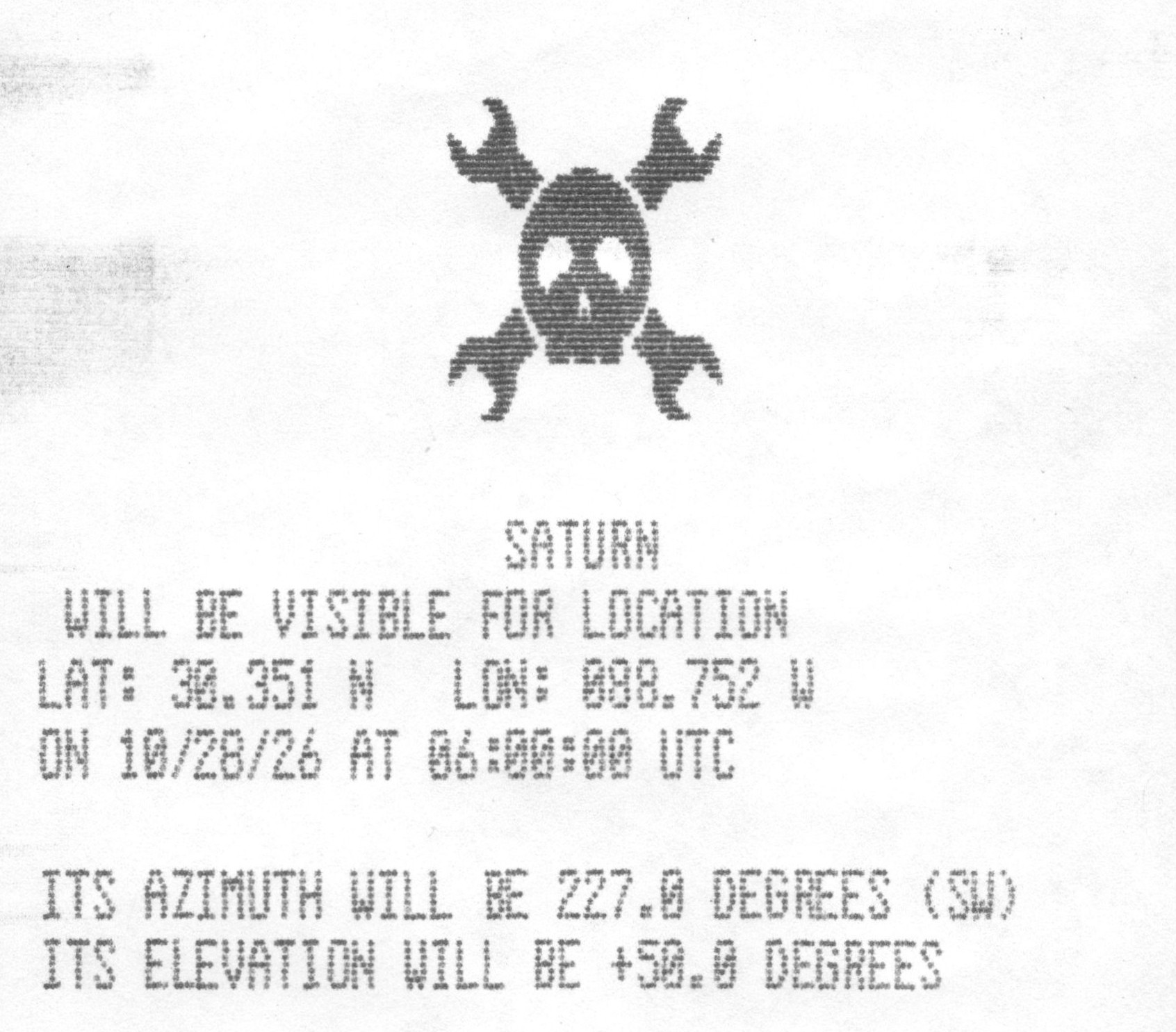 Thanks to the UV erasable ROMs used in the TRANZ 330, loading new code on the device is easy enough. With a bit of educated poking around, [CharlesD] was able to map out what did what. Working from the basics of getting the display and keypad working, he moved onto the serial interface, which in turn let him communicate with a modern GPS module and era-appropriate thermal printer. From there it was just a matter of getting the math implemented to compute the azimuth and elevation of a given planet, and he had an offline map of the solar system for use with his telescope.
This is one of those projects which is awesome enough on its own merits, but it’s particularly exciting to see just how easy it is to repurpose one of these card readers, especially since [CharlesD] was kind enough to share his source code. If you end up picking one of these up and getting something running on it, be sure to let us know.