Yamato-1: The World’s First Ship With Magnetohydrodynamic Propulsion

Although the humble propeller and its derivatives still form the primary propulsion method for ships, this doesn’t mean that alternative methods haven’t been tried. One of the more fascinating ones is the magnetohydrodynamic drive (MHDD), which uses the Lorentz force to propel a watercraft through the water. The somewhat conductive seawater is thus the working medium, with no moving parts required.

The end of the MHD thruster from the Yamato 1. It has six smaller green tubes surrounding a central circle. All of these pieces are coming through a grey metal fixture that is a circular shape. Small labels are affixed with Japanese writing on them. It is inside a sky blue metal frame.
The end of the MHD thruster from the Yamato-1.

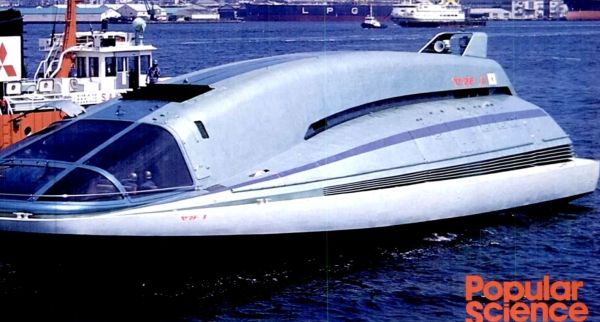
Although simple in nature, only the Japanese Yamato-1 full-scale prototype ever carried humans in 1992. As covered in a recent video by [Sails and Salvos], the prototype spent most of its time languishing at the Kobe Maritime Museum, until it was scrapped in 2016.

There are two types of MHDD, based around either conduction – involving electrodes – or induction, which uses a magnetic field. The thrusters used by the Yamato-1 used the latter type of MHDD, involving liquid helium-cooled, super-conducting coils. The seawater with its ions from the dissolved salts responds to this field by accelerating according to the well-known right-hand rule, thus providing thrust.

The main flaw with an MHDD as used by the Yamato-1 is that it’s not very efficient, with a working efficiency of about 15%, and a top speed of about 15 km/h (8 knots). Although research in MHDDs hasn’t ceased yet, the elemental problem of seawater not really being that great as the fluid without e.g. adding more ions to it has meant that ships like the Yamato-1 are likely to remain an oddity like the Lun-class ekranoplan ground effect vehicle.

For as futuristic as this technology sounds, it’s suprisingly straightforward to build a magnetohydrodynamic drive of your own in the kitchen sink. Continue reading Yamato-1: The World’s First Ship With Magnetohydrodynamic Propulsion”

Bulked Up MHD Drive Makes Waves While Standing Still

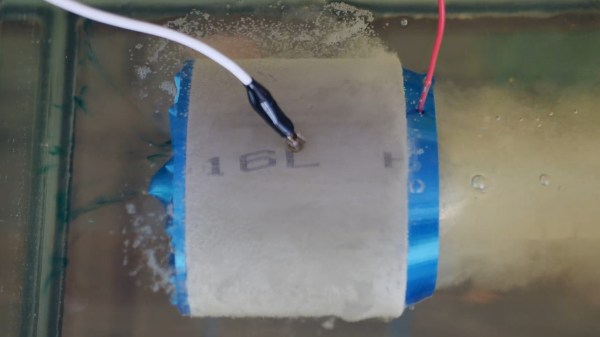
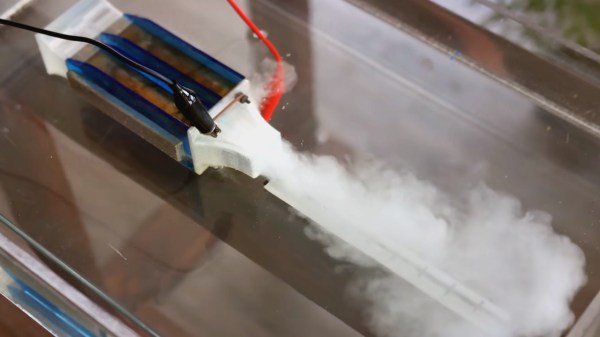
Looking back through the archives, we actually haven’t seen much in the way of homebrew magnetohydrodynamic drives (MHDs) — which is somewhat surprising, as the core concept isn’t nearly as complicated as its syllable-laden name might indicate. You can see results with little more than a magnet, a couple of electrodes, and a bench power supply. The trick is turning these base components into something that might actually have practical value.

That’s where we find [Jay Bowles], who has gone down a bit of a MHD rabbit hole these last few months. His latest MHD unit is a considerable improvement over its predecessor by all practical metrics, and as an added bonus, really nails the look of a futuristic propulsion unit. Even though the all-electric thruster hasn’t gone on a mission to anywhere more exotic than a table-top aquarium, you could easily imagine a pair of them slung under some top secret stealth watercraft.

Continue reading “Bulked Up MHD Drive Makes Waves While Standing Still”

A Magnetohydrodynamic Drive In The Kitchen Sink

The magnetohydrodynamic (MHD) drive certainly sounds like something out of science fiction — using an array of magnets and electrodes, this high-tech propulsion technology promises to silently propel a craft through the water without any moving parts. As long as you can provide it with a constant supply of electricity, anyway.

Of course, as is often the case, the devil is in the details. Even with the obvious scientific and military applications of such a propulsion unit, scaling MHD technology up has proven difficult. But as [Jay Bowles] of Plasma Channel shows in his latest video, that doesn’t mean you can’t experiment with the concept at home. Even better, getting verifiable results is much easier than you’d think.

Continue reading “A Magnetohydrodynamic Drive In The Kitchen Sink”