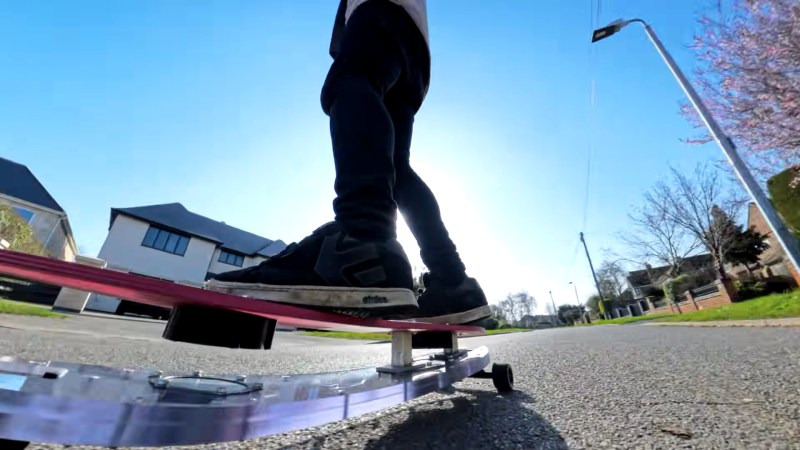
Anyone who saw Back to the Future II was disappointed when 2015 rolled around with nary a hoverboard in sight. There have been various attempts to fake it, but none of them quite have the feel of floating about wherever you’d like to go that the movie conveys. The little-known YouTuber [Colin Furze] has a new take on the idea: use magnets. Really big magnets.
If you’re one of [Colin]’s handful of subscribers, then you probably saw his magnetic-suspension bike. We passed on that one, but we couldn’t resist the urge to cover the hoverboard version, regardless of how popular [Colin] might be on YouTube. It’s actually stupidly simple: the suspension is provided by the repulsive force between alarmingly large neodymium magnets. In this case, two are on the base plate that holds the skateboard ‘trucks’, and two are on the wooden ‘deck’ that [Colin] rides upon.
Of course magnetic repulsion is a very unstable equilibrium, so [Colin] had to reduce the degrees of freedom. In his first test, that was with a pair of rods and linear bearings. That way the deck could only move in the z-axis, providing the sensation of hovering without allowing the deck to slide off its magnetic perch. Unfortunately those pins transferred too much vibration from the ground into the deck, ruining the illusion of floating on air.
Continue reading “Magnetic-Suspension Hoverboard Is Only 11 Years Late”