Building A Super-Compact Cistercian Numerals Clock

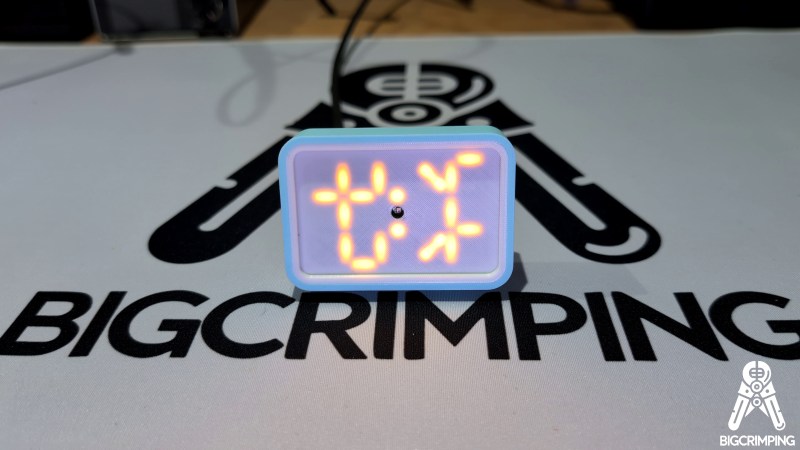
Around the thirteenth century CE, European society was in the midst between transitioning from Roman numerals to the Arabic numerals that we use today. Less remembered are the Cistercian numerals, which [BigCrimping] used for their most recent project in the form of a rather unique clock.

The Cistercian numeral system was developed by the Cistercian monastic order in the 13th century, forming a rather unique counterpoint to the Arabic numeral system. Although Arabic numerals are already significantly more compact than Roman numerals, Cistercian numerals up the ante by being capable of displaying any number between 1 and 9,999 with a single glyph.

Although for a simple 24-hour clock you don’t need to use more than a fraction of the possible glyphs, there is the complication of the Cistercian numerals not having a zero glyph, but that invites an even better take. For the version that [BigCrimping] made there are namely two glyphs that encode date and time, with the left glyph a counter for blocks of two hours and the right for seconds from 1 through 7200.

The clock is based around MAX6969 LED drivers and an ESP32 MCU on a custom PCB, with the design files including the 3D-printed enclosure available in the repository.

Continue reading “Building A Super-Compact Cistercian Numerals Clock”

Learn To Count In Seximal, A Position Above The Rest

Believe it or not, counting is not special. Quite a few animals have figured it out over the years. Tiny honeybees compare what is less and what is more, and their brains are smaller than a pinky nail. They even understand the concept of zero, which — as anyone who has had to teach a toddler knows — is rather difficult to grasp. No, counting is not special, but how we count is.

I don’t mean to toot our own horn, but humans are remarkable for having created numerous numeral systems, each specialized in their own ways. Ask almost anyone and they will at least have heard of binary. Hackaday readers are deeper into counting systems and most of us have used binary, octal, and hexadecimal, often in conjunction, but those are just the perfectly standard positional systems.

If you want to start getting weird, there’s balanced ternary and negabinary, and we still haven’t even left the positional systems. There’s a whole host of systems out there, each with their own strengths and weaknesses. I happen to think seximal is the best. To see why, we have to explore the different creations that arose throughout the ages. As long as we’ve had sheep, humans have been trying to count them, and the systems that resulted have been quite creative, if inefficient.

Continue reading “Learn To Count In Seximal, A Position Above The Rest”