Super Refined Kinect Physics Demo

kinect_demo

Since the Kinect has become so popular among hackers, [Brad Simpson] over at IDEO Labs finally purchased one for their office and immediately got to tinkering. In about 2-3 hours time, he put together a pretty cool physics demo showing off some of the Kinect’s abilities.

Rather than using rough skeleton measurements like most hacks we have seen, he paid careful attention to the software side of things. Starting off using the Kinect’s full resolution (something not everybody does) [Brad] took the data and manipulated it quite a bit before creating the video embedded below. Skeleton data was collected and run through several iterations of a smoothing algorithm to substantially reduce the noise surrounding the resulting outline.

The final product is quite a bit different than the Kinect videos we are used to seeing, and it drastically improves how the user is able to interact with virtual objects added to the environment. As you may have noticed, the blocks that were added to the video never rarely penetrate the outline of the individual in the movie. This isn’t due to some sort of digital trickery – [Brad] was able to prevent the intersection of different objects via his tweaking of the Kinect data feed.

We’re not sure how much computing power this whole setup requires, but the code is available from their Google Code repository, so we hope to see other projects refined by utilizing the techniques shown off here.

[via KinectHacks]

Continue reading “Super Refined Kinect Physics Demo”

Space Elevator A Real Possibility

The space elevator may be a very real possibility within our lifetimes. Previously the stuff of science fiction novels, scientists and engineers around the world will continue their discussion at a conference in Japan this November. The space elevator’s basic design would include a cable that is anchored to the Earth’s surface, and on the other end, tens of thousands of kilometers away, a counterweight for balance. The space elevator could be used to solve many different problems, from nuclear waste disposal to powering homes with solar panels.

The technology driving the development of the space elevator is the carbon nanotube. Its lightweight properties and tensile strength, over 180 times stronger than steel cable, make it the ideal cable for the space elevator. Currently there are several logistical problems, which range from designing a carbon nanotube strong enough to support the elevator to finding an ideal site to design and build the elevator, which would require international consensus and input. Several organizations are working on space elevator designs, and NASA is holding a $4 million Space Elevator Challenge to encourage designs.

Large Hadron Collider User Manual Online


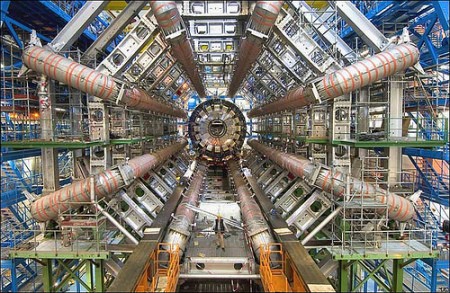
If you’ve got a few hours (or weeks) of spare time, you could learn how to run the Large Hadron Collider, located at CERN in Switzerland. CERN published the full technical details of the collider and detectors online, and anyone with some curiosity and patience can read all 1,589 pages. Tell us if you got through all of it, and if you’re planning to make your own particle accelerator.

[via MetaFilter]