
What Happens If Russia Shuts The Door On Their Leaky ISS Module?

There was a particularly tense moment aboard the International Space Station earlier this month, with NASA directing their astronauts to secure themselves in the Dragon capsule and prepare for a potential return to Earth while their Russian counterparts engaged in what we now know to have been some impromptu demolition work on their side of the orbiting complex.

Despite objections from their American partners, Roscosmos had given their cosmonauts the go-ahead to drill and cut into the walls of the Zvezda module — one of the core components of the ISS which has been in orbit since 2000 — to try and identify and ultimately repair persistent leaks that have been venting the Station’s atmosphere out into space for several years. We may never know the exact nature of the behind-the-scenes communication that went on between the two space agencies, but in the end the Russians abandoned their plan and NASA’s personnel were told to resume their normal duties.

But where do things go from here? Although it’s true the International Space Station is entering its final years, the mission isn’t over yet, and that means the two countries need to continue to work together if they hope to get any science done in the time they have left.

At this point there hasn’t been any official word from either agency, but sources that wish to remain anonymous have been dropping hints, and that’s got the rumors swirling. With the understanding that anything is still possible, at this point it looks like Russia is going to abandon any further attempts to repair the leak and instead seal off the crippled compartment of the Zvezda module. This won’t solve all the problems, and in fact will create some new ones. But if that’s what it will take to keep the peace with NASA until Station operations wind down, it’s apparently a bargain they’re willing to make.

Continue reading “What Happens If Russia Shuts The Door On Their Leaky ISS Module?”
Dragon Is The Latest, And Final, Craft To Reboost ISS

The International Space Station has been in orbit around the Earth, at least in some form, since November of 1998 — but not without help. In the vacuum of space, an object in orbit can generally be counted on to remain zipping around more or less forever, but the Station is low enough to experience a bit of atmospheric drag. It isn’t much, but it saps enough velocity from the Station that without regular “reboosts” to speed it back up , the orbiting complex would eventually come crashing down.

Naturally, the United States and Russia were aware of this when they set out to assemble the Station. That’s why early core modules such as Zarya and Zvezda came equipped with thrusters that could be used to not only rotate the complex about all axes, but accelerate it to counteract the impact of drag. Eventually the thrusters on Zarya were disabled, and its propellant tanks were plumbed into Zvezda’s fuel system to provide additional capacity.

An early image of ISS, Zarya module in center and Zvezda at far right.

Visiting spacecraft attached to the Russian side of the ISS can transfer propellant into these combined tanks, and they’ve been topped off regularly over the years. In fact, the NASA paper A Review of In-Space Propellant Transfer Capabilities and Challenges for Missions Involving Propellant Resupply, notes this as one of the most significant examples of practical propellant transfer between orbital vehicles, with more than 40,000 kgs of propellants pumped into the ISS as of 2019.

But while the thrusters on Zvezda are still available for use, it turns out there’s an easier way to accelerate the Station; visiting spacecraft can literally push the orbital complex with their own maneuvering thrusters. Of course this is somewhat easier said than done, and not all vehicles have been able to accomplish the feat, but over the decades several craft have taken on the burden of lifting the ISS into a higher orbit.

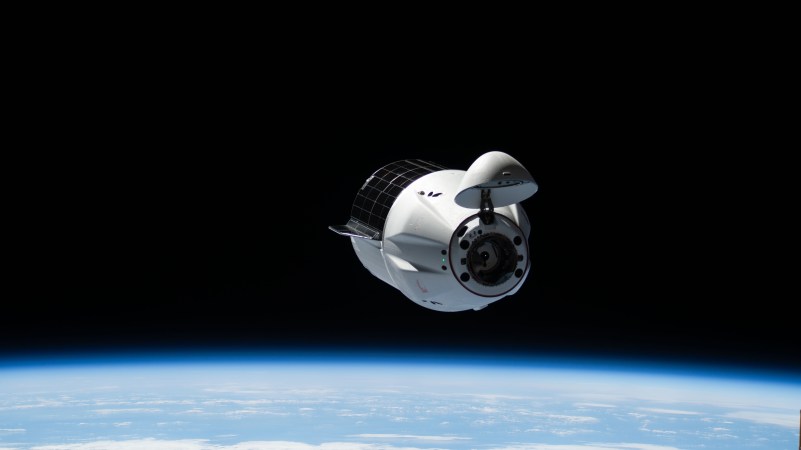
Earlier this month, a specially modified SpaceX Cargo Dragon became the newest addition to the list of spacecraft that can perform a reboost. The craft will boost the Station several times over the rest of the year, which will provide valuable data for when it comes time to reverse the process and de-orbit the ISS in the future.

Continue reading “Dragon Is The Latest, And Final, Craft To Reboost ISS”









