How A Belkin USB Charger Pulls Off A 3 Milliwatt Standby Usage

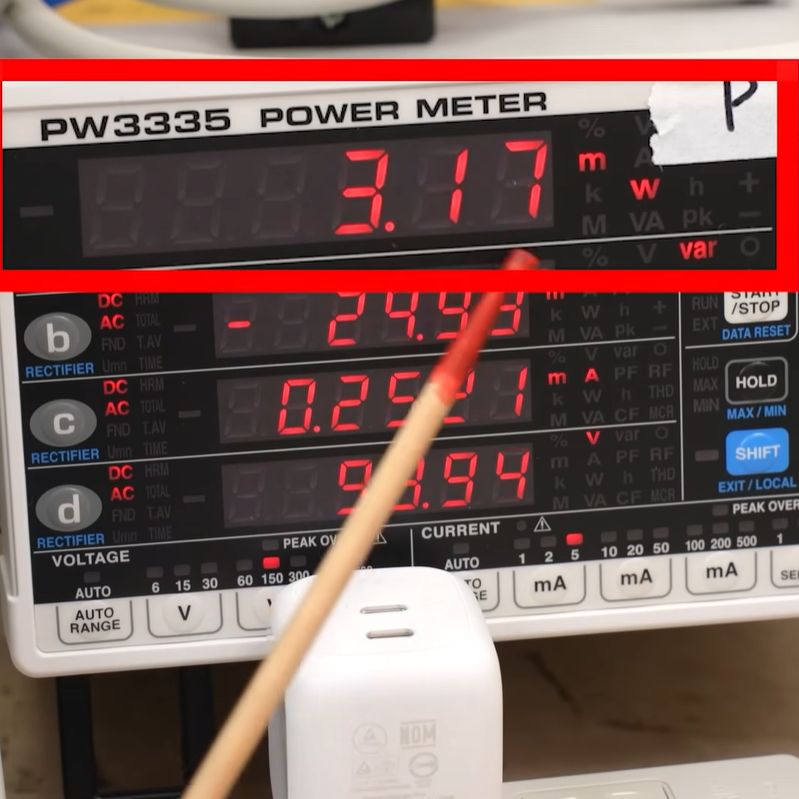
Belkin charger standby power. (Credit: Denki Otaku, YouTube)

A well-known property of wall warts like power bricks and USB chargers is that they always consume some amount of power even when there’s no connected device drawing power from them. This feels rather wasteful when you have a gaggle of USB chargers constantly plugged in, especially on a nation-sized scale. This is where a new USB-C wall charger by Belkin, the BoostCharger Pro, is interesting, as it claims ‘zero standby power’, which sounds pretty boastful and rather suspect. Fortunately, [Denki Otaku] saw fit to put one to the test and even tear one down to inspect the work of Belkin’s engineers.

Naturally, no laws of physics were harmed in the construction of the device, as ‘zero standby power’ translated from marketing speak simply means ‘very low standby power usage’, or about 3 milliwatt with 0.3 mA at the applied 100 VAC.

Fascinatingly, plugging in an e-marker equipped USB-C cable with no device on the other end caused this standby usage to increase to about 30 mW, clearly disabling the ‘zero standby’ feature. With that detail noted, it was time to tear down the charger, revealing its four PCBs.

Continue reading “How A Belkin USB Charger Pulls Off A 3 Milliwatt Standby Usage”
Hacked Television Uses No Power In Standby Mode

How much effort do you put into conserving energy throughout your daily routine? Diligence in keeping lights and appliances turned off are great steps, but those selfsame appliances likely still draw power when not in use. Seeing the potential to reduce energy wasted by TVs in standby mode, the [Electrical Energy Management Lab] team out of the University of Bristol have designed a television that uses no power in standby mode.

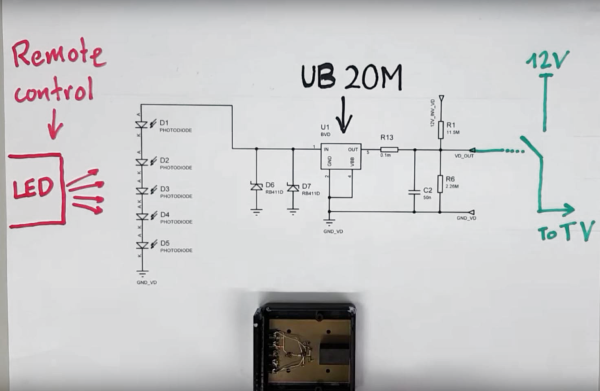
The feat is accomplished through the use of a chip designed to activate at currents as low as 20 picoamps.  It, and a series of five photodiodes, is mounted in a receiver which attaches to the TV. The receiver picks up the slight infrared pulse from the remote, inducing a slight current in the receiving photodiodes, providing enough power to the chip which in turn flips the switch to turn on the TV. A filter prevents ambient light from activating the receiver, and while the display appears to take a few seconds longer to turn on than an unmodified TV, that seems a fair trade off if you aren’t turning it on and off every few minutes.

Continue reading “Hacked Television Uses No Power In Standby Mode”

Power Strip Hack Reduces Standby Electricity Consumption

computer-standby-circuit

For years, [Rasmus] has left his computer connected directly to the mains power so that he can turn it on via Wake on Lan. While powered down, it would still continuously consume about 6W of electricity, but now that he didn’t need it to be on standby so often, he wanted to make it more energy efficient.

In Denmark, where he lives, many people use power strips that have an onboard USB cable. These strips are meant to reduce the standby power consumption of PC peripherals such as monitors by powering on the mains sockets only when the computer is active. He decided the easiest way to cut his standby energy consumption to 0W would be to power his computer via this strip as well.

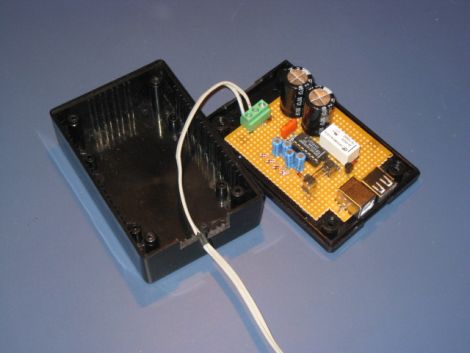
While it sounds great in theory, it presented a sort of chicken/egg problem. If the computer needs to be turned on for the power strip to recognize it, then how could he also supply power to the computer from the same strip? His solution was a small circuit that would charge up while the computer was running, and still hold enough juice to kickstart the PC’s boot process, thus turning on the power strip.

It really is an ingenious way to go about things, nice job!

Halloween Props: Pumpkin In Standby-mode

Evil Mad Scientist Laboratories is preparing for Halloween with this standby-mode pumpkin. Inside there’s an LED plugging a hole that is drilled just to the skin of the gourd-like vegetable. It fades in and out similar to a sleeping Mac, using what we think is a vastly over-powered circuit based on an ATtiny2313 (1k  of programming space for this?). But we still like the idea and we’d enjoy seeing it scaled up to a full LED matrix.

We’ve come to expect pumpkin hacks from EMSL and they don’t disappoint. Last year was a mechanized version, and the year before an LED schematic symbol. So what about your creation? With about one week left, take a look around and see if you can’t create something as wonderful as the Pie of Sauron.