

Hackaday Links Column Banner

Hackaday Links: May 17, 2026

To start things off, we’d like to extend a special thanks to everyone who joined us for Hackaday Europe this weekend in Lecco, Italy. It was 48 hours of fascinating talks, incredible badge hacks, and some of the greatest company you could hope for. For those who couldn’t make it in person, we didn’t forget you — expect to hear more about what went down once we get a chance to catch our collective breath.

That’s not the only thing to keep an eye out for in the coming days. This is your reminder that Amazon will be officially ending support for older Kindles in a few days. After May 20th, any of the megacorp’s e-readers that were introduced before 2012 will be persona non grata, so you should plan accordingly.

The biggest change is that these older devices won’t be able to buy digital books from Amazon, but you can still use them offline, and the fantastic Calibre makes it a breeze to load up content from other sources. To be perfectly honest, we’d advise any Kindle user to decouple their device from the Amazon mothership by using Calibre or even jailbreaking it and installing KOReader, so the end of official support is fine by us. In fact, if a surge of unsupported Kindles brings more attention and users to those projects, that suits us just fine.
Continue reading “Hackaday Links: May 17, 2026”

Hackaday Links Column Banner

Hackaday Links: July 30, 2023

A couple of weeks ago, we noted with interest that the space shuttle Endeavour (OV85) would be set up as a full-stack launch configuration display, complete with external fuel tank and solid rocket boosters. We predicted that this would result in some interesting engineering, not least of which will be making the entire 20-story stack safe from seismic activity. Looks like we were right on all counts, with this story about the foundation upon which the display will stand, which has been under construction for quite a while now. The base has six seismic isolators that support the 2.4-m thick slab of reinforced concrete that will serve as a perch for the full stack. The 1,800-ton slab will be able to move a meter or so from its resting position during earthquakes. Or perhaps more accurately, the foundation will allow Los Angeles to move as much as it wants while Endeavour rides it out.

If like us you’re worried that seismic loads are vastly different than the loads the spacecraft was actually designed for, relax — it turns out that the flight loads are far in excess of predicted loads from seismic stress. The plan is to build the booster stacks first — the aft skirts, which will support the entire stack, were just bolted in place — then lift the external tank in place between the boosters, and finally hoist the actual orbiter into place. After the stack is complete, the rest of the building will be built around it. We’re really looking forward to seeing some video on this project.

Continue reading “Hackaday Links: July 30, 2023”

Master Video Call Control Panel Is Made Of PCBs

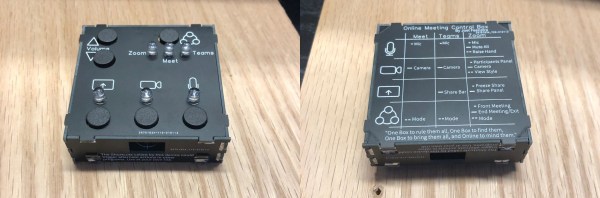
[memestra] is a teacher whose life has become a series of videoconferences over the last year or so. With all the classes and meetings, they spend the whole day switching between either Zoom, Teams, or Meet. If anyone needs a single piece of hardware to control them all, it’s [memestra]. Well, and every other teacher out there.

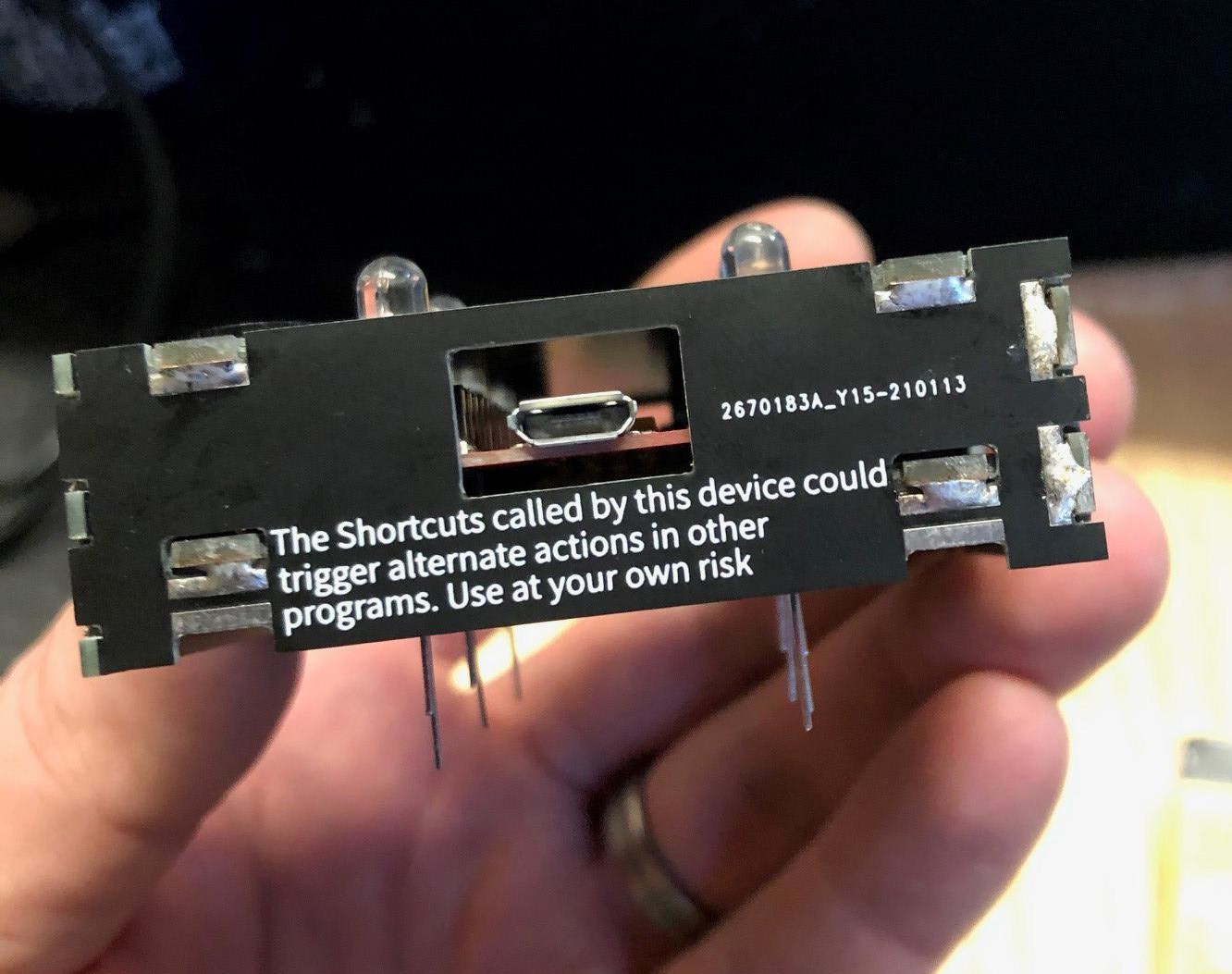
The hardware — an Arduino Pro Micro and some buttons — should come as no surprise, except for maybe [memstra]’s use of a resistor network for the LEDs. Still, there’s a lot to like about this little box, starting with the enclosure. That’s not milled or laser-cut metal — each side is a PCB, and they’re all soldered together into a box.

We especially like the top panel, which fits down over the PCB that all the components are soldered to. Each of the non-volume buttons has multiple functions that are accessed by pressing, long pressing, or double pressing. But even the volume buttons do double duty: press them together to mute and un-mute. If [memestra] ever forgets which button does what and how, there’s a handy reference table silkscreened on the bottom panel.

In true teacher fashion, [memestra] has written comprehensive instructions for anyone looking to build a similar device. The heavily-commented code should make it a cinch to drop in keyboard shortcuts for Discord or anything else you might be using, though it’s worth noting that this box is optimized for the desktop apps and not the browser-based versions.

Just looking for a fun way to end video calls? Pull chains are pretty fun.

Ask A Winner…

nokiapush1

We’ve been given the honor of interviewing each team from the Nokia N900 PUSH competition one on one. However, rather than be selfish, we thought it would be fun and informative if the readers got to ask the teams some questions too.

Just post your question in a comment and we will be sure to ask.

Avoid the basics, like “what was your inspiration” – don’t worry, we’ve got those covered. But maybe you have that dieing question of “Haptic Guide: What kind of battery life do you expect with 9 or more motors constantly spinning, surly we wont be wearing Lead Acid around will we?”

Nokia PUSH Competition Update

A couple of readers weren’t too thrilled when the winners were announced a while back for the Nokia N900 competition. And to be honest, we even wondered on some ideas (like what does skateboarding have to do with hacking?) However, The teams have been hard at work and a picture video is starting to form for each. Check after the break for some video recaps.

[Thanks Matt]
Continue reading “Nokia PUSH Competition Update”









