
Reverse-Engineering A Handheld Car Tire Pressure Gauge

The SDIC 8-bit MCU. (Credit: electronupdate, YouTube)

In this wonderful world of MEMS technology, sensor technology has been downsized and reduced in cost to the point where you can buy a car tire pressure sensor for less than $3 USD on a site like AliExpress. Recently [electronupdate] got his mittens on one of these items to take a look inside, and compare it against his trusty old mechanical tire pressure gauge.

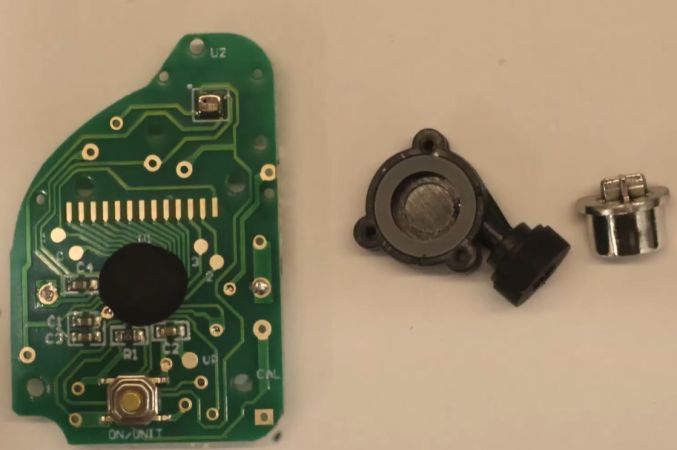
Perhaps unsurprisingly, there isn’t a whole lot inside these devices once you pop them open to reveal the PCB. The MEMS device is a tiny device at the top, which has the pressurized air from the tire guided to it. The small hole inside the metal can leads to the internals that consist of a thin diaphragm with four piezoresistors that enable measurements on said diaphragm from which pressure can be determined.

Handling these measurements and displaying results on the small zebra connector-connected LCD is an 8-bit MCU manufactured by Chinese company SDIC. Although the part number on the die doesn’t lead to any specific part on the SDIC site, similar SDIC parts have about 256 bytes of SRAM and a few kB of one-time programmable ROM.

This MCU also integrates the clock oscillator, thus requiring virtually no external parts to work. Finally, its sigma-delta ADC interacts with the MEMS device, rounding out a very simple device that’s nevertheless more than accurate enough for a spot check as well as quite portable.

Continue reading “Reverse-Engineering A Handheld Car Tire Pressure Gauge”

Tech In Plain Sight: Finding A Flat Tire

There was a time when wise older people warned you to check your tire pressure regularly. We never did, and would eventually wind up with a flat or, worse, a blowout. These days, your car will probably warn you when your tires are low. That’s because of a class of devices known as tire pressure monitoring systems (TPMS).

If you are like us, you see some piece of tech like this, and you immediately guess how it probably works. In this case, the obvious guess is sometimes, but not always, correct. There are two different styles that are common, and only one works in the most obvious way.

Obvious Guess

We’d guess that the tire would have a little pressure sensor attached to it that would then wirelessly transmit data. In fact, some do work this way, and that’s known as dTPMS where the “d” stands for direct.

Of course, such a system needs power, and that’s usually in the form of batteries, although there are some that get power wirelessly using an RFID-like system. Anything wireless has to be able to penetrate the steel and rubber in the tire, of course.

Continue reading “Tech In Plain Sight: Finding A Flat Tire”

No-Battery Pressure Sensors For Bike Tyres

Finding out you’ve got a flat tyres halfway into a long ride is a frustrating experience for a cyclist. Maintaining the

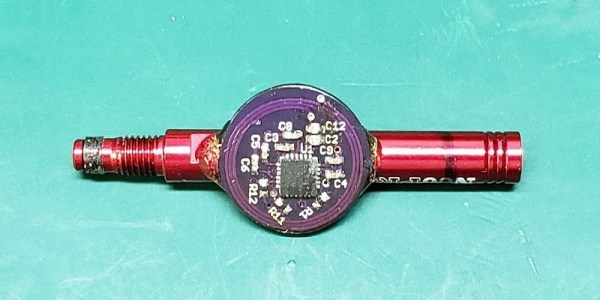
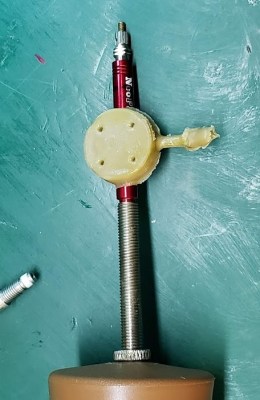
While the epoxy does a great job of sealing the PCB to the valve extension, the overmoulding process would likely be key to producing a product with shelf-quality fit and finish. This test run was done with 3D printed ABS moulds.

correct tyre pressures is key to a good ride, whether you’re stacking up the miles on the road or tackling tricky single track in the mountains. [CaptMcAllister] has put together a device that makes keeping an eye on your tyres easy.

The device consists of an ultra low power microcontroller from Texas Instruments, paired with a pressure sensor. Set up for Near Field Communication, or NFC, it’s designed to be powered by the smartphone that queries the microcontroller for a reading. We featured a prototype back in 2015 which required mounting the device within the inner tube of the tyre itself. However, this required invasive installation and the devices tended to wear out over time due to flex damaging the delicate copper coil antenna.

The new design consists of the same microcontroller hardware, but mounted in a modified valve extension that fits to the fill valve of the bicycle tyre. The PCB is directly epoxied on to the valve extension, ensuring air can’t leak out over time. The assembly is then overmoulded in an injection moulding process to provide further sealing and protection against the elements. This should help immensely in rough-and-tumble mountain biking applications.

The new device provides a simple screw-on solution for tire pressure monitoring that’s set and forget — no batteries required. [CaptMcAllister] is currently investigating options for a production run, and given the simple design, we imagine it couldn’t be too hard to rattle off a few hundred or thousand units. We could imagine it would also pair well with a microcontroller, NFC reader, and a display setup on the handlebars to give live readings where required. We look forward in earnest to seeing where this project goes next!