

Ah, the heady aroma of damp engineers! It’s raining in Silicon Valley, where the 2010 Embedded Systems Conference is getting off the ground at San Jose’s McEnery Convention Center.
ESC is primarily an industry event. In the past there’s been some lighter fare such as Parallax, Inc. representing the hobbyist market and giant robot giraffes walking the expo. With the economy now turned sour, the show floor lately is just a bit smaller and the focus more businesslike. Still, nestled between components intended to sell by the millions and oscilloscopes costing more than some cars, one can still find a few nifty technology products well within the budget of most Hack a Day readers, along with a few good classic hacks and tech demos…
First order of business was to follow up on a couple of products we’ve covered in the recent past…
We reviewed NXP’s mbed prototyping platform in November of last year. While there’s no stunning new revision, the good news is that the mbed community is going strong and economies of scale have made it possible to trim the starter kit price from $99 back down to the original early adopter cost of $59.
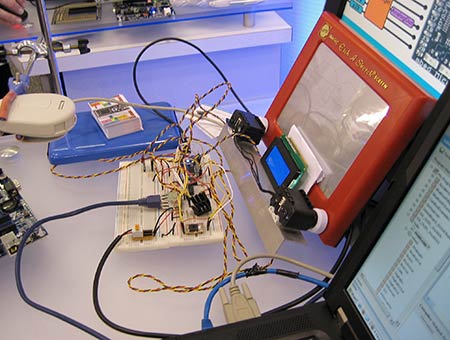
Additionally, they’ve thrown together a project in just a few days to demonstrate the prototyping ease of the mbed platform. Reading like a checklist of Hack a Day clichés, the demo brings together Twitter, the Logo programming language, live web streaming, servos and an Etch-a-Sketch. You can read more on the mbed blog, or watch the live stream and participate during ESC show hours.
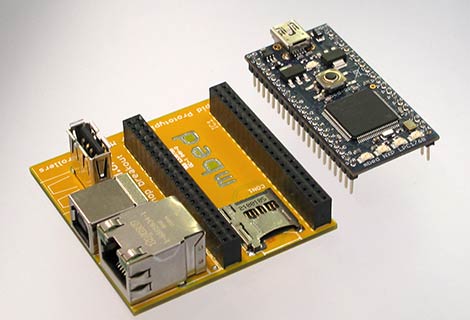
We also liked this little breakout board which adds the most essential interfaces to mbed: MicroSD, Ethernet and USB host & client. This was something quickly made for an mbed workshop, and while there are no plans to officially productize it, we’re told the unpopulated board might be available through SparkFun’s BatchPCB service in the future.
Many readers were put off by the web-centric development approach used by mbed, as well as the lack of a debugger. Another NXP entry-level evaluation product called the LPCXpresso provides an affordable ARM development kit from a more traditional angle.
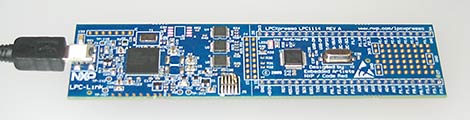
The $30 LPCXpresso boards are available in Cortex-M0 or -M3 varieties and include an integrated JTAG debugger. The downloadable Windows development environment is based around the Eclipse IDE and GNU toolchain. With headers installed the LPCXpresso is breadboard-friendly and in fact shares the same pinout as mbed, so there’s an existing ecosystem of hardware to work from.
STMicroelectronics’ STM8S-Discovery made a huge impact when we mentioned this $7 kit in November, clearing out distributors in a matter of days. At ESC, ST was showing their new ultra-low-power 8- and 32-bit MCUs with demos powered by a cactus (a variation on the classic lemon battery), a cup of warm water sitting atop a Peltier junction, and a modest induction charger. (What, no wind power?)
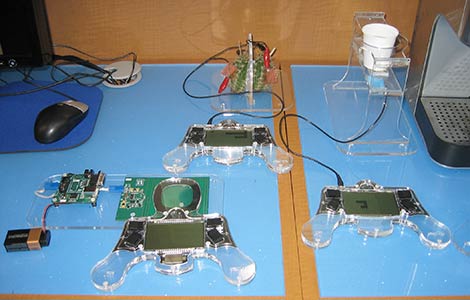
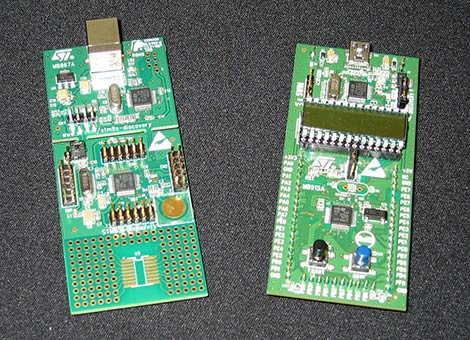
A new version on the STM8S-Discovery based on the new lower-power chip should be available within a couple of months, and is expected to be similarly affordable.
At the Texas Instruments booth, the BeagleBoard XM was being demonstrated, which improves upon its predecessor in nearly every regard.
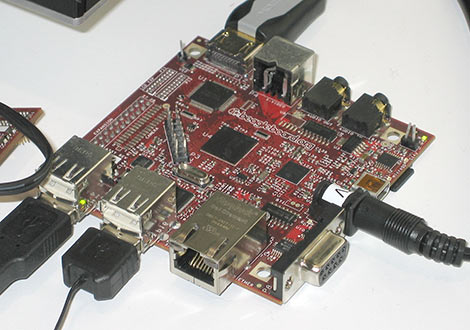
We’re told BeagleBoard XM stands for “extra MIPS,” “extra memory,” (and “extra money,” they joked). The XM does not replace the original BeagleBoard, but will be sold alongside it at a premium price of $179 when it ships in June. The XM includes a faster processor (1 GHz), more RAM (512 MB, and a 1GB model may be forthcoming), Ethernet, more USB ports and improved power protection. The NAND flash is gone, replaced by a MicroSD slot on the underside. The new board is slightly larger but retains the same mounting holes, so it may fit as an upgrade into some existing BeagleBoard projects.
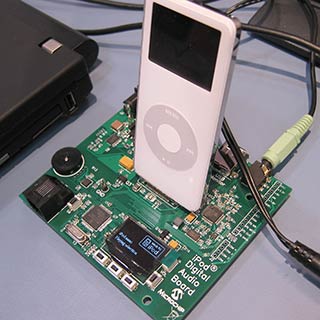
Microchip’s iPod/iPhone accessory development boards that we mentioned last month were on display. Unfortunately it appears one must be signed on with Apple’s “Made for iPod” developer program before these kits can even be ordered from Microchip, which really puts a damper on the fun for anyone who might just want to tinker.
Drifting further from product specifics and more into hacks and eye candy…
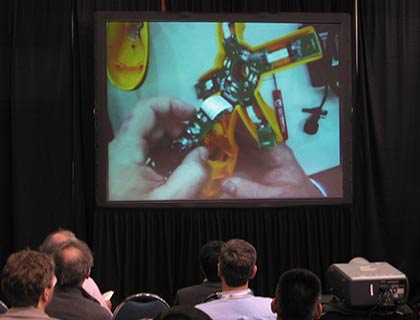
Product teardowns have become a staple of tech culture. “Zero-day” and live blog teardowns of new products are particularly exciting. ESC’s gone one better, making a show of ripping into a product (if a rather esoteric one) months before its official release: a high-end Zircon AC wire detector built around a Microchip dsPIC and a bevy of e-field sensors. It’s like engineer pr0n!
National Instruments certainly had one of the most entertaining booths at the event. Rather than passively showing dry PowerPoint summaries and monitors running LabVIEW (their graphical programming environment for engineers and scientists), they instead presented physical demos and projects making use of the software. Some serious, others not-so-serious. Hacks!
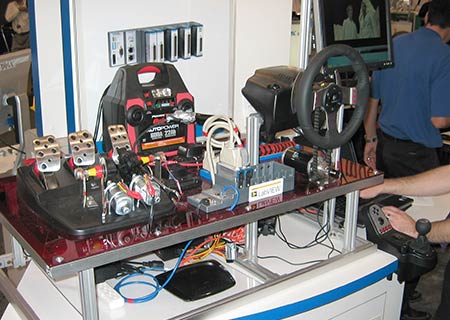
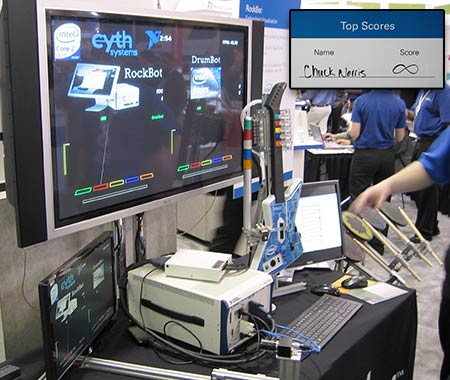
Remember Waterloo Labs’ iPhone-controlled car hack? There it is! Rather, there it is minus the actual car, but with all the essential parts nicely laid out where we can observe the rig in action. At the other end of the booth, one can challenge “RockBot” to a round of Frets on Fire, not unlike prior hacks we’ve seen.
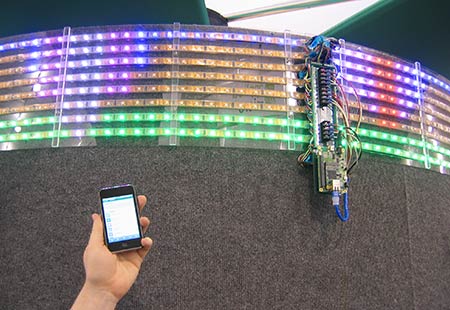
Hack a Day readers might be familiar with Digi International for their XBee wireless modules, such as used in Adafruit’s Tweet-a-Watt power monitor. Easily distracted by shiny things, we were initially smitten with this addressable LED matrix wrapped around their booth; not a product, just something to catch peoples’ interest:
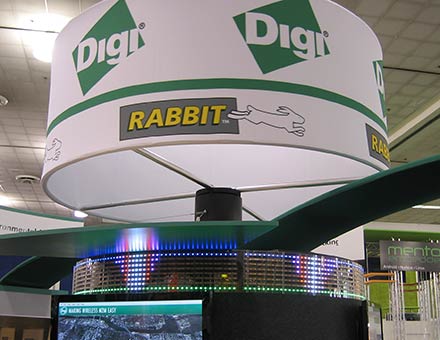
As it turns out, there’s an added bonus hack behind the hack. Most of Digi’s booth displays could be controlled and monitored using their own custom web apps, so it was a simple matter of walking around with an iPod touch to run the show:
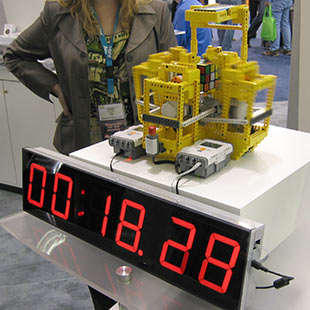
At the ARM pavilion, this “Speedcuber” was solving Rubik’s cubes in under half a minute. The camera and puzzle-solving logic comes from a Motorola Droid. Commands are issued over Bluetooth to a pair of LEGO Mindstorms NXT controllers to drive the motors that manipulate the cube.
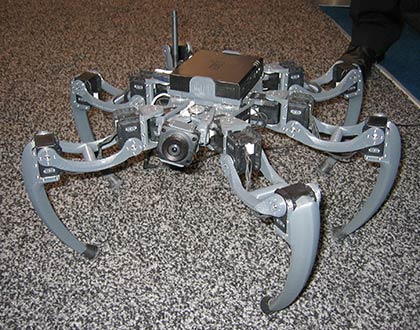
Macraigor Systems produces a line of JTAG debuggers…but to be honest, we (and pretty much everyone else passing the booth) nearly missed that fact, as we were all so distracted by their demo application involving one spectacular and elegant Intel hexapod robot:
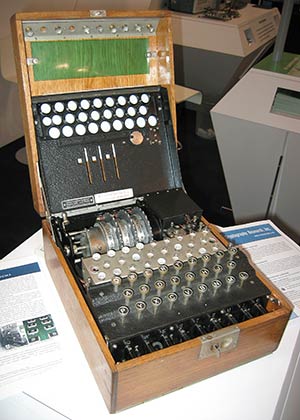
We similarly fanboyed over Cryptography Research’s German Enigma cipher machine, as it was our first time seeing one not under lock and key in a glass museum case:
ESC Silicon Valley runs through Thursday, April 29th, and last we checked one could still register for a free exhibits-only pass on the ESC web site.












Enough trivia. What swag did you get??!!
For crypto lovers that happen to find themselves in the Maryland / Metro DC area, the National Cryptologic Museum at Fort Meade/NSA is a must:
http://www.nsa.gov/about/cryptologic_heritage/museum/
They have the first known book on ciphers dating back to the 15th century, and a working Enigma you can actually play with. It’s small, but definitely geektastic.
Oh, you were there yesterday? I roamed around, saw some good stuff. Possibly going again today and trying to catch more of the learning sessions.
Regarding swag, don’t worry about it. Since the economy tanked no one pushes swag on you and I have enough pens, thank you. It is possible to walk from booth to booth nibbling on fun-size candy bars and Starburst if free stuff is your thing.
Yeah, being that I need to head to San Jose later today, are they giving away any good free stuff?
Ummm….yeah….some oscopes nowadays cost more than some houses…..not just cars…
@Tom: there are a few free conference sessions that provide kits (such as the mbed or LPCXpresso) in exchange for a couple hours’ time, usually to a very limited number of people. And the supply of free STS8S-Discovery packs will likely go fast. So otherwise, from a purely swag-grab point of view it would be difficult to offset the cost of downtown parking or a convention center soda. Now, if you’re in the market for higher-end development tools, there may be value in the discount codes and coupons some companies offer to attendees (e.g. 20% off anything from Microchip), and whatever value you place on seeing these things in person and having questions addressed face-to-face. Free issues of Circuit Cellar magazine and breath mints from Atmel are appreciated perks, but hardly a reason to go in themselves.
My thoughts exactly — the new Agilent 90000 X-series o’scope can run over $250k.
$250K is still car money and not house money, around here.
I liked the zero-power wireless FRAM from Ramtron…
The STM8S board was probably the best piece of SWAG (I like techy swag!) Flash drives from Coilcraft and TI (TI’s “technology day” was co-located, and I attended several pretty good sessions there on low-power wireless. though not the ones where they were giving away their Watch development kit to the first 100-odd people to show up (I already have one anyway.)
Lots of drawings for iPads, but I’d rather win the Beagleboard or leCroy scope!
I can’t wait to get my hands on the robotic eval board for the Stellaris micros that they were showing. You punch PCB pieces out of a panel, build wheels, sensors etc, then bolt on the motors and mounts and viola! You have a 4″ diameter robot. They mentioned that the board/book will run about $200+ when it is available. I’d post a link but I can’t find it on their website yet.