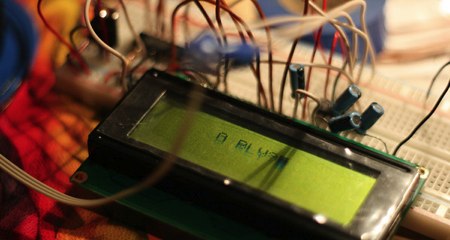
Hack a Day favorite [Mikey Sklar] is back with a new project. Mini-D is a battery desulfator. If a 12V lead-acid battery sits with a voltage below 12.3V, sulfur crystals will begin to form on the lead plates. This crystal growth increases the internal resistance and eventually makes the battery unusable. A battery desulfator sends high frequency pulses through the battery to create a resonance that will break up the crystals. On a 60lb automotive battery, it will take approximately three weeks to completely desulfate. You can find schematics plus a dozen lines of code for the ATmega169 on his site. Embedded below is a video where he explains the device and other techniques like load testing.
It seems one of our commenters took great umbrage with [PodeCoet] not documenting his capacitive discharge cutting properly. [PodeCoet] had been waiting till he got the full spot welder working before publishing, but he’s expedited the work after all our whining. Check out his full writeup of the device in its current state. It uses a 1Farad audio cap for storage. A dsPIC monitors all of the voltage sources and regulates charging. A nice touch is the tactile switch on the electrode.
Reader [john] finished up his home power monitor over the holiday weekend. It uses a pair of current transducers clamped onto the mains. These output 0-3V and are read by the Arduino’s ADC. The Arduino averages samples over a 20 second period, calculates power used, and uploads it using an Ethernet Shield. The shield can’t do DNS lookups, so he uses a WRT54G to negotiate with the remote webserver. He admits that the system could be more accurate; it can’t detect small loads like wall warts. He also says that money could be saved by talking serial to the router instead of over ethernet. Here are the current usage charts.
You can find many power monitor projects like this in out Home Hacks category.
Everyone’s favorite packet sniffer has a new stable release. Wireshark 1.2.0 has a slew of new features. They’ve included a 64-bit Windows installer and improved their OSX support. A number of new protocols are recognized and filter selection autocompletes. One of the more interesting additions is the combined GeoIP and OpenStreetMap lookups. We’re excited about this new release as Wireshark has proven an indispensable tool in the past for figure out exactly what was going on on our network.
Create Digital Music has a great post on [Luca De Rosso]’s OTTO. Built as part of his masters’ thesis, it’s a unique tangible music interface. You load a sample into the software which displays it on the instrument surface. The user can then manipulate the sample using various hardware inputs while watching the LED representation. The device uses just one Arduino for the display and inputs. It works with Max/MSP and is designed to give the performer only the information they truly need. You can find more pictures of the device on Flickr and a picture of the guts on CDM. Embedded below is the ‘Getting Started’ video that shows it in use.
Embedded above is an interesting multitouch demo by [Lahiru]. The goal of the project was to find an easy way to retrofit current LCDs for multitouch. Instead of using infrared or capacitive recognition, it uses a standard webcam mounted overhead. To calibrate, you draw polygon around the desktop screen as the webcam sees it. The camera can identify the location of markers placed on the screen and their color. iDisplay can also recognize hands making the pinch motion and sends these as touch events via TUIO, so it works with existing touch software. It’s written in C++ using OpenCV for image processing with openFrameworks as the application framework.
Update, Saturday July 4th, 2009: All preorders are closed.
We’re excited to announce our partnership with the folks at Seeed Studio (home of the excellent Seeeduino) to put the Bus Pirate v2go into production! The pre-order period ends July 3rd. The price is $30 including worldwide shipping. The board pictured above is a hand soldered prototype, but the ones sold by Seeed are completely factory assembled.
This is the first officially produced piece of Hack a Day hardware. Depending on its success, we’ll be able to put many future designs into production. Read more about the Bus Pirate in our latest How-to. Thank you for your support!
***Update, Monday June 29, 2009: Wow, your support has been overwhelming! Thank you! There have been more orders for the Bus Pirate than we ever imagined. As of this update, there’s a few (12) Bus Pirates left in the Seeed pre-order. After that, we’ve exhausted the supply of PIC24FJ64GA002s available in Shenzhen. If you’ve already placed your order nothing changes, the manufacturing process has already begun and your Bus Pirate will ship ASAP.
After the first pre-order is filled, Seeed will start a new pre-order. The second pre-order will be delayed until more PIC24FJ64GA002s are delivered, about 4 to 6 weeks. This order should ship about 6 to 8 weeks after July 3, 2009, but we’ll try our best to get it out sooner. Thank you again for your support!
Boxee, the free media center management and streaming application, is now available for Windows platforms. We’ve been following the developments of Boxee since we first announced its alpha this time last year. At that time, it was only available for OSX with promised Ubuntu support. We were a bit skeptical about the interface noting, “Unfortunately all the dynamic resizing, animated, sliding, floating info boxes make it behave like the zooming user interface’s retarded cousin”. Our interest in Boxee was almost entirely based on it being a fork of XBMC, the media center project developed for initially for hacked Xboxes. It was interesting to see Boxee become the interface of choice for hacked Apple TVs and then go mainstream with a big push at CES.
Have you been using Boxee as your media center? What do you love/hate? What about alternatives like XBMC, Plex, or MythTV?
The iPhone dev-team has released Ultrasn0w to SIM unlock the iPhone 3G running the 3.0 firmware. It’s available via Cydia, which installs when you use the recently released PwnageTool to unlock the 3.0 firmware. There doesn’t seem to be any caveats besides advising T-Mobile US users to turn off 3G before install.
The iPhone dev-team has released an updated version of PwnageTool. It supports jailbreaking iPhones using the 3.0 firmware. This update does not include the much easier to use QuickPwn, but it should be coming soon. The release also doesn’t include the UltraSn0w unlock which will be coming via Cydia.
[Alex] put together this handy cheat sheet to make pinout lookups much quicker. It covers the most common chips from the AVR line, ISP headers, and FTDI cables.
TechEBlog has posted a few pictures of a student constructed coil gun. It’s bolt-action and includes a six round magazine. The gun only has a single stage to accelerate the projectile. While not as impressive as the portable coil pistol, it’s still more fun than most shop projects we’ve seen. You can find a video of the device below.
Did you upgrade your iPhone to 3.0 yet? 9 to 5 Mac has posted a very good reason to upgrade: enabling tethering is almost stupidly simple. Just run a simple command and then go through a restore procedure. All thats left is to sit back and enjoy your other new features you could find on a four year old Nokia.
A friend recently commissioned us to install OSX on a netbook. We advised him to purchase the Dell Vostro A90. It’s essentially a rebadged Dell Mini 9, a model that has been discontinued, but is well suited for OSX. It’s only available with a 1.6GHz Atom processor, 1GB RAM, and 16GB SSD. Depending on what deals are available, it’s $250-$300. We also had him purchase a 2GB stick of RAM which is the upper limit supported by the BIOS. Read the rest of this entry »