Hackerspace Intros: Squidfoo In Springfield, Missouri

I am particularly pleased to be announcing SquidFoo, an Art gallery/studio and hackerspace in Springfield Missouri (hackerspaces.org link). For those unaware, this small town is where I’m located (Brad Pitt came from here too!). I would love to take credit for this hackerspace, but I can’t. [Scott Sauer] and [Phil Broussard] created it and reached out to me when they heard I was in town. I’m going to make up for coming late to the party by helping them get organized, and possibly planning some events. You’ll be seeing more of SquidFoo here because this is probably where I’ll be doing future Hackaday projects for a while!

Continue reading “Hackerspace Intros: Squidfoo In Springfield, Missouri”
Laptop Touchpad As A Standalone Peripheral

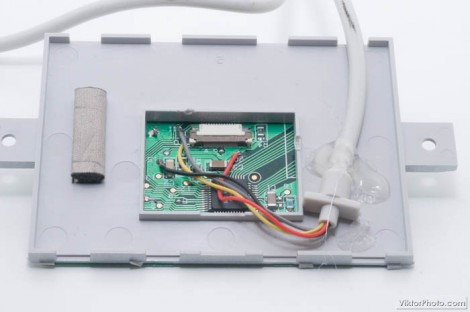
[Viktor] is working on salvaging parts from a dead laptop. In his eyes the biggest gem to be had is the touchpad, so he set out to see if he could make the touchpad a standalone device. You might be envisioning the many hells of interfacing this with a microcontroller and writing firmware to measure and translate the input to HID compatible commands. The good news is it’s quite a bit simpler than that, with just one gotcha.

He looked around to see what he could find about the chip that drives the touchpad. He couldn’t locate an exact match, but a datasheet from a similar family of controllers make him think that there should be a PS/2 data and clock output from the chip. After probing the test points on the board he found them, as well as the voltage and ground rails. Above you can see he soldered an old mouse cable to the board and it works when plugged in.

But we did mention the gotcha. There doesn’t seem to be any support for the right and left buttons. Those were housed on a flexible PCB which attached to the white connector seen above. That PCB also connected to the computer so we don’t know if they will work with this hack or not.

Your Face In Chocolate

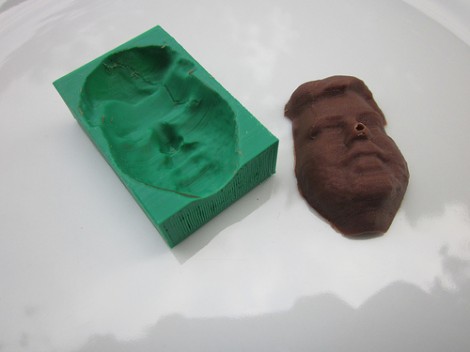
We think in might be absurdly vain, but wouldn’t it be fun to give everyone in your family a chocolate modeled after your mug this holiday season? [Eok.gnah] has already worked out a system to make this possible. It consists of three parts: scanning your head and building a 3D model from it, using that model to print a mold, and molding the chocolate itself.

He used 123D to scan his face. No mention of hardware but this face scanning rig would be perfect for it. He then cleaned up the input and used it to make a mold model by subtracting his face from a cube in OpenSCAD. That needs to be sliced into layers for the 3D printer, and he used the Slic3r program which has been gaining popularity. Finally the mold was printed and the face was cast with molten chocolate. We’d suggest using a random orbital sander (without sand paper) to vibrate the bottom of the mold. This would have helped to evacuate the bubble that messed up his nose.

You know, it doesn’t have to be your face. It could be another body part, even an internal one… like your brain!

Telepresence Robot Lets You Play A Hand Of Cards

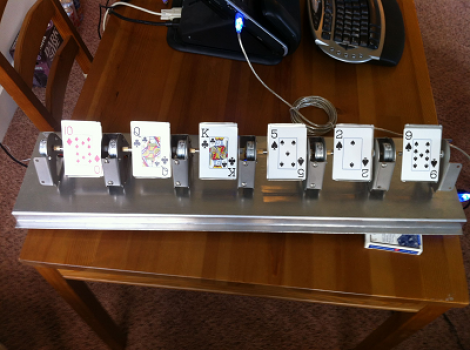
Virtual card games proliferate the interwebs, but this card-playing telepresence device is unique. [Patrick] calls the project Vanna, and we’d bet that’s an homage to the tile-flipping TV star [Vanna White]. Much like she flips the blank tiles to reveal letters, this device can flip the hand of cards either face up or face down.

Each of the six card trays is connected to a stepper motor. The local player deals the hands, placing each card in a tray so that it faces the webcam for the remote player. That remote player has an on-screen interface that can discard by tilting the tray forward and dropping the card on its face, or play a card by tilting toward to the local player so they can see its face value. All becomes clear in the clip after the break.

The hardware is USB controlled from a Windows machine thanks to the PIC 18F4585 which controls it. But it should be quite simple to get it talking to the OS of your choice.

Continue reading “Telepresence Robot Lets You Play A Hand Of Cards”

Power Index Window Display Turns Buildings Into LED Matrices

What started off as a fun project using light bulbs picked up some sponsorship and is going on tour. This project now uses LED modules controlled on the 2.4 GHz band to turn buildings into full color displays. It’s the product of students at Wrocław University of Technology in Poland. The group is something of an extra-curricular club that has been doing this sort of thing for years. But now they’ve picked up some key sponsorships which not only allowed for upgraded hardware, but sent the group on a tour of Universities around Europe. Who would’ve thought you could go on tour with something like this?

Much like the MIT project we looked at in April, this lights up the dark rooms of a grid-like building. It does go well beyond playing Tetris though. The installation sets animations to music, with a custom animation editor so that you can submit your own wares for the next show. Don’t miss the lengthy performance after the break.

Continue reading “Power Index Window Display Turns Buildings Into LED Matrices”

Measuring Projectiles With OpenChronometer

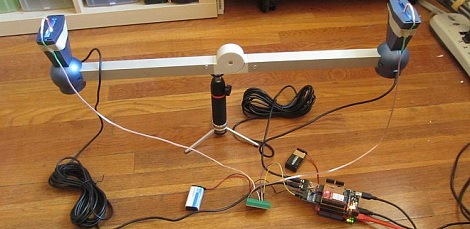
[Spork] over on the Netduino forums wanted to push the limits of what his little board could do. He put together a chronometer to measure the velocity of rifle rounds and Nerf darts using an Arduino-compatable CPLD shield.

The project is built around a pair of commercial CED M2 chronograph sensors; because people have the tendency to shoot through these sensors, they’re available as replacement units for much less than the cost of a complete chronograph setup. [Spork] couldn’t figure out a way for his Arduino clone to read pins with a resolution of 1 microsecond, so a Amani GTX CLPD shield was added to the build. This programmable logic chip takes the output from a chronometer sensor, starts a timer, waits for the second sensor to trigger, and stops the timer. From that, the velocity of just about any projectile can be calculated.

Of course, [Spork] needed to test his new device, so he took it out to the range and fired 25 rifle rounds through his chronometer. The result was a very nice, normal distribution centered around 2400 feet per second, exactly as would be expected. Although [Spork] didn’t test out low-velocity projectiles such as Nerf darts, we expect the same reliable results.

via majolsurf

Ironman Replica Twofer

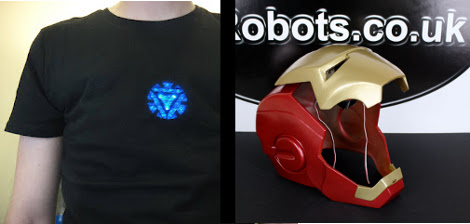
We think it’s a bit to late to show up for a screening of The Avengers in full costume, but an arc reactor T-shirt would be pretty cool. [4ndreas] built a chest strap that looks much like [Tony Stark’s] chest-mounted power source. It has a 3D printed enclosure which hosts the ATmega8 and 22 LEDs which provide the pulsing goodness. The thin cellphone battery helps to keep the size of the package to a minimum and a strategically placed hole in a black T-shirt completes the look. It’s even bright enough to shine through the fabric of this black T-shirt.

But if you insist on head-to-toe regalia you’ll appreciate [James Bruton’s] Ironman suit replica build. Not only does he look the part, but he’s trying to build as much functionality into the project as possible. Most recently he finished the helmet. It’s got a motorized faceplate and LED edge-lit eye plates to impress hackers and cosplay fans alike.

Find video of both projects after the break.

Continue reading “Ironman Replica Twofer”