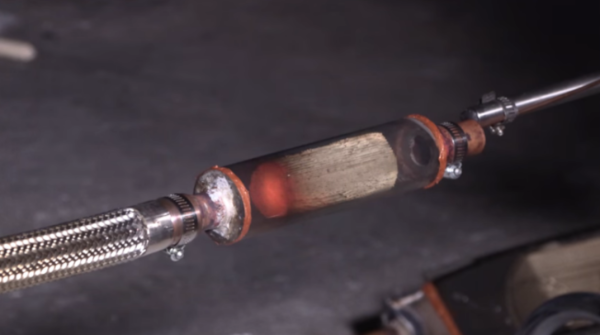
See-Through Catalytic Converter

There’s always something to be learned from taking things apart. Sometimes the parts can be used for other things, sometimes they can be repaired or improved upon, but sometimes it’s all in good fun. Especially in this case where extremely high temperatures and combustible gasses are involved. This is from the latest video from [Warped Perception] that lets us see inside of a catalytic converter as its operating.

Catalytic converters are installed on most vehicles (and other internal combustion engines) in order to process unburned hydrocarbons from exhaust gasses with a catalyst. These can get extremely hot, and this high temperature complicated the build somewhat. There were two prototypes constructed for this build and the first was a cross-section of a catalytic converter with a glass window sealed on in order to allow the viewing of the catalyst during the operation of a small engine. It was easy to see the dirty exhaust gasses entering and cleaner gasses leaving, but the window eventually blew off. The second was a complete glass tube which worked much better until the fitting on the back finally failed.

A catalytic converter isn’t something we’d normally get to see the inside of, and this video was worth watching just to see one in operation in real life. You could also learn a thing or two about high-temperature fittings as well if you’re so inclined. It might be a nice pairing with another build we’ve seen which gave us a window into a different type of combustion chamber than ones normally found on combustion engines.

Thanks to [Ryoku] for the tip!
Continue reading “See-Through Catalytic Converter”

A Nano With An Otter’s Bite

The would-be microcontroller experimenter is now faced with a bewildering array of choices when it comes to a tiny development board for their projects. Everything from descendants and clones of the original Arduino through to full-fat Linux powerhouses such as the Raspberry Pi Zero and similar boards can be had, and often for a reasonable price.

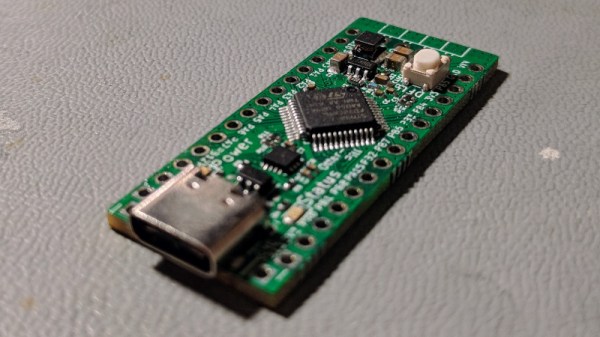
A new entrant has now joined the fray, the OtterPill is an STM32F072-based board with an Arduino-Nano-like pinout, and it comes from the bench of [Jana Marie]. With so many competitors you might ask yourself what it can offer, and it would be a valid point given that a Nano clone can be had for relative pennies. Aside from the Nano shield compatibility and extra power of the ARM Cortex M0 then, it’s an open source development board with USB-PD included from its USB-C socket, and with some elite BoM wizardry she’s managed to get the cost of its components to below three dollars. A USB-PD example firmware is available and a blank firmware is on its way. For now the board exists only in prototype form, but she’s putting together a production run if you would like one too. We saw an early development of it at eth0 back in the autumn, and given the progress since then we’re sure that we won’t have to wait for long.

Regular readers will recognise [Jana Marie]’s work, because otter-themed boards have made their way to these pages before. Our most recent ones were the USB-C replacement board bringing USB-PD to the TS-100 soldering iron, and  a nifty little USB board for addressable LEDs.