
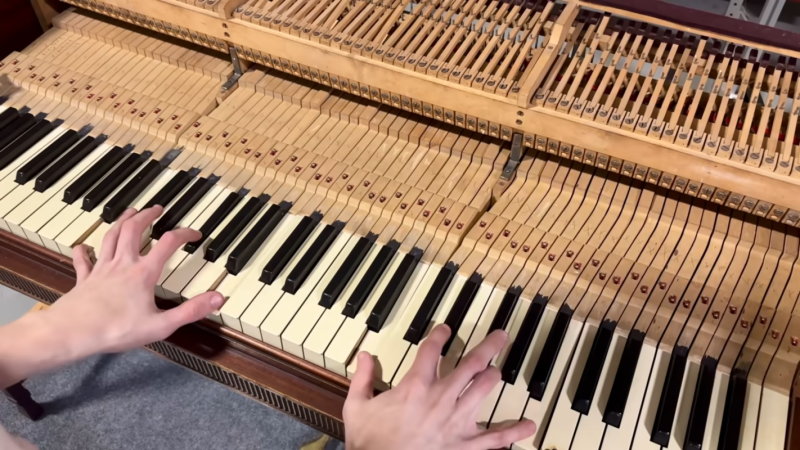
Not only are pianos beautiful musical instruments that have stood the test of many centuries of time, they’re also incredible machines. Unfortunately, all machines wear out over time, which means it’s often not feasible to restore every old piano we might come across. But a few are worth the trouble, and [Emma] had just such a unique machine roll into her shop recently.
What makes this instrument so unique is that it’s among the first electric pianos to be created, and one of only three known of this particular model that survive to the present day. This is a Vivi-Tone Clavier piano which dates to the early 1930s. In an earlier video she discusses more details of its inner workings, but essentially it uses electromagnetic pickups like a guitar to detect vibrations in plucked metal reeds.
To begin the restoration, [Emma] removes the action and then lifts out all of the keys from the key bed. This instrument is almost a century old so it was quite dirty and needed to be cleaned. The key pins are lubricated, then the keys are adjusted so that they all return after being pressed. From there the keys are all adjusted so that they are square and even with each other. With the keys mostly in order, her attention turns to the action where all of the plucking mechanisms can be filed, and other adjustments made. The last step was perhaps the most tedious, which is “tuning” the piano by adjusting the pluckers so that all of the keys produce a similar amount or volume of sound, and then adding some solder to the reeds that were slightly out of tune.
With all of those steps completed, the piano is back in working order, although [Emma] notes that since these machines were so rare and produced so long ago there’s no real way to know if the restoration sounds like what it would have when it was new. This is actually a similar problem we’ve seen before on this build that hoped to model the sound of another electric instrument from this era called the Luminaphone.
Thanks to [Eluke] for the tip!












Technically not a piano-forte because of the fixed pluck instead of hard or soft caused by hitting after let-off. There maybe some dynamics but not like a Wurlitzer, that’s why they put a volume pedal set on this. Step on both pedals and gear teeth get broken. The black plucker stuff is likely rubber that has hardened. It would soften the harder click of plucking the reeds.
Nobody had an amp then maybe the “phono” jack on a table or console radio, so rather hard to sell especially during the depression. It would have been great on live radio for not picking up studio sounds. A piano is hard to mic live even today. A large wooden “horn” covering the whole top of a lidless grand with a carbon mic at the top was first tried.
Germany had the Neo Bechstein first, with strings and magnetic pickups. Things did well at first then Hitler hit.
Wow, I’m impressed with the care she took to get it just right. What a fascinating machine.
It would be good to get the cog and capacitor sorted to really finish it off.
The scratchy pot could probably be fixed with some contact cleaner. Some antique radio restorers would heat that wax capacitor, remove the insides and put a modern capacitor inside. If done right, it looks original.
I gotta guess that piano is like a boat- Two best days are when you buy it and when you sell it.
I had to get rid of an upright piano once. Wouldn’t wish that on my worst enemy.
Really? I’ve moved 5-10 in my life so far. It wasn’t particularly easy, but it was well worth the enjoyment of hearing them played.
None of the moves were actually to my house, but maybe when my kids get a few years older we will move one into my place.
This is wild that I got this on my Google chrome recommended article LOL. Thanks for enjoying and sharing!
I enjoyed the video. It has a good mix of information and simply watching someone do something they are good at.
I’d never seen anyone adjust the mechanical parts of a piano, so I was surprised at the number of special tools. The one for removing and replacing the felt rings was especially interesting. It just never occured to me that there’d be a tool for that.
Nice to see such historical equipment brought back to life.
Haha yea it’s actually crazy how many we have, there are another 30 or so that only pertain to pianos. Glad you enjoyed :)
A few years ago, I got hold of an upright piano from 1895 and the journey of learning how to tune it is a real joy! It took many tunings to get it to stay in tune and some small wooden, leather and felt repairs later and a good cleaning and it sounds decent for a 130 year old machine and with myn untrained ear. My daughter loves playing on it and the disadvantage is that every other piano sounds “fake”. They just don’t have the subtle dissonants, resonance and other disturbances in it. If you want it to sound perfect, just don’t use a mechanical piano in the first place.
I love to see Emma repair a piano that is mostly similar to any upright piano, except for the missing strings. She uses some tools I never knew existed!
A big plus of a full upright piano is it’s almost a grand, in how it sounds, because it has such a massive soundboard. Everything else sounds tinny after you’ve played an upright. I learned on a 1920’s upright and then my parents got rid of it in favor of a brand new very nice Yamaha spinet, and yeah it stayed in tune better but it sounded like a synthetizer in comparison.
Wait… replacing a tiny little capacitor that isn’t even visible without disassembly is too much of a change such that losing that function is preferable. But… gluing metal sheets over the inside of the formerly wooden chassis to provide shielding is totally cool?
Nope! I cannot put myself into this mindset. Original vs functional, pick a lane!
Also, as Bill said, you could hollow out the capacitor and hide the new one inside. I have done this. But.. if you are making modifications like adding shielding I think you are long past things like that.
Especially with hot “glue” which is molten plastic. Also spraying and wet wiping the keys in place when they were taken out and put back in dirty.
The beauty of every piano (upright, concert, no matter) is its deck. From what I’ve heard, it only gets better with age, even with the old abandoned pianos left in damp church basements. (though, obviously, NOT the ones left to the elements in the wild). Meaning, one can get a piano restored, mechanical, etc, as long as the deck is still usable.