
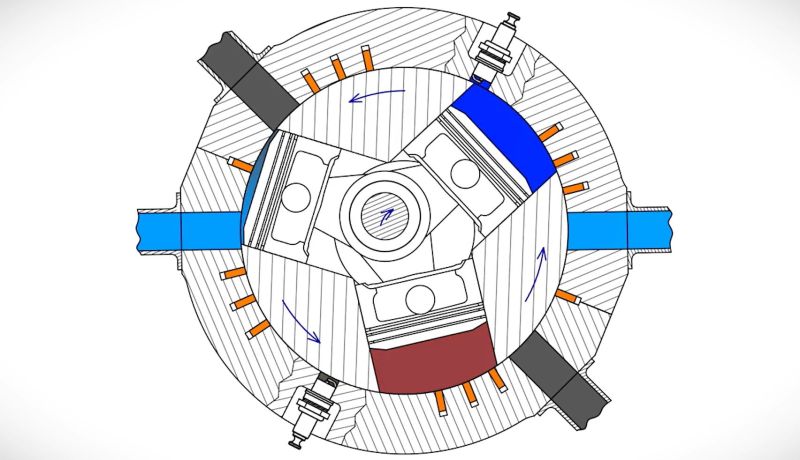
Everyone generally knows about piston and rotary engines, with many a flamewar having been waged over the pros and cons of each design. The “correct” answer is thus to combine both into a single engine design. The resulting birotary engine comes courtesy of Czech company [Knob Engines] which makes their special engine for the aviation market. The workings of this engine and why it makes perfect sense for smaller airplanes is explained by [driving 4 answers] in a recent video.
Naturally, it’s at best confusing to call an engine a “rotary”, as this covers many types of engines. One could consider the birotary engine perhaps a cross between the traditional rotary piston engines that powered early aircraft and the Wankel rotary engines that would appear much later. The fact that both the housing and the crankshaft rotate reinforces this notion of a piston rotary, while it keeps the fixed ports and glow plugs on the housing that is typical of a Wankel-style engine. Having both the housing and crankshaft rotate is also why it’s called the ‘birotary’.
The claimed benefits of this design include a small size, low vibrations, reduced gyroscopic effect due to counter-rotation, no apex seals, and less mechanically complex than a piston engine. This comes at the cost of a very short stroke length and thus the need for a relatively high RPM and slow transition between power output levels, but those disadvantages are why small airplanes and UAVs are being targeted.











It may have its uses, but some critique from just the drawing at the top:
Short connecting rods means large friction between piston and cylinder.
Friction between rotating cylinder block and casing.
Large areas for heat transfer between fluid chamber and casing.
And was the sealing issues inherited from wankels ever solved?
Yes, I find all the many alternative engines I have seen over the decades interesting, but they all eventually fall short of ‘pistons and poppets’.
Absolutely try other cycles (fex atkinson or miller), opposing pistons and ancillary systems. But the basic engine design comes back to the same.
I like the sandone rotary patented in 1963,has anyone ever made a working model?
He didn’t say a word about lubrication; the crankshaft and piston seals could use regular oil, like a four-stroke, but it seems the seals for the rotating part would require oil mixed into the fuel, like a two-stroke engine, with an the nasty emissions that causes. It would only be fair to compare it to other two-stroke engines, instead of the four-stroke 912, and I think those would get a significantly better power to weight ratio.
Also, the fuel efficiency isn’t just about internal friction, the short stroke and limited angle for the power stroke would probably make this engine less fuel efficient than the competition.
I would assume that any oil lubricating the crankshaft would be pooling up on the pistons and leak out through the piston rings as it gets spun around at a couple thousand RPM. It’s difficult to see how you even get oil flowing in and out of the crankcase. Some must go in, otherwise the whole thing would seize up, but how it comes out of a rotating part and back into the loop without leaking everywhere… maybe it is actually just dripping oil into the crank very slowly and allowing it to leak out through the piston rings.
The second issue is cooling. The rotating cylinder block cannot have water channels in it because again, how do you pump coolant in and out without having it leak everywhere? Since it’s rotating it cannot have a large surface area in contact with anything else, so it seems like the engine would simply overheat under load.
the rotating part could have oil seals on the faces or the outside circumference, just like crankshaft etc. have. Another issue is uneven heating and thus distortion, because like in a wankel the intake and combustion always happen in different places
There’s no perfect moving seal, so oil would end up in the combustion chamber, and fuel and exhaust particles would end up in the oil. To keep the oil from fouling and re-circulating soot into the engine, it makes sense it would simply leak the oil and let the engine burn it at a controlled rate.
no different than a regular piston engine, oil control rings are not perfect but pretty good, oil consumption is bad for emmisions
Thanks for the extensive and entertaining explanation. The first aircraft I flew had a König 3 cylinder 2-stroke engine. 24 kgs , 24 HP. So, in that respect, they did not gain much.
I could imagine though that this might be a good base for range extenders for EV (less and less important with every week) or an engine to power unmanned AV, which, sadly enough, is a booming market.
Let’s see what the future brings, but it is good to know that there is still some decent engineering being done in Europe.
I’m afraid you’re going to be seeing a lot more of those as the automakers are trying to get around the 2035 regulations deadline AND make cars that ordinary people can actually afford to buy. The problem is that nearly all the batteries and battery chemicals, and the electronics, come from China which is both a geopolitical and an economic dead-end. If the European automakers end up just re-packaging Chinese EV technology, they’ll be shoveling money out the door into the open hands of their own competition. Soon enough, no more European cars.
Then the battery itself costs half the price of the car, or more, for any model affordable to the people and not just the upper middle class. If you want the range, you need the battery, so the only way to keep any sort of profit margin is to make more expensive cars that most people can’t buy. The alternative would be to cut cost on everything else, which is impossible due to regulations – you can’t make your cars like 1970 anymore.
More than half the people can’t afford to buy new cars, or used EVs for that matter because the batteries are dead too soon. It’s not a trickle down deal where good new cars eventually pass down to the common people, because these vehicles simply don’t last the 10-30 years in use. They’re not even designed to.
So, to get you an “affordable EV” that meets the EU regulations of +90% fleet emission reduction after 2035, you have to cheat. You put in a small battery – as small and cheap as you can get away with – and pretend it’s an EV. Then you put in an option for a range extender. The car, as it officially comes out of the factory is an EV that gets no emissions on paper, and then all the owners get the range extender installed and run on gasoline or diesel for most of the time.
If the European politicians were wise, they would raise their hands up and go “Sorry, we were wrong, let’s try something else.” – and then try to figure out ways to make cheap clean fuels, like power-to-gas synthesis, which some people are already doing and getting ignored for it.
But politics is not about making the right choices that benefit everyone, or reduce harm – it’s about getting votes and saving face. The most successful democratic rulers, personal career and class-wise, are those who never solve the problems they set out to solve, yet always find ways to point the blame elsewhere and present themselves as the solution to that problem.
1) Ban gasoline vehicles and hydrocarbon fuels no matter the source
2) Lose the domestic auto industry to foreign competition
3) Install heavy tariffs and subsidies to keep the auto industry alive at a massive public cost
4) ???
5) Profit?
I’ll let the world’s most unblinking man explain it for me:
https://www.youtube.com/watch?v=GzvTt2xq8os
yes? who? at comparable conversion efficiencies like renewable energy into batteries into e-motor?
1) pretty sure there are exceptions for “special” vehicles (not to mention plenty of vehicles that do not drive on roads)
2) yeah, just keep subsidizing them while the cheat every new requirement (regarding cleaner combustion, efficiency and whatnot). /S
3) and if they did “Sorry, we were wrong, let’s try something else.” how would this change anything? The subsidize are already massive, yet they are falling behind and e-cars are on the rise no matter what.
You know, finite carbon fuel resources, finite land to waste on “green-fuel” plants, etc.
Porsche and the Fraunhofer Institute come to mind first. Efficiency is similar once you take into account the embedded energy of batteries (manufacturing costs), but lower efficiency isn’t the concern: price and availability without reliance on China is. You can make the fuel anywhere you have carbon dioxide, water and cheap energy – like surplus wind and solar power – this is direct synthesis, not biofuels.
1) They’ll have to come up with a lot more exemptions if they don’t want to make owning a car the preserve of the rich only. If the thing did go on as planned so far, the planners would get torches and pitchforks come 2035.
2) The cheating is the result of politicians demanding more than physics and economics will give you, and then leaving loopholes for the automakers to get away with not squeezing blood from a stone. They buy votes with big promises, realistic or not, and pay them by pointing fingers elsewhere for a distraction.
3) First of all it would save a lot of money from pretending to do the impossible. “e-cars” as in battery-electric vehicles have saturated their market segment already, and the segment is shrinking as governments are pulling back subsidies they can’t afford to keep paying.
And the subsidies for e-fuels and fuel cells and whatnot are not “massive”. They’re pretty much nothing, zero, compared to the amount of tax breaks and direct subsidies that BEVs get.
While you do have a point in places, 2nd hand EV are coming on the market at sane prices and just as likely to have a productive life as good or better than a similar vintage ICE powered vehicles – as those are not 1990 or earlier models any more that are simple to work on and practically can’t die if you put in some maintenance and EV battery are now pretty darn durable – the designs have gone a long way from the early stuff like the leaf who’s batteries are easy to cook…
If anything I’d bet on the sort of folks that really can’t afford it as you are claiming are the sort that will find the second hand EV lasts vastly better for them – as they are the sort that probably can’t do their own maintenance at all, and can’t afford the relatively expensive and continual stream of servicing of an ageing ICE requires. The EV practically doesn’t have service wear components in that way – its going to last for that 20 odd years the battery is still good enough for then need one big part replacement, at which point you probably just pick up another second hand EV instead. Still a way better value and expected lifespan compared to that stead trickle of parts, and the expensive labour to change them and keep that ICE alive a few more years you get to spend practically nothing till the battery dies.
Totaled Teslas getting refurbished.
https://ev-a2z.com/news/dead-teslas-gain-new-life-in-ukraines-emerging-industry/
Ukraine has fewer and lighter regulations on who’s allowed to repair them, with what qualifications and parts, and how you should insure them afterwards.
The scrap cars that come from northern Europe and the US are quite often just minor fender benders. They become “unfixable” because the insurance companies and the MOTs refuse to qualify and license them back on the road without “official” repairs by licensed shops using manufacturer approved parts, which the manufacturers refuse to sell to you at reasonable prices because they don’t want you fixing your car. No fix, only buy.
The fact that they are selling so low is also a problem. The difference between the first sale and the second sale is what the first owner pays, and if the EV depreciates in price quickly – and they do – that means they are unaffordable to more people. If they held their value better, a lot more people could afford to buy them new, and a lot more would end up on the second hand market. So far, the prices are “sane” because there’s no demand. People don’t want them.
The reason why they depreciate so fast is that nobody wants to buy a car that may require a total battery system overhaul in just few short years, and which is full of electronic gadgets and computer systems that are totally obsolete by the time you get it. As if you wanted to pay anything for a 10 year old iPhone, even if the battery was somehow still fine. If you’re looking for a car at a price point at or under 10k on the second hand market, you won’t look for a car which may cost you another 10k or more soon after. It’s a very high risk to spend all your savings on, because you may not be able to afford to keep it.
I dunno, I have 5 years second use on a 10 year old salvage volt pack
What does that mean? Is it 10 years old now, or when you got it?
The Volt was exceptional among EVs on the fact that they put almost twice as much battery in than they would allow the car to use – to maximize the lifespan. That means the user won’t notice even if the capacity goes down by a significant amount, keeping it functional for longer. It also means that when the battery does go past the “knee point” in wear where the capacity loss accelerates rapidly, the death of the battery will come as a surprise to the user.
The Volt is also a series/parallel hybrid that can bypass the electric system on the highway, so it doesn’t use the battery as heavily as a proper EV.
Not always a big gap between the sale prices, at least by car depreciation standards, and pretty much if not all the big gaps in resale value are at the high end luxury stuff just like it is for ICE vehicles too.
And your 10 year old iPhone argument applies just as much if not more to the ICE stuff these days – full of computerised and obsolete crap, that is likely unobtainium when you need a spare too… If anything I’d bet on the EV being more likely to actually be capable of upgrade/repair to the computerised stuff and its software than the ICE!
Which is what EVs by and large are. They’re aimed at the upper end of the market, because the price vs. value of a very basic EV with no frills, and a battery the size and price that the median wage earner could afford, would be absolute and utter crap.
For example, in the UK the median selling price of a car is around £16-17k new or second hand. Not £37k as the EV makers would like to demand. Almost nobody will buy a new EV and even fewer will buy a second hand EV because it’s not gonna last.
The only people who are actually buying these things as a market are the Norwegians who are swimming in oil and gas money by pumping oil out of the sea.
At least you can still buy basic models for not a lot of money. Brands like Dacia, Skoda, come to mind. Where’s the Skoda of electric cars?
I’ll answer myself: it is actually the Dacia Spring, starting at only £15k it features a 0-60 acceleration of 19 seconds with a massive 45 HP motor, a range of 140 miles in fair conditions, and for an extra thousand pounds you can upgrade the motor to 65 HP albeit at a loss of top range. One star Euro NCAP crash rating as well.
What a great deal. Much better than the Dacia Sandero, which for the same price will give you a 90 HP petrol engine in an actual car.
Really not true at all, all the exclusively electric only manufacturers might well be aimed at the upper market, for good reason no doubt. But the working vehicle and comparably basic aimed at pretty much everyone that actually buys new vehicles at all EV have existed for some time now, often in the exact same body shell and a great deal of parts overlap outside the power train between electric and ICE, usually for much less than 10K premium for the electric…
You have a huge range of stuff in that middle of the road not crazy premium bracket of 20K to maybe around 30K. Which is where even pretty basic normal spec ICE powered things are today like the Ford and your Skoda cars are all priced – seriously the cheapest new skoda is 26K with their cheapest electric being about 6k more than that!!! And plenty of cheaper EV options out there very comparable to that 26K skoda….
And while they might not all be good for everyone, as some folks really do pack on the miles often they are all in the 200 odd mile stated range or better, that is for 99% of people going to cover getting there and back again all darn week, with maybe one or two trips in a year that will make them visit a charging station (if they home/work charging potential).
I believe this engine would be a great setup for a hybrid vehicle. I know Mazda is currently working on a rotary engine hybrid. You could run this engine at its most efficient RPM and only use this engine to run a generator to charge the batteries not to “drive” the car.
Was going to say the exact same thing. Pair this with a Plug in Hybrid version, kinda like the Volt. That the engine is efficient only at a specific RPM wouldn’t be a problem as power generation can be tailored for that.
I would love to watch the video but the guy is unwatchable. made it till 1:25 than had to bail out.
I did not watch the video, because i think video is a horrible way to receive this kind of information, and because the video’s header page seems to indicate a low quality. So i’m disappointed that the write up didn’t really answer any of my questions. This doesn’t look Wenkel at all. It just looks like a rotating radial piston engine “rotary engine”. That’s been done. What makes this birotary instead?
There are also links in the summary article that you can click with more information.
You’re welcome.
I’m saying straight up that the summary that it’s halfway between a piston engine and a wenkel engine is wrong but that gee a summary would have been appreciated
Light weight revvy engine requires heavy gearbox to work with real word propellers…
Also: Airplane engines are mostly built to be reliable.
The engine having counterrotating masses is pointless.
If you have a gearbox, you turn the prop the opposite direction from the engine rotating assembly.
I suggest watch the video before commenting.
There might not be any advantage now for you to do that, but to my novice mind I think many of those are addressed in what he said
From the article…
“…One could consider the birotary engine perhaps a cross between the traditional ROTARY piston engines that powered early aircraft …”
I’m certain you meant to say “…traditional RADIAL piston engines…”.
Your keyword here is “traditional”.
All ‘traditional’ commercial and military aircraft after WW1 used either radial or inline ICE prime movers until the wholesale adoption of the turbine (jet) engine (the inline ICE is still used, of course, in low-cost general aviation airframes).
There was a rotary aircraft engine developed in the first years of the 20th century (with a rotating crankcase, of course), but its long litany of inherent problems rendered it ‘dead and gone’ (in favor of the ‘radial’) after about 1925.
The wanlel rotary argument always ends with “if it is so much better, why is no major manufacturer adopting them.”